An equity carve-out is an initial public offering (IPO) of part of the equity in a parent company’s subsidiary. The parent can keep control after the subsidiary starts trading. For an analyst, the IPO changes who has a claim on the subsidiary’s earnings and may change where cash sits in the group. Lamont and Thaler, §I · Kenvue IPO prospectus, cover and Use of Proceeds
Who gets the USD 200?
Suppose a fictional parent owns all 100 shares of a subsidiary, with one vote and equal economic rights per share. In the IPO the parent sells 25 existing shares at USD 8 each. The parent receives USD 200 before fees and taxes. The subsidiary receives zero from that sale. The parent keeps and retains control in this example.
If the subsidiary instead issues 25 new shares at USD 8 each, it receives the USD 200 gross. The parent still owns 100 shares, now out of 125, so its stake falls to . An offering can combine both types of sale. Read the prospectus cover for who sells each block of shares and Use of Proceeds for where the issuer’s cash goes next. SEC investor bulletin, Selling shareholders
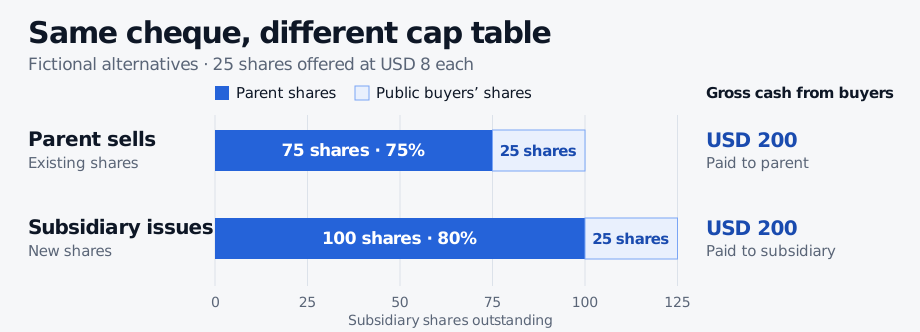
The bars share a common scale. Selling existing shares divides the original 100 shares between the parent and the buyers. Issuing new shares extends the total to 125.
Listing and giving up control can happen months apart
In a spin-off, the parent delivers subsidiary shares pro rata to its existing shareholders. The distribution itself raises no cash from those holders. If the parent distributes its entire stake and retains no control rights, it gives up control. A split-off instead delivers subsidiary shares to participating parent shareholders in exchange for the parent shares they tender. Either type of distribution can follow a carve-out as a separate step, subject to its own closing conditions. GE and GE Vernova distribution agreement, §5.01 · Kenvue IPO prospectus, The Distribution
Kenvue’s 2023 carve-out shows both distinctions. Kenvue issued new shares, and its IPO prospectus specified that the net proceeds would go to Johnson & Johnson as part of the payment for the consumer health business. Johnson & Johnson retained control at the IPO and stopped consolidating Kenvue after a separate exchange offer in August, even though it still held some Kenvue shares. Kenvue IPO prospectus, Use of Proceeds · Johnson & Johnson Form 10-K, Note 21
For a parent that reports under IFRS 10 and continues to control the subsidiary, the ownership change is an equity transaction in the consolidated accounts. The group still includes the subsidiary’s results and attributes the outside shareholders’ portion of profit to non-controlling interests. Once the parent loses control, it stops consolidating and generally measures any retained stake at fair value at that date. IFRS 10, paragraphs 20–25 and B94–B98
The SelfMadeQuant lesson on equities, indices and corporate actions covers how data vendors adjust the parent’s return series when shareholders receive shares in a spin-off. The full lesson requires membership.