In a stock purchase, the buyer acquires shares from the target’s shareholders. Buying all the common stock of a company with a single share class gives the buyer ownership of the company. The target still owns its assets and owes its liabilities. In an asset purchase, the buyer acquires specified assets from the selling company and takes on the obligations allocated to it under the agreement and applicable law. An acquisition model starts with those rights and obligations because they determine which cash flows the buyer acquires. Either structure can use cash or the buyer’s shares as payment. Big Fish Games stock purchase agreement, § 2.1, Micron Optics asset purchase agreement, §§ 2.1–2.4, IFRS 3, B5–B6
Reconciling the two prices
Suppose a fictional target has assets worth USD 100 million and liabilities worth USD 30 million. Common shareholders own the entire residual after those liabilities, and there are no other claims. Both bids use the same values at closing and ignore fees, taxes and synergies.
The stock buyer pays USD 70 million for the shares. The asset buyer can match that net value by acquiring the same USD 100 million of assets, assuming the full USD 30 million of liabilities and paying USD 70 million in cash to the selling company. The two bids match on this pre-tax valuation because they cover the same assets and obligations. The asset buyer’s assumed obligations explain the difference between the cash payment and the gross asset value. When moving between enterprise value and equity value, use the relevant financing claims and non-operating assets. An operating payable already reflected in forecast working capital stays in those cash flows. Damodaran, Working Capital in Valuation
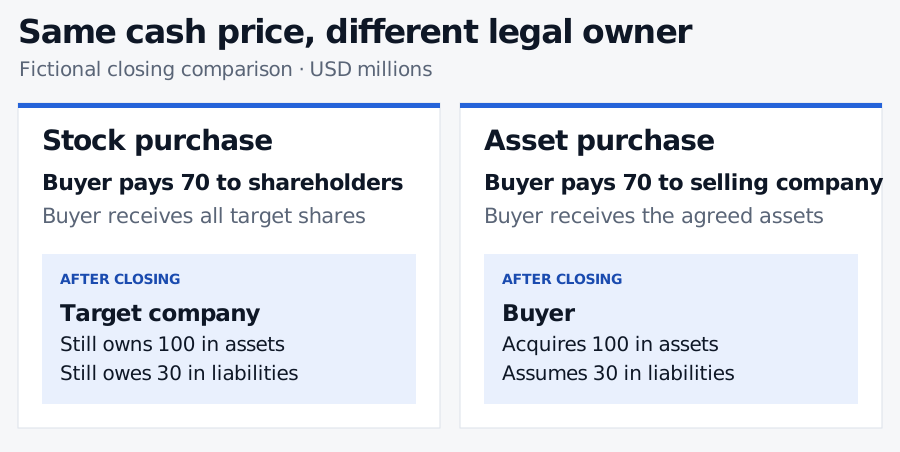
The same cash amount goes to different parties. The target remains the obligor in the stock purchase, while the buyer assumes the liabilities in the asset purchase.
What the agreements actually transfer
Aristocrat’s agreement to buy Big Fish Games identifies all the target shares as the property to be delivered. Luna Technologies’ agreement to buy assets from Micron Optics lists the purchased assets and the obligations Luna assumes, including some customer warranties. Micron Optics keeps its cash and certain corporate records. It also provides a way to share the benefits and costs of certain contracts while waiting for consent to transfer them. Big Fish Games stock purchase agreement, recitals and § 2.1, Micron Optics asset purchase agreement, §§ 2.1–2.4 and 2.9
A customer agreement can require consent to assignment in an asset purchase or impose a separate condition if the customer’s counterparty changes ownership in a stock purchase. A missing consent can affect whether the buyer can count on that revenue at closing. Liability exclusions allocate obligations between buyer and seller, while applicable law can still give third parties claims against an asset buyer under successor-liability rules. U.S. bankruptcy sales under Section 363 have a separate process that can permit sales free and clear of interests in the property under specified conditions. Big Fish Games stock purchase agreement, § 3.3, Blendtec v. BlendJet, pp. 9–11, 11 U.S.C. § 363(b), (f)
Tax basis and acquisition accounting
For U.S. federal income tax, the buyer in an ordinary taxable stock purchase generally takes a cost basis in the shares and the target generally keeps its existing bases in its assets. In a taxable purchase of business assets, allocation of the price establishes the buyer’s basis in the acquired assets and affects the seller’s gain or loss by asset. That allocation can change future depreciation or amortisation deductions. A Section 338 election can treat a qualifying corporate stock purchase as a deemed asset sale and repurchase for federal income tax. 26 U.S.C. § 1012, IRS, Sale of a business, IRS, Instructions for Form 8023
Under IFRS 3, the accounting question is whether the buyer obtains control of a business. Acquiring a set of assets and activities that meets the business definition can be a business combination even when the contract is an asset purchase agreement. A set that fails the definition is accounted for as an asset acquisition without goodwill. That classification determines whether the business-combination rules for purchase price allocation apply. IFRS 3, paragraphs 2–3 and B5–B12D
For the common shareholder’s residual claim in the price bridge, see the SelfMadeQuant finance primer’s Equities lesson. The preview is public and the full lesson requires membership.
Sources
- Big Fish Games stock purchase agreement, 2017
- Micron Optics asset purchase agreement, 2018
- U.S. District Court for the District of Utah, Blendtec v. BlendJet, 2025
- 11 U.S.C. § 363, Use, sale, or lease of property
- IRS, Sale of a business
- 26 U.S.C. § 1012, Basis of property
- IRS, Instructions for Form 8023
- Aswath Damodaran, Working Capital in Valuation
- IFRS Foundation, IFRS 3 Business Combinations