Eight outcomes, no relationship between the numerators
Define and . Conditioning on the denominator makes the mechanism visible:
| Denominator | Probability of this denominator | Possible values of each ratio | Mean of each ratio within this group | Within-group correlation |
|---|---|---|---|---|
| 1 or 3 | 2 | 0 | ||
| 2 or 6 | 4 | 0 |
Within either group, the ratios remain independent. Pool the groups, however, and a small denominator raises both ratios together. The pooled means are both 3. Direct probability-weighted calculation gives
The numerators have correlation zero. Nothing about their relationship changed; the shared scaling introduced another source of co-movement.
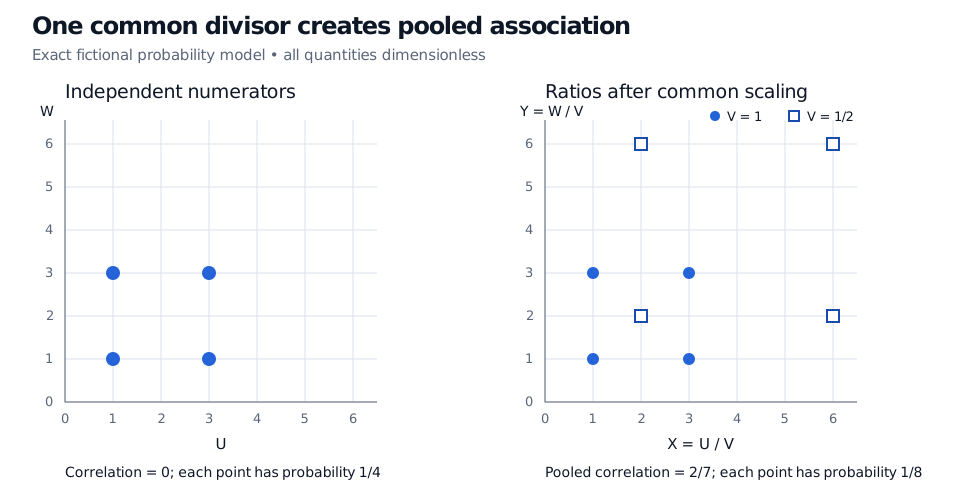
These are all outcomes of a stipulated distribution, rather than eight independently sampled firms or dates. The coefficient is a population calculation under that model, with no significance test or empirical discovery attached.
The common multiplier is the source
Write , so and . Assume , and are mutually independent, all have finite second moments, and the two ratios have positive variance. Here must be nonzero with probability one; finite moments of alone would not guarantee finite moments of its reciprocal.
For the example, the numerator means are both 2 and , producing covariance 1. The variance calculation is
This identity describes an independent-variable benchmark, not a universal formula for financial ratios. In actual company data, profit, investment and assets need not be independent. Their joint economic relationships can strengthen, weaken or reverse the association. Even under the benchmark, opposite-sign numerator means give negative covariance; a common denominator does not imply positive correlation in every setting.
Audit the interpretation before changing the variables
A useful investigation starts by retaining the two numerators and the denominator in the dataset, rather than retaining only the ratios.
- Specify the question. A relationship between profit and investment is different from a relationship between their intensities per unit of assets. Ratios can be economically meaningful outcomes in their own right.
- Inspect the scaling. Plot each numerator against the denominator and examine the ratios by denominator range. Very small or mismeasured denominators deserve attention because division can magnify their effects.
- Write down the model before normalising. If the model in levels is , dividing it by gives . An ordinary constant in a regression of on does not generally replace the term . Scaling also changes the error structure. Bartlett and Partnoy develop these specification and denominator-measurement concerns for ratio outcomes.
There is no automatic cure in “control for size”: a single linear denominator term may miss reciprocal or interaction terms required by the economic model. Likewise, the fact that conditioning removes association in the fictional example does not establish a causal adjustment strategy for real data.
Sources
- Ji-Hyun Kim (1999), “Spurious correlation between ratios with a common divisor”, Statistics & Probability Letters 44(4), 383–386. Publisher abstract, introduction, theorem preview and discussion: the exact independent-variable benchmark and the interpretation of mechanically induced association. The finite model, derivation presentation and figure here are original.
- Robert Bartlett and Frank Partnoy (September 2020), The Ratio Problem, introduction, §2.1 and §3.2: ratio outcomes, omitted reciprocal/scaled terms and denominator measurement error. These are broader regression concerns; they do not imply that every ratio is an invalid economic construct.