Sell-side research is analysis that brokers and investment banks produce for investor clients. An equity report may forecast a company's earnings, explain how the analyst values its shares and give a rating or price target. A portfolio manager can use the report to challenge their own assumptions. A quant can use changes in forecasts, targets or ratings as distinct signals, provided each observation is dated to when the strategy could actually see it. Baird’s equity research disclosures and Morgan Stanley’s general research disclosures
A lower target can still imply upside
Suppose a fictional stock trades at USD 100 just before and after a research update. The analyst cuts the forecast for earnings per share for a specified fiscal period from USD 11 to USD 10.50. Keeping the price-to-earnings multiple at 10 times that forecast, the analyst cuts the 12-month price target from USD 110 to USD 105. The earnings estimate is a forecast. Multiplying it by 10 is the valuation method. USD 105 is the revised target produced by that method.
Against the same starting market price, the target-implied price change falls from 10% to 5%. The calculation for the revised target excludes dividends.
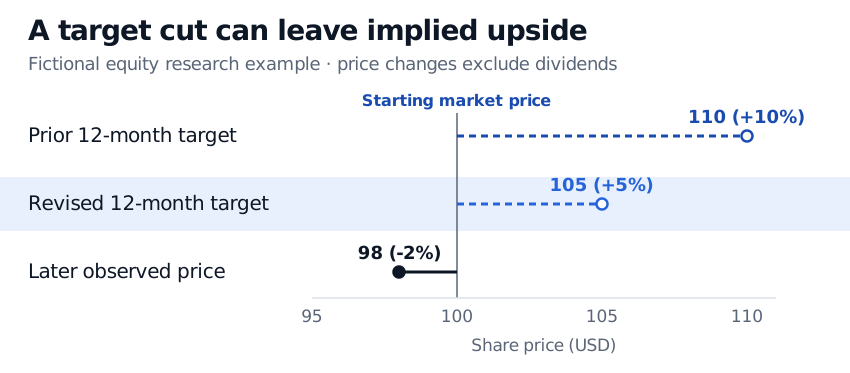
Dashed lines compare each target with the same market price. The solid line shows a fictional outcome for the revised report’s horizon.
If the stock ends the revised report’s 12-month horizon at USD 98, its realised price return from USD 100 is −2%. The target-implied +5% was calculated at the time of the update. Any dividends received would also enter the realised total return.
A rating is the broker’s recommendation under its own definitions. The target cut alone does not determine whether the rating changes. For example, Baird’s Outperform rating refers to risk-adjusted total return relative to the broad US equity market over 12 months. The 5% price gap alone gives neither the stock’s expected total return nor the relevant market comparison. Baird’s equity research disclosures
Which version could the strategy see?
A broker may distribute research through a client portal and make some products available through data vendors. If an update carries a Monday report date but your strategy’s feed first delivers it after Monday’s close, using the revised target at that close introduces look-ahead bias. Keep each version and its first usable timestamp. A revision signal needs the previous and new targets from the same broker and product, on comparable price and horizon bases. A test of target accuracy then needs a separately observed price at the stated horizon. Morgan Stanley’s general research disclosures
For US equity research within its scope, FINRA Rule 2241 requires member firms to maintain procedures designed to prevent early selective distribution of a report ahead of other clients entitled to receive it. Firms can offer genuinely different products, such as short-term trading research and longer-term investment research, under the rule’s conditions. A public headline and a client research feed can therefore represent different information sets. FINRA Rule 2241, paragraph (g) and supplementary material .07
Read the disclosures alongside the thesis
A broker may also underwrite an offering for the company it covers or make a market in its shares. These relationships matter when assessing how independent the research is. Within the scope of FINRA Rule 2241, member firms must disclose specified conflicts, including relevant investment banking relationships and whether the firm makes a market in the covered security at distribution. The rule also calls for procedures to support a reasonable basis for the recommendation or target and explain the valuation method and risks. The disclosures describe the business relationship. Forecast accuracy is a separate question you can test against outcomes. FINRA Rule 2241, paragraphs (b) and (c)
The SelfMadeQuant lesson Evaluating Security Analysis and Forecasting Skill works through tests of analyst earnings forecasts against actuals and simple benchmarks. The full lesson requires membership and has a public preview.
Sources
- FINRA. Rule 2241, Research Analysts and Research Reports. Current rulebook text, paragraphs (b), (c) and (g) and supplementary material .07. Checked 8 November 2026.
- Baird. Equity Research Disclosures. Investment rating definitions, target horizon and valuation methods. Checked 8 November 2026.
- Morgan Stanley. General Research Disclosures. Equity rating definitions, target horizons and client and vendor distribution. Checked 8 November 2026.