In a cash securitization, an originator transfers a pool of loans or receivables to a vehicle that funds the purchase by issuing asset-backed securities. Derecognition removes an asset, or a qualifying portion, from the reporting entity’s balance sheet. For a credit analyst, the cash raised is only one piece of the transaction. The originator may still report the loans and related debt, or it may remove the loans while keeping a claim or guarantee exposed to losses. Seller-side receivables factoring addresses a similar sale-versus-borrowing question when a business turns invoices into cash through a factor. Securitization adds an issuing vehicle and investor claims on the pool. IFRS 9, §3.2, FASB ASU 2009-16, ASC 860-10-55-20
Establish the group before testing the transfer
Consolidation comes first. IFRS 9 applies the transfer test to the group after applying IFRS 10. Under IFRS 10, control requires power over the vehicle, exposure or rights to variable returns, and the ability to use that power to affect those returns. U.S. GAAP likewise assesses consolidation before the ASC 860 transfer test. For a variable interest entity under ASC 810, the primary beneficiary has both the power to direct the activities that most significantly affect the vehicle’s economic performance and a potentially significant obligation to absorb its losses or right to receive its benefits. When the originator consolidates the vehicle, the internal transfer is eliminated in the group accounts. The loans remain within the group, and securities issued to outside investors may appear as group debt. IFRS 9, ¶3.2.1, IFRS 10, ¶7, B51–B54 and B86(c), FASB ASU 2015-02, ASC 810-10-25-38A, FASB ASU 2014-11, ASC 860-10-40-4
IFRS 9. Establish whether the contractual cash-flow rights were transferred or a qualifying pass-through arrangement exists. Compare exposure to variability in the amount and timing of cash flows before and after the transfer. If substantially all risks and rewards pass to the transferee, remove the asset. If the transferor keeps substantially all, keep the asset in full and recognise a liability for the consideration received. In between, ask whether the transferee can in practice sell the entire transferred asset unilaterally to an unrelated party without additional restrictions. If so, derecognise and account separately for rights and obligations retained or created. If the transferor retains control, keep recognising the asset to the extent of its continuing involvement, with an associated liability. IFRS 9, ¶¶3.2.3–3.2.9 and 3.2.15–3.2.17
U.S. GAAP, ASC 860. For a transfer outside the group of a whole asset, a pool of whole assets or a qualifying participating interest, sale accounting requires three conditions. The assets are legally isolated from the transferor and its creditors, including in bankruptcy or receivership. The relevant transferees, or the third-party beneficial interest holders in some securitizations, can pledge or exchange their assets or interests without a restriction that also gives the transferor more than a trivial benefit. The transferor surrenders effective control, which certain repurchase terms can preserve. A transfer that fails the sale test is accounted for as a secured borrowing. FASB ASU 2014-11, ASC 860-10-40-4–5, FASB ASU 2009-16, ASC 860-30-25-2
Two transfers that raise 92
A fictional originator carries a loan pool at 100 and raises 92 in cash, both in reporting-currency units. In the first case, assume a transfer of the whole pool qualifies for derecognition and the originator obtains a new retained beneficial interest with a fair value of 8. Assume no fees, separate servicing balances or other adjustments. Remove the pool of 100 and recognise cash of 92 and the new interest of 8. The day-one gain is . IFRS 9, ¶¶3.2.11–3.2.12, FASB ASU 2009-16, ASC 860-20-25-1 and 860-20-30-1
In the second case, assume the transfer fails derecognition and is accounted for as a simple secured borrowing. The pool stays at 100. The originator records cash of 92 and a new secured borrowing of 92. In this comparison, the borrowing adds 92 of gross debt and 92 of gross assets relative to the sale. Day-one net assets from these balances are 100 either way. IFRS 9, ¶3.2.15, FASB ASU 2009-16, ASC 860-30-25-2
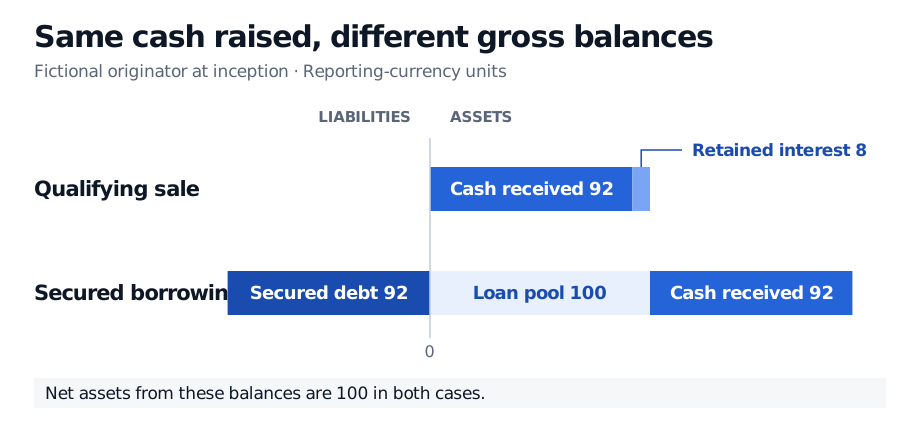
The bars use a common scale and place liabilities to the left of zero. The secured borrowing leaves a larger balance sheet even though the cash raised is the same.
The 8 measures the fair value of the new claim. To assess the credit risk the originator kept, follow the loss allocation and any guarantee terms. A first-loss tranche can absorb losses before senior investors take any, and a separate guarantee may require cash payments. The rights and obligations determine both the economic exposure and the transfer analysis. For instance, IFRS 9 illustrates a subordinated retained interest that results in continued recognition to the extent of continuing involvement. A qualifying transfer of part of a larger asset can instead require allocating the original carrying amount by relative fair values. IFRS 9, ¶¶3.2.13–3.2.17 and B3.2.16–B3.2.17
The SelfMadeQuant lesson works through loss priority and payment triggers in non-agency MBS and ABS. The preview is public and the full lesson requires membership. Non-Agency MBS, ABS, and the Securitization Waterfall
Where to look for retained exposure
Read the consolidation and transfer notes alongside gross borrowings when assessing leverage. Upstart’s June 2026 Form 10-Q gives both presentations. Its consolidated securitization includes loans and amounts payable to outside noteholders. For its unconsolidated deals, it reports that it recognises a sale gain or loss when the transfer meets the sale criteria, and it reports retained beneficial interests separately. Where IFRS 7’s continuing-involvement disclosures apply, compare the carrying amounts and fair values of retained rights and obligations with the disclosed maximum exposure to loss and potential cash outflows. Losses can erode a first-loss investment, while a guarantee or repurchase commitment can require a separate cash payment. Upstart Holdings, June 2026 Form 10-Q, Note 3, IFRS 7, ¶¶42D–42E
Sources
- IFRS Foundation, IFRS 9 Financial Instruments, 2026 issued text, section 3.2 and application guidance B3.2.
- IFRS Foundation, IFRS 10 Consolidated Financial Statements, 2026 issued text, paragraph 7, B51–B54 and B86(c).
- IFRS Foundation, IFRS 7 Financial Instruments Disclosures, 2026 issued text, paragraphs 42D–42E.
- FASB ASU 2014-11, amendments to the transfer conditions in ASC 860-10-40.
- FASB ASU 2009-16, amendments to the securitization example, sale recognition, initial measurement and secured borrowing in ASC 860-10, 860-20 and 860-30.
- FASB ASU 2015-02, amendments to ASC 810-10-25-38A on the primary beneficiary of a variable interest entity.
- Upstart Holdings, Form 10-Q for the quarter ended 30 June 2026, Note 3.