A variable interest entity (VIE) is a legal entity that falls under the variable interest consolidation model in U.S. GAAP because of how it is funded or how decision rights, losses and returns are allocated. Its primary beneficiary consolidates it, even when that party holds less than a majority of the voting equity. For a credit analyst, that decision determines whether the vehicle’s loans and outside funding are included in the group’s reported assets and liabilities. FASB ASU 2015-02, ASC 810-10-15-14 and 810-10-25-38 through 38A
Identify the entity before identifying its primary beneficiary
ASC 810 first asks whether the VIE guidance applies and whether the reporting company holds a variable interest. This is an ownership, contractual or other financial interest that absorbs or receives some of the variability the entity is designed to pass to interest holders. A first-loss tranche in a securitization is one example. Subject to the scope rules, an entity is a VIE if at least one of these conditions applies. FASB ASU 2015-02, ASC 810-10-05-6, 810-10-15-14 and 810-10-25-52, FASB, May 2026 Public Markets Advisory Committee materials, pp. 43–45
- The equity at risk is too small to finance the entity’s activities without additional subordinated financial support.
- The at-risk equity holders as a group lack at least one of the usual attributes of control through their equity interests. Those are decision-making power over the most significant activities, the obligation to absorb expected losses and the right to expected residual returns.
- Some investors’ votes are out of proportion to their loss exposure or residual returns, and substantially all activities involve or are carried out on behalf of an investor with disproportionately few votes.
Once the entity is classified as a VIE, assess the reporting company’s power and economics. Power means the ability to direct the activities with the greatest effect on the VIE’s economic performance. If decisions about troubled loans drive that performance, a contractual right to decide workouts can matter even before any loans default. Economics means an obligation to absorb losses or a right to receive benefits that could be significant to the VIE itself. Either side of the economic exposure can satisfy that criterion. The primary beneficiary meets both the power and economics criteria. FASB ASU 2015-02, ASC 810-10-25-38A–38B
Three separate loan vehicles
Assume each fictional vehicle is an in-scope VIE, each party being assessed holds a variable interest, and no shared power or related-party issues alter the analysis. In all three cases, decisions about loan workouts are the most significant activity.
- A holds a first-loss tranche whose exposure could be significant to its vehicle. Another party directs workouts.
- B can direct workouts and has a guarantee that could require it to absorb significant losses of its vehicle.
- C can direct workouts. Its only economic interest is a residual position whose potential losses and benefits are both stipulated to be insignificant to its vehicle.
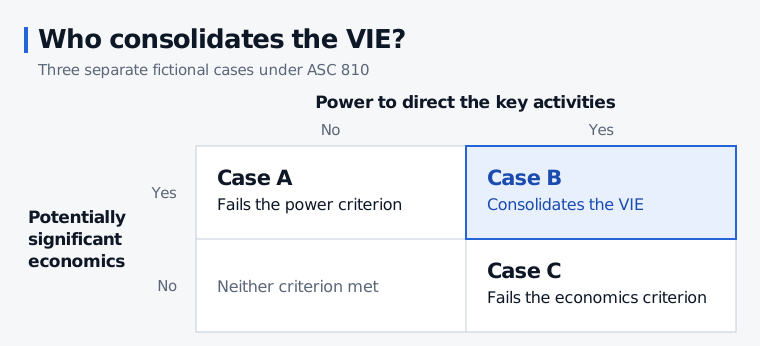
Power and economics are assessed separately. Only the upper-right cell satisfies both criteria.
The SelfMadeQuant lesson traces how a first-loss tranche absorbs credit losses before senior investors are affected. The preview is public and the full lesson requires membership. Non-Agency MBS, ABS, and the Securitization Waterfall
Find the exposure in the filing
In its September 2026 Form 10-Q, JPMorgan Chase identifies itself as the primary beneficiary of Chase Issuance Trust. Its VIE note shows third-party loans and liabilities within its consolidated balances and describes which claims generally lack recourse to JPMorgan Chase’s general credit. The same note separately reports retained interests in unconsolidated securitization vehicles. When comparing leverage, read the recourse terms alongside the reported debt and check for guarantees and retained interests in vehicles outside the group. For a transfer to a vehicle outside the group, securitization and derecognition covers the separate test for removing the loans. JPMorgan Chase, September 2026 Form 10-Q, Note 13
Sources
- FASB ASU 2015-02, Consolidation (Topic 810), amendments and reproduced text for ASC 810-10-05-6, 810-10-15-14, 810-10-25-38 through 38B and 810-10-25-52.
- FASB, May 2026 Public Markets Advisory Committee materials, pp. 42–46, summary of the existing consolidation models and research project.
- JPMorgan Chase, Form 10-Q for the quarter ended 30 September 2026, Note 13 and consolidated balance-sheet footnote (a).