Receivables factoring is a seller’s arrangement to turn unpaid customer invoices into cash before they fall due, typically by transferring them to a factor. Buyer-led supply-chain finance, often called reverse factoring, is a programme in which a finance provider offers to pay a buyer’s suppliers and the buyer settles with the provider on the agreed date. The programme can give the supplier earlier payment, the buyer longer terms, or both. Both change when cash moves. The seller’s entries show whether it still carries the invoice and owes a borrowing. The buyer’s disclosures show whether the programme extends its payment cycle or changes the nature of what it owes. FASB, Topic 860 implementation guidance, IAS 7, paragraphs 44F–44G
Seller factoring can produce a sale or a borrowing
A factor may charge a fee or pay a discounted price. Some agreements also hold back part of the proceeds until the customer pays. Recourse means the factor can turn back to the seller for specified shortfalls. Read what triggers it. A promise to cover customer defaults can leave the seller with much of the original credit exposure. A promise that an invoice is valid or that the goods were delivered addresses a different risk. Guarantees, repurchase terms and retained interests all matter to the accounting. IFRS 9, paragraphs 3.2.6–3.2.9 and B3.2.4–B3.2.5, FASB, Topic 860 transfer guidance
Consider a fictional supplier with a receivable carried at 100 in reporting-currency units. It receives 97 in cash today. Compare two stipulated transactions at inception. The first qualifies as a full sale with no retained rights, obligations or other consideration. The second is a simple secured borrowing for which derecognition fails. Ignore separate fees and subsequent interest.
| At inception | Qualifying full sale | Secured borrowing |
|---|---|---|
| Increase in cash | 97 | 97 |
| Receivable remaining on seller’s balance sheet | 0 | 100 |
| New borrowing liability | 0 | 97 |
| Immediate loss on transfer | 3 | 0 |
On sale, the supplier removes the carrying amount and records a loss of . On borrowing, the cash and new debt offset each other in net assets, and the customer invoice stays on the books. If a receivable remains recognised and is subject to impairment, its expected credit loss allowance estimates collection shortfalls. The sale loss in this example compares proceeds with the receivable’s carrying amount. A securitisation adds an issuance structure that funds assets with claims sold to investors. It raises its own consolidation and transfer questions. IFRS 9, paragraphs 3.2.12, 3.2.15 and 5.5.15, SEC, Regulation AB interpretation 301.04
How the seller’s accounting tests differ
- IFRS 9. Establish whether the rights to cash flows were transferred or a qualifying pass-through exists. Then assess who bears the variability in the amount and timing of cash flows. Transfer substantially all the risks and rewards and the asset is derecognised. Retain substantially all and it stays recognised. In between, control determines whether to derecognise the asset or keep recognising it to the extent of continuing involvement. A guarantee covering likely credit losses on short-term receivables is an example of retaining substantially all risks and rewards. IFRS 9, paragraphs 3.2.3–3.2.9, 3.2.15–3.2.16 and B3.2.5
- U.S. GAAP, ASC 860. For a transfer of an entire receivable, a group of entire receivables or a qualifying participating interest outside the consolidated group, sale accounting requires all three conditions. The receivables must be legally isolated from the seller and its creditors, including in bankruptcy or receivership. The transferee must be able to pledge or exchange the assets without a constraint that gives the seller more than a trivial benefit. The seller must surrender effective control, which can be retained through certain repurchase terms. The legal effect of the agreement in the relevant jurisdiction matters even where the factor assumes customer default risk. FASB ASU 2014-11, ASC 860-10-40-4 through 40-5
Reverse factoring starts with the buyer’s invoice approval
A buyer sets up the programme with a finance provider and confirms eligible invoices. A participating supplier can request early payment from the provider, often at a discount. The buyer pays the provider on the programme’s settlement date. A supplier can be paid early even if the buyer’s payment date stays at the original due date. The example below shows a programme that also extends the buyer’s terms. IAS 7, paragraph 44G, FASB ASU 2022-04, ASC 405-50-15
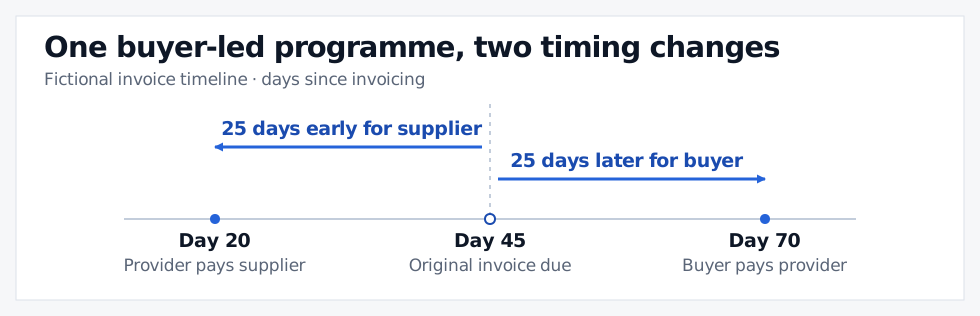
Both timing changes are measured from the original invoice due date. The provider funds the interval between its payment to the supplier and settlement by the buyer.
Under IFRS 9, the buyer assesses whether the original payable has been extinguished and whether it now owes a new liability to the finance provider. The nature of the liability then informs where it is reported and how the cash settlement is classified. The IFRS Interpretations Committee’s 2020 agenda decision points to factors such as extra security and differences in payment terms. Where settlement is payment of a borrowing, the buyer classifies that cash outflow as financing. If the provider’s payment creates a financing liability without cash moving through the buyer, the buyer discloses the non-cash financing transaction separately from its cash flow statement. The agenda decision cites IAS 1 for balance-sheet presentation. IFRS 18 replaces IAS 1 for annual periods beginning on or after 1 January 2027, with early application permitted. IFRS Interpretations Committee, December 2020, IFRS 18 overview
| Buyer disclosures | What to look for |
|---|---|
| IFRS, IAS 7 and IFRS 7. The supplier finance amendments apply to annual periods beginning on or after 1 January 2024. | Key terms, opening and closing carrying amounts and their balance-sheet lines, the portion for which suppliers have already been paid, due-date ranges versus comparable trade payables outside the programme, and the type and effect of non-cash changes. IFRS 7 also addresses the arrangements in the context of liquidity risk. IAS 7, paragraphs 44F–44H and 62, IFRS 7, paragraph 39 and B11F(j) |
| U.S. GAAP, ASC 405-50. The disclosure rule applies to fiscal years beginning after 15 December 2022, with the annual rollforward effective for fiscal years beginning after 15 December 2023. | Key terms, confirmed obligations outstanding, their balance-sheet location and the annual rollforward. The interim disclosure is the amount of confirmed obligations outstanding. ASC 405-50 covers buyer programmes where suppliers can request early payment against confirmed invoices. Recognition, measurement and presentation follow other applicable guidance. FASB ASU 2022-04, ASC 405-50-10, 50 and 65 |
Longer buyer terms can make the reported cash conversion cycle look shorter even when the underlying purchase and sales cycles are unchanged. Compare the programme’s due dates and balances with ordinary supplier terms. If the facts support treating part of the programme as debt in an analytical model, remove that same amount from operating payables so it is counted once. Use period movements and actual settlements when analysing cash flow. An ending programme balance measures what is still owed at one date. If the provider stops financing new invoices, the buyer may have to fund new purchases on shorter terms while older balances still fall due. IFRS Interpretations Committee, December 2020