The cash conversion cycle (CCC) estimates how many days pass between paying suppliers and collecting cash from customers. It starts with the time inventory and receivables tie up cash, then subtracts the time the business takes to pay suppliers. A profitable business can still need financing during that gap. Under accrual accounting, a sale can earn a profit before the customer pays. Richards and Laughlin, A Cash Conversion Cycle Approach to Liquidity Analysis
Three balances, three daily flows
Choose a reporting period. For each component, divide the average balance by the matching flow per day. The flow is the period total divided by the number of days in that period.
| Component | Average balance | Flow per day |
|---|---|---|
| Days inventory outstanding (DIO) | Inventory | Cost of goods sold (COGS) per day |
| Days sales outstanding (DSO) | Trade receivables | Net credit sales per day |
| Days payables outstanding (DPO) | Trade payables | Credit purchases per day |
Use cost of goods sold for inventory because both are measured at cost. Use credit sales for receivables and credit purchases for payables because those transactions create the balances. Public filings may give only total net sales and COGS, so analysts often use those as proxies for credit sales and credit purchases, respectively. A large cash-sales share pulls a total-sales DSO below the credit-sales measure. A stock build can separate purchases from the cost of goods sold. If credit purchases exceed COGS, using COGS increases measured DPO. Barth, Berkovitch and Israeli, §3.1 and variable definitions, CDW 2025 Form 10-K, Operating Activities
What a 50-day gap looks like
In a fictional 365-day year, all sales and purchases are on credit. Annual net sales, COGS and credit purchases are each 365 currency units, so each daily flow is one unit. Average inventory is 60, average trade receivables are 35 and average trade payables are 45. DIO is 60 days, DSO is 35 days and DPO is 45 days. The operating cycle runs for 95 days from inventory receipt to collection. Supplier credit covers the first 45 days, leaving a 50-day cash conversion cycle.
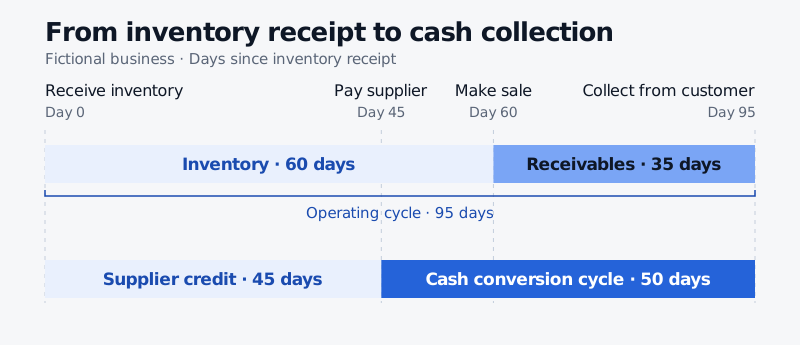
The inventory and receivables intervals run back to back. The payables interval overlaps the operating cycle, leaving the cash conversion cycle from payment to collection.
The diagram translates the ratios into one illustrative sequence. A published DSO of 35 means the receivables balance equals 35 days of sales at the measured rate. To find how long individual invoices have been unpaid, use invoice dates and an ageing report.
Trade working capital is inventory plus trade receivables minus trade payables, measured in currency. The broader net working capital measure subtracts all current liabilities from current assets. In the example, average trade working capital is 50 currency units. The numerical match with 50 days comes from the three daily flows all equalling one. If the firm sells the same volume at twice the price with the same unit cost and collection timing, annual credit sales rise to 730 and average receivables to 70. The CCC stays at 50 days while average trade working capital rises to 85 currency units.
The cash flow statement tracks changes over the period. More cash tied up in inventory and receivables, after allowing for any increase in operating payables, reduces operating cash flow relative to profit, all else equal. Use the reported working capital movements in that reconciliation and check for non-cash changes such as acquired balances or currency translation. IAS 7, paragraphs 18–20 and 25–28
What moved the cycle?
- Check the period and method. Match balances and flows to the same period and business scope. State the day count, whether you use actual fiscal days or a fixed convention. An opening-and-closing average is a starting point. Monthly balances can better capture a seasonal inventory build, and same-quarter comparisons help separate seasonality from changes in timing. CDW's fiscal 2025 filing calculates its cycle on a rolling three-month basis and includes inventory financing in its payables balance. CDW 2025 Form 10-K, Operating Activities
- Read the components before judging a shorter cycle. A negative CCC means payables days exceed inventory and receivables days. That can fit a retailer that sells stock quickly and collects before paying suppliers. Costco's fiscal 2026 filing says it often sells inventory before payment is due. Longer DPO can also reflect overdue invoices or supplier finance. Read the payment terms and check which obligations the calculation includes. Costco 2026 Form 10-K, Item 1, IAS 7, paragraphs 44F–44H
- Separate operating timing from balance changes. Selling receivables to a factor can shrink the reported balance even when customers pay on the same schedule. A change in inventory costing can move both inventory and COGS without changing how long goods sit in a warehouse. Compare businesses with similar operating models and compute each component on the same basis. Hewlett Packard Enterprise, July 2025 Form 10-Q, Operating Activities, Barth, Berkovitch and Israeli, §3.1
Sources
- Richards and Laughlin, A Cash Conversion Cycle Approach to Liquidity Analysis (1980), pp. 34–36
- Barth, Berkovitch and Israeli, The Information Content of Operational Effectiveness (2026), §3.1 and appendix
- CDW, Form 10-K for the year ended 31 December 2025, Operating Activities
- Hewlett Packard Enterprise, Form 10-Q for the quarter ended 31 July 2025, Operating Activities
- Costco, Form 10-K for the year ended 30 August 2026, Item 1
- IFRS Foundation, IAS 7 Statement of Cash Flows, 2026 issued text