Inventory Costing: FIFO, LIFO and Weighted Average
See how FIFO, LIFO and weighted average split purchase costs between cost of goods sold and ending inventory, and why the split changes gross margin.
Inventory Costing: FIFO, LIFO and Weighted Average
Inventory costing assigns the costs of goods available for sale to two places. The cost assigned to goods sold becomes cost of goods sold (COGS) on the income statement. The cost assigned to units still on hand remains in inventory on the balance sheet, subject to subsequent measurement. When purchase prices change, the cost formula can change reported gross margin even if two firms buy and sell the same goods at the same prices. IAS 2, paragraphs 23–27 and 34
Two purchases, one sale
A fictional parts supplier starts the period with no inventory. It buys 8 interchangeable parts at USD 10 each, then 12 at USD 15 each. After both deliveries it sells 10 parts at USD 20 each. The supplier has USD 260 of cost to allocate at period-end. Assume periodic costing, with no losses or write-downs.
Periodic method
Which costs go to the 10 units sold?
COGS (USD)
Ending inventory (USD)
First-in, first-out (FIFO)
Oldest costs first. Eight at 10 and two at 15.
110
150
Last-in, first-out (LIFO)
Newest costs first. Ten at 15.
150
110
Weighted average
Ten at the pooled cost of 13 per unit.
130
130
The periodic weighted average divides total available cost by total available units. The second delivery has more units, so its price carries more weight.
8+128(10)+12(15)=13USD per unit.
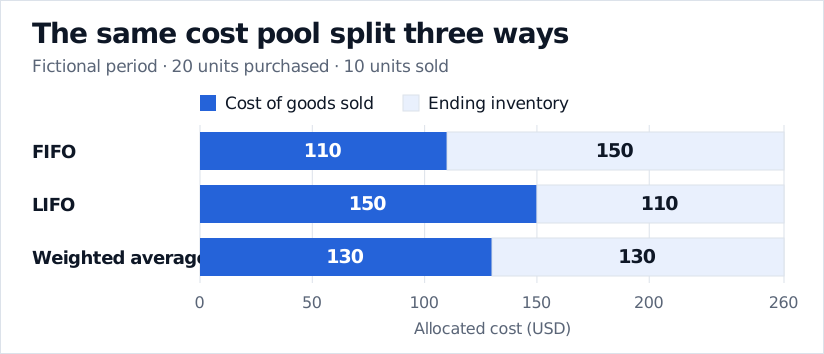
Fictional periodic example in USD. FIFO assigns 110 to cost of goods sold and 150 to ending inventory. LIFO assigns 150 and 110. Weighted average assigns 130 to each. All three totals are 260.
The end of each bar stays at USD 260. Every extra dollar assigned to cost of goods sold reduces ending inventory by one dollar in this example.
The warehouse can ship the oldest parts first under any of these methods. The accounting assumption determines which costs leave inventory. It can also matter when the calculation runs. Periodic weighted average pools the whole period’s available cost. A moving weighted average updates after each receipt, so a sale between deliveries can use a different unit cost. IAS 2, paragraph 27
At USD 200 of revenue, gross profit is USD 90 under FIFO, USD 50 under LIFO and USD 70 under weighted average. That gives gross margins of 45%, 25% and 35%. LIFO brings the newer, higher purchase costs into this period’s COGS sooner. All three cases have the same supplier payments and customer receipts if the payment terms are the same.
Read the inventory policy before comparing margins
Under IFRS, IAS 2 uses FIFO or weighted average for ordinarily interchangeable inventory. It uses specific identification for non-interchangeable items and for goods or services produced and set aside for specific projects. US GAAP also permits LIFO under ASC Topic 330. A US federal tax election to use LIFO generally requires using LIFO for the primary presentation of annual earnings to owners and creditors, with exceptions such as certain supplemental disclosures. IAS 2, paragraphs 23–27 · FASB staff summary of ASC 330-10-30-9 · 26 CFR § 1.472-2(e)
For a filing example, Kroger’s balance sheet at 31 January 2026 shows USD 9,445 million of FIFO inventory and a USD 2,553 million LIFO reserve as a deduction. Together they give a carrying amount of USD 6,892 million. The reserve is a balance at that date. The separately reported USD 157 million LIFO charge is the cost effect for the fiscal year. When comparing margins, check which method applies to the inventory you are analysing and look for the period charge separately from the balance sheet reserve. Also check whether an inventory write-down reduced the carrying amount after costs were assigned. Kroger Form 10-K, consolidated balance sheets, Note 1 and Gross Margin discussion · IAS 2, paragraphs 28–34