IFRS Accounting Standards and US generally accepted accounting principles (US GAAP) are financial reporting frameworks. Their rules and policy choices can put different amounts on the same business activity. A company can look cheaper on a price-to-book screen simply because its balance sheet carries equipment at a higher value. Start with the reporting framework in the filing, then read the accounting policy for the line that drives your ratio.
One asset, two carrying amounts
For ordinary property, plant and equipment (PP&E), IAS 16 allows a company to choose the cost model or, if fair value can be measured reliably, the revaluation model. The choice applies to the whole class, such as machinery. Under the revaluation model, the company updates values often enough to avoid a material difference from fair value at the reporting date. Under US GAAP, ordinary PP&E held and used stays on a depreciated historical-cost basis when an appraisal alone shows a higher value. IAS 16, paragraphs 29–38 and SEC staff comparison, section III.K
Take fictional equipment with a cost of USD 100,000 and accumulated depreciation of USD 20,000. On the measurement date, its fair value is USD 110,000. Assume the IFRS entity applies revaluation to the entire equipment class, this item has no prior revaluation decrease and there are no tax effects. The equipment is held and used in both cases.
- IFRS revaluation model. Carrying amount rises from USD 80,000 to USD 110,000. The USD 30,000 increase enters other comprehensive income (OCI) for the period and accumulates in equity as revaluation surplus. An upward revaluation enters profit or loss to the extent it reverses an earlier revaluation decrease on that same asset that went through profit or loss. IAS 16, paragraphs 31 and 39–42
- US GAAP historical cost. Carrying amount stays at USD 80,000 on that date. An IFRS entity using the cost model would also carry the equipment at USD 80,000 with the same inputs and no impairment. SEC staff comparison, section III.K and IAS 16, paragraph 30
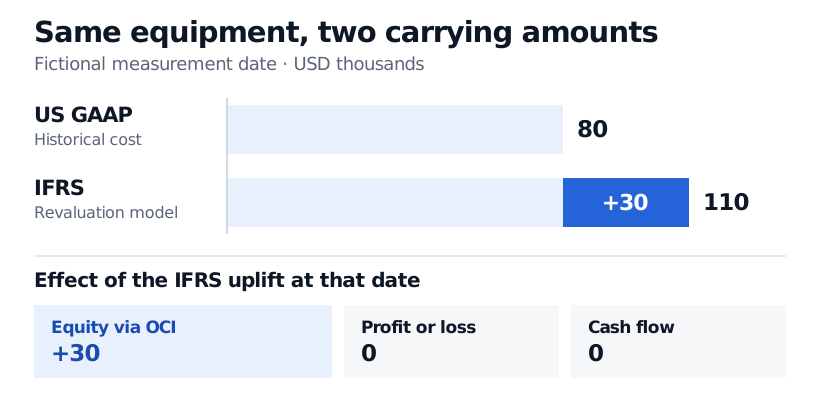
At the measurement date, the revaluation changes the asset and equity balances. The higher carrying amount can also change later depreciation.
Rebuild the ratio before ranking peers
Hold other assets at USD 120,000, liabilities at USD 80,000 and market capitalisation at USD 300,000. Assume all book equity belongs to common shareholders. Book equity is USD 120,000 at historical cost and USD 150,000 after the revaluation. Using USD thousands, price-to-book is
The book denominator accounts for the full change in the multiple. For a cost-basis comparison, start with the IFRS PP&E note. IAS 16 requires a cost-model carrying amount for each revalued class and disclosure of the revaluation surplus. Use that information to isolate the measurement difference, and check tax effects and depreciation assumptions before adjusting book equity or forecasting earnings. The disclosed figure is an IFRS cost-model amount, so check any other measurement differences separately. IAS 16, paragraphs 41–42, 48–53, 73 and 77
The same denominator issue matters in a book-to-market portfolio sort. The SelfMadeQuant lesson Factor construction shows how book-to-market rankings determine portfolio membership. The link opens the public preview, with the full lesson available to members.
Where else to check the notes
In an inventory-heavy business, compare inventory cost formulas before comparing gross margins. For ordinarily interchangeable inventory, IAS 2 uses first-in, first-out (FIFO) or weighted average. US GAAP also permits last-in, first-out (LIFO), which assigns the most recent costs to sales first. That choice can change both cost of sales and ending inventory. Brown-Forman's 2026 Form 10-K gives a concrete example. Its accounting policies explain where it applies LIFO and disclose how much higher inventory would have been under FIFO. IAS 2, paragraphs 23–27, FASB staff handout, paragraphs 5–8, and Brown-Forman, 2026 Form 10-K, Note 1