An inventory write-down reduces the amount recorded for inventory and recognises a loss while the goods are still on hand. Under IAS 2, inventory subject to the standard’s general measurement rule is carried at the lower of cost and net realisable value (NRV). The charge reduces inventory on the balance sheet and profit on the income statement, so a falling inventory balance can reflect a lower estimate for the same stock. IAS 2, paragraphs 2–4, 9 and 34
From selling price to carrying amount
Inventory costing assigns a cost to the item. To estimate NRV, start with the price the company expects in the ordinary course of business, then subtract what it still expects to spend to finish the item and what it needs to spend to sell it. The IFRS Interpretations Committee explains that this estimate can include necessary selling costs shared across sales as well as costs incurred for an individual sale. IAS 2, paragraphs 6–7 and 10–27, IFRS Interpretations Committee, June 2021 agenda decision
A manufacturer has one unfinished item with an assigned cost of 50. It expects to sell the finished item for 48 and estimates a further 7 in combined completion and necessary selling costs. All amounts are in currency units per item.
The manufacturer expenses the 9 now. The write-down entry itself moves no cash. When the item sells, the manufacturer expenses its carrying amount at that time in the same period as the related revenue. IAS 2 usually applies the test item by item, with limited grouping of similar or related items. A sale after the reporting date can inform the estimate if it confirms conditions that already existed at that date. IAS 2, paragraphs 28–30 and 34
How much can an IFRS reversal restore?
IAS 2 requires a fresh NRV estimate each period. For an item still on hand, the company reverses a write-down when the conditions that caused it have gone away or changed economic conditions clearly support a higher NRV. The revised carrying amount is the lower of original cost and revised NRV. The company records the reversal as a reduction in inventory expense in that period. IAS 2, paragraphs 33–34
Take two possible outcomes for the same item at the next reporting date, with the remaining costs still at 7 in both cases. If the expected selling price rises to 53, NRV rises to 46 and the manufacturer reverses 5. If the expected selling price instead rises to 61, NRV reaches 54. The manufacturer restores only the original 9, bringing the carrying amount back to 50.
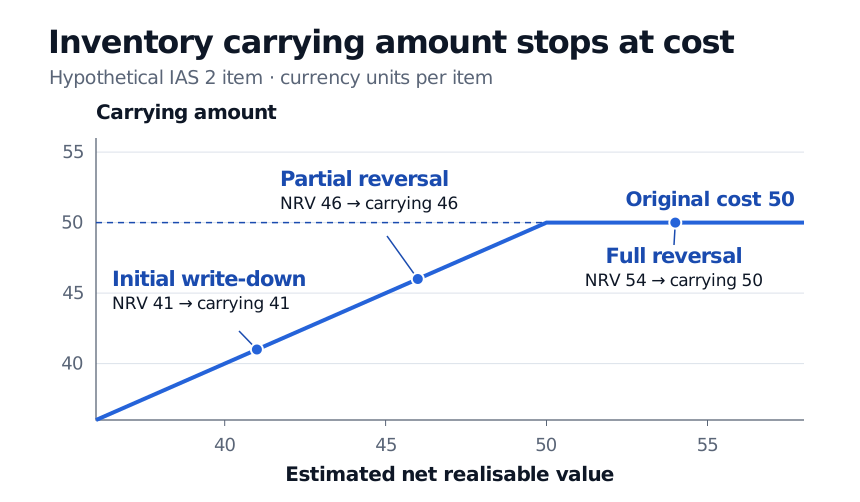
Under IAS 2, the carrying amount tracks the revised NRV up to original cost. Above that point, further recovery leaves the carrying amount at 50.
The U.S. GAAP distinction
Under ASC 330, inventory measured using first-in, first-out (FIFO), average cost or another method besides last-in, first-out (LIFO) or the retail inventory method uses lower of cost and NRV. LIFO and the retail inventory method use lower of cost or market. Here, market generally starts with replacement cost, bounded above by NRV and below by NRV less an approximately normal profit margin. FASB ASU 2015-11, ASC 330-10-35-1A through 35-7 and BC3–BC6
A U.S. GAAP write-down at fiscal year-end establishes a new cost basis. A recovery in the following fiscal year leaves that reduced basis in place. In a later interim period of the same fiscal year, a recovery on the same inventory is recognised as a gain up to the earlier interim loss. The relevant recovery is in market value for LIFO or retail inventory and in NRV for other inventory. SEC SAB Topic 5.BB, citing ASC 330-10-35-14, FASB ASU 2015-11, ASC 270-10-45-6(c)
When comparing filings, start with the inventory note. Under IAS 2 it identifies the cost formula, the write-down and reversal amounts, and what drove any reversal. Those disclosures help assess earnings quality when a reversal lifts profit even though the stock is still on hand. IAS 2, paragraph 36