Residual land valuation estimates what a development site is worth under a proposed scheme by working backwards from the value of the completed project. The basic method deducts non-land costs, financing and a target developer profit. What remains is the highest price the developer can pay for the site and still meet that profit target under the appraisal assumptions. Homes England, Financial viability for housing-led projects
How much can the developer bid?
Suppose a fictional apartment project has a gross development value of USD 150 million, based on estimated sales of the completed units. Construction and other non-land development costs, including selling costs, total USD 100 million. The model allows USD 10 million for financing and USD 15 million for target developer profit. Assume the four estimates have already been put on the same basis at the land purchase date and there are no additional acquisition charges. The amount available for the land purchase, in USD millions, is
The USD 25 million bid ceiling belongs to this scheme and these assumptions. If a developer already knows the land price, the same appraisal can work in reverse. Include the land price on the cost side and solve for expected profit. If acquisition taxes, fees or financing depend on the land price, include that dependence when solving for the bid. RICS, Valuation of development property, section 7.2 and appendix B3
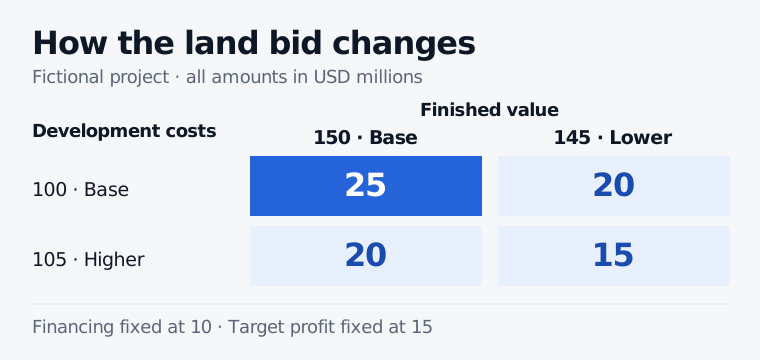
The sensitivity grid holds financing at USD 10 million and target developer profit at USD 15 million.
A USD 5 million drop in finished value is about 3.3% of the original sales forecast. It cuts the residual by 20% because the other amounts are fixed in this test. When build costs also rise by USD 5 million, the residual drops by 40%. A negative residual means the proposed scheme misses its target even if the land is free. An appraisal of the site can also consider other feasible uses and check the residual against comparable land transactions where available. RICS, Valuation of development property, section 7.1
Put the build and sales on a calendar
For a phased development, discounted cash flow valuation dates the outlays and receipts individually. Assume land is paid for today. Add the present values of all non-land project cash flows, with receipts positive and outlays negative. This gives the land price that would bring the project's net present value to zero at the required project return. If sales are delayed while the other cash flows stay fixed, the amount available for land falls at a positive discount rate. RICS, Valuation of development property, section 6.2
In an unlevered project DCF, leave out borrowing flows and interest. The project discount rate incorporates the required return, so subtracting the basic method's lump-sum developer profit as well would charge for that return twice. Check whether a cost contingency and a rate uplift compensate for the same uncertainty before applying both. RICS, Valuation of development property, appendix B1