A renewal process counts events separated by independent, identically distributed waiting times. Each event restarts the same probabilistic clock. The waits need not be exponential, so the model can describe repeated insurance or operational events whose chance of occurring depends on time since the last event. The assumption that every cycle resets the system is the modelling commitment: a renewal model does not automatically capture changing market conditions or contagion between claims.
Under the strictly positive waiting-time convention used here, let be i.i.d. waits and define
The origin is a fresh start, not a counted event. An event exactly at the horizon is included. The renewal times record when events occur; the counting process records how many have occurred.
Same average wait, different short-horizon count
Consider a synthetic claims clock. After every event, the next wait is independently either one hour or three hours, each with probability . A new cycle starts at time zero. This is a deliberately simple model, not an estimate of actual insurance arrivals.
At two hours there are only three possibilities:
| What the waits reveal | Renewals by hour 2 | Probability |
|---|---|---|
| First wait is 3 hours | 0 | |
| First wait is 1 hour; second is 3 hours | 1 | |
| First two waits are both 1 hour | 2 |
The mean wait is two hours, but the expected two-hour count is
Dividing the horizon by the mean wait gives , which misses the exact answer. Compare a clock whose waits are always two hours: it has the same mean wait and exactly one renewal by hour two. The full waiting-time distribution matters at finite horizons.
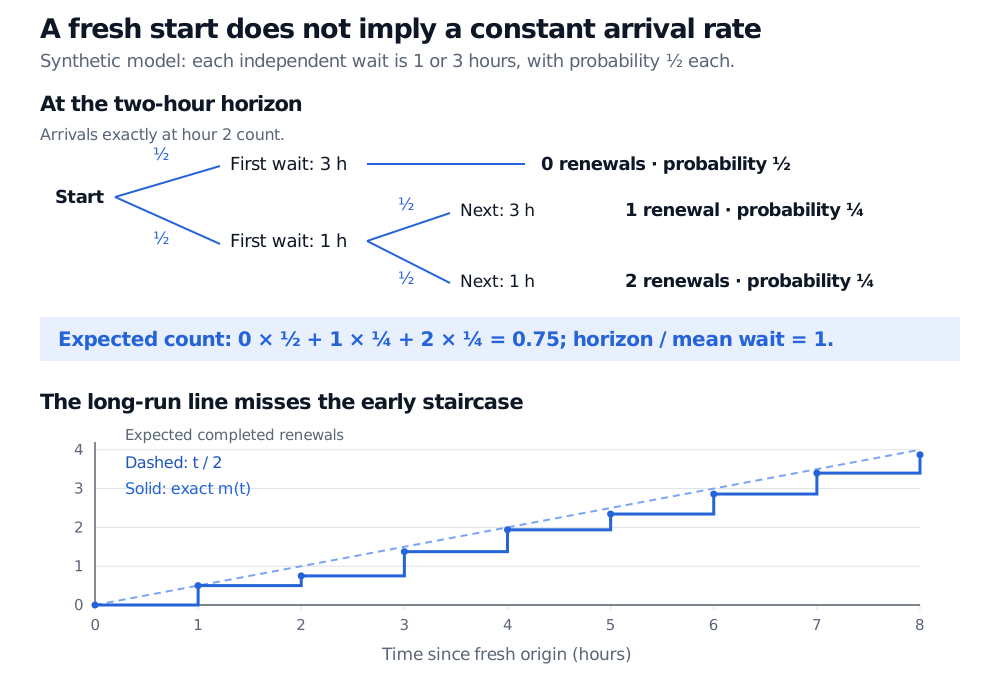
Original exact calculation for the synthetic two-point waiting-time model. Filled points include arrivals at the stated time. The dashed line is the long-run rate multiplied by time; the solid staircase is the expected count from a fresh origin.
A reset happens at an event, not whenever you look
A Poisson process is the special renewal process with exponential waits. Exponential memorylessness lets its clock restart without changing its law even when observed partway through a wait. General renewal processes reset at renewal times; they need not have that stronger property.
In the claims clock, suppose there has been no event by hour one. The first wait must be three hours, so there cannot be an event during . If there was an event by hour one, it occurred exactly then; the next independent wait is one hour with probability . The probability of an event in the second hour therefore depends on what happened in the first. Independent waits do not imply independent count increments.
Starting observation at an arbitrary calendar time also differs from starting a new cycle. The remaining wait then depends on the age of the current cycle. A delayed renewal process allows the first observed wait to have a different distribution from subsequent waits.
The expected count has its own equation
Let and . Condition on the first wait: if it exceeds , the count is zero; otherwise there is one event and a fresh process with the remaining time. This gives the renewal equation,
The integral uses the waiting-time distribution, so the formula includes discrete waits as well as continuous ones. In the one-or-three-hour model, it reduces to
with for . Thus and . The restart property supplies a practical calculation, even when there is no Poisson count formula.
For the first-arrival derivation and further examples, Renewal Processes and the Renewal Equation has a public preview; the full lesson requires membership.
What the average wait does tell you
When , the long-run renewal rate is
Here that rate is one-half renewal per hour. These limits justify a long-run rate calculation; they do not turn into a finite-horizon identity. If each completed cycle also pays a random amount, a renewal-reward process extends the same cycle structure from event counts to accumulated costs or receipts.
Sources
- Richard Durrett, Essentials of Stochastic Processes, third edition (2016), §3.1, pp. 125–127: renewal construction, long-run rate and cycle rewards.
- Robert G. Gallager, Renewal Processes, Chapter 4, MIT OpenCourseWare 6.262 (2011), §4.1: positive i.i.d. waits, counting convention and restart at renewal epochs; §§4.3 and 4.6: long-run renewal rates.
- Kyle Siegrist, Renewal Equations, Random: Probability, Mathematical Statistics, Stochastic Processes: conditioning on the first arrival and integration against the waiting-time distribution.