A renewal reward process adds cash at completed cycles. Learn why long-run cash per hour is a ratio of means, and why a two-hour expectation can differ.
Renewal reward process
A renewal reward process adds a reward to each completed cycle of a renewal process. It turns random cycle lengths and cash amounts into a cumulative cash process. Its main financial use is to measure revenue or cost per unit of calendar time when the opportunities to earn or spend arrive at irregular intervals.
The cycle might be a completed service job, an equipment replacement, or a regeneration of a system. Choosing genuine repeatable cycles matters: serially dependent trading profits do not become independent merely because they have been grouped into trades.
The cash clock
Let Wi>0 be cycle i's duration and Ri its reward, measured in consistent time and cash units. Assume the pairs(Wi,Ri) are independent and identically distributed across cycles. A reward may depend on its own cycle's duration: a longer job may pay more. Independence between Wi and Ri is unnecessary.
With a fresh cycle starting at time zero, define
S0=0,Sn=i=1∑nWi,N(t)=max{n≥0:Sn≤t}.
The completion-only reward process is
C(t)=i=1∑N(t)Ri.
A reward enters at the exact completion time Si, including a completion at the observation cutoff. An unfinished cycle contributes nothing. Positive rewards give an upward staircase; signed rewards allow costs or losses as well. This convention describes booked completion cash, rather than accrual accounting or a marked-to-market portfolio.
One hour pays more per hour, but three hours occupy more time
Suppose a hypothetical service performs one job after another, with no idle time between jobs. Each new cycle independently selects one of two joint outcomes:
Cycle type
Probability
Duration
Cash at completion
Cycle's own cash rate
Short
1/2
1 hour
USD 2
USD 2/hour
Long
1/2
3 hours
USD 3
USD 1/hour
The expected reward is USD 2.50 per cycle, and the expected duration is 2 hours per cycle. The long-run cash rate is therefore
E[W1]E[R1]=22.50=1.25USD/hour.
Averaging each job's rate instead gives
E[W1R1]=21(2)+21(1)=1.50USD/hour.
That answers a different question: the average rate of a randomly selected cycle. Over many cycles, the long jobs take three quarters of the elapsed time and the short jobs take one quarter. Time weighting gives (1/4)(2)+(3/4)(1)=1.25 USD/hour. Equal probabilities of cycle types do not mean equal shares of the clock.
The model is synthetic. Its cash rate ignores discounting, capital employed and risk; it is not a strategy return or a pricing result.
What the long-run theorem guarantees
For the completion-only process above, sufficient conditions are
0<E[W1]<∞,E[∣R1∣]<∞.
The renewal-reward theorem then states
tC(t)⟶E[W1]E[R1]almost surely as t→∞.
The mechanism is a law of large numbers: average reward per completed cycle approaches its mean, and completed cycles per unit time approach the reciprocal mean duration. For N(t)>0,
tC(t)=N(t)1i=1∑N(t)RitN(t).
Finite variance is not required for this limit. Nor is a continuous waiting-time distribution: the integer-hour example qualifies. The theorem is a long-run statement, so it does not promise smooth cash receipts or a prescribed error over the next few hours.
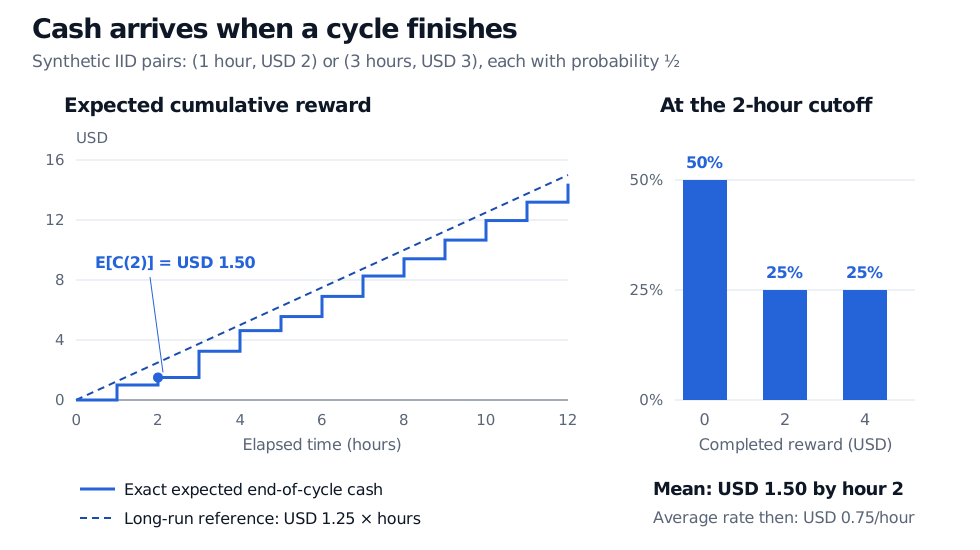
Return to the service example and stop exactly 2 hours after a fresh start:
A long first job finishes after the cutoff: probability 1/2, completed reward USD 0.
A short job followed by a long job produces one completed job: probability 1/4, reward USD 2.
Two short jobs both finish by the cutoff: probability 1/4, reward USD 4.
Thus
E[C(2)]=21(0)+41(2)+41(4)=1.50USD.
The expected cash rate over these first two hours is USD 0.75/hour, although the long-run rate is USD 1.25/hour. Multiplying the long-run rate by two would give USD 2.50, which is not the finite-horizon expectation. Completion timing and the fresh start explain the difference.
Exact synthetic cycle model. Expected completed cash at two hours is USD 1.50. The two-hour reward is USD 0 with probability 50%, USD 2 with probability 25%, and USD 4 with probability 25%. The long-run rate is USD 1.25 per hour.
Exact synthetic model, with rewards paid only at completion. The solid staircase shows expected cumulative cash; the dashed line is the long-run rate multiplied by elapsed time, not an exact expectation formula. The right panel resolves the two-hour cutoff into its three possible cash outcomes.
A compound Poisson process is a special case when cycle waits are exponential and rewards are independent marks. Renewal rewards allow more general cycle lengths and dependence between a cycle's duration and reward. If rewards accrue during a cycle, the process definition must include that partial reward explicitly; the completion-only definition here does not include it.
Sources
Richard Durrett, Essentials of Stochastic Processes, third edition, Springer, 2016, §3.1, Theorem 3.3, pp. 126–128 — completed-cycle rewards, dependence within IID pairs and the strong-law argument.