A regulated utility rate base is the amount of capital recognised by a regulator for calculating the return allowance on a utility’s regulated services. It is also called a regulatory asset base (RAB). For an electricity distributor, whether new substations enter the base, and when they enter it, affects how much of a return customers fund through future network charges. FERC, Glossary
From network investment to allowed revenue
Start with the opening base, add the capital expenditure the regulator admits, and subtract the period’s depreciation charge against the base. The regulator can also specify adjustments for inflation, assets sold or retired, capital contributions from customers, and the timing of new investment. The cash spent on a project and the amount admitted to the base can therefore differ. AER, United Energy final decision, Attachment 1 §1.2
In a building-block determination, the return on capital pays for financing the recognised investment. It is the allowed rate of return times the base specified for the period. Return of capital, through regulatory depreciation, lets the utility recover the investment over time. The two contribute separately to allowed revenue, alongside allowed operating costs, tax allowances and any applicable adjustments. Actual earnings depend on the revenue the utility realises and the costs it incurs. AER, United Energy final decision, Attachment 1 §§1.1–1.4
Same network, different base for the return
Take a fictional network with an opening base of AUD 100 million. The regulator admits AUD 20 million of new plant, and depreciation reduces the existing base by AUD 5 million. With no other adjustments, the closing base in AUD millions is .
If this regulator applies an annual 7% rate to the closing base, the return component in AUD millions is . Using the opening base at the same rate would give AUD 7.00 million. The choice changes that year’s return allowance even though the asset roll-forward is identical.
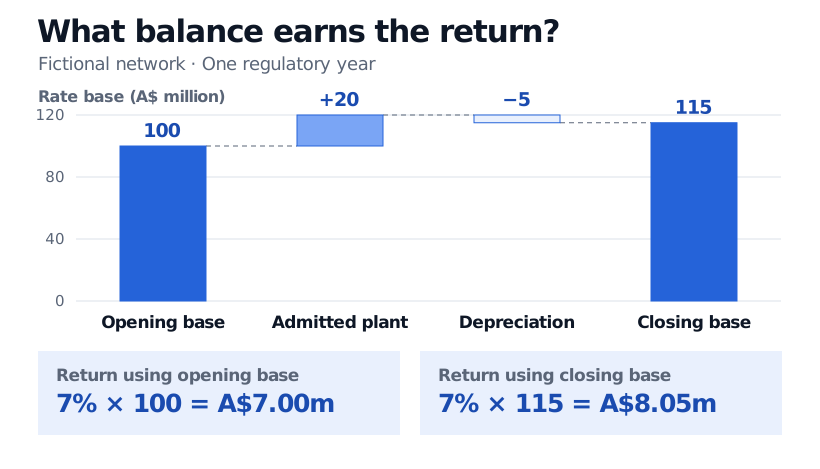
Applying the same 7% to either end of the roll-forward isolates the effect of the balance the regulator uses.
The Australian Energy Regulator (AER) uses the opening RAB for United Energy’s Victorian electricity distribution determination for July 2026 through June 2031. For its standard distribution services in 2026–27, an opening RAB of AUD 3,030.0 million and an allowed nominal rate of 6.14% give about AUD 186.0 million of return on capital. The AER’s benchmark weighted average cost of capital uses its assumed mix of debt and equity. The AER calls it a nominal vanilla WACC because it combines a nominal pre-tax debt return and a nominal post-tax equity return. Corporate income tax has its own allowance. The AER updates the benchmark debt return annually after the first year. AER, United Energy final decision, Overview §2.2, Attachment 1 §§1.1, 1.2 and 1.4
The rate base in a valuation
For an infrastructure investor, the rate base helps forecast revenue. Check which balance or averaging convention the regulator uses, when future spending qualifies for recovery, and how the allowed rate treats inflation and tax. A discounted cash flow valuation starts from expected collections and deducts operating cash costs, taxes and capital spending. The discount rate reflects the risk of those cash flows and can differ from the allowed return. The resulting valuation can sit above or below the regulatory balance.