Infrastructure investment is putting capital into long-lived assets that provide services such as transport, electricity, water or digital connectivity. Investors can own equity in a project or an operator, lend to it, or gain exposure through a fund. For valuation, the first question is what triggers a payment. Two roads can carry the same traffic and generate very different cash flows if their contracts pay for different things. European Investment Bank, DIF Core Infrastructure Fund I
What triggers payment?
| Revenue mechanism | What the operator is paid for | What can reduce revenue |
|---|---|---|
| Usage-based | Each trip, connection or unit delivered. On a toll road, drivers typically pay per trip. A public authority can also pay per trip under a shadow toll. | Fewer users, lower usage per customer or restrictions on raising the tariff. |
| Availability-based | Keeping the asset open and meeting service standards. In a public-private partnership, a public authority may pay a periodic fee with deductions for closures or poor performance. | Service failures can trigger deductions even when demand is high. Payment also depends on the counterparty meeting its obligations. |
| Regulated | Customers pay tariffs under a regulatory framework. For example, the Australian Energy Regulator sets a revenue allowance for standard distribution services, with building blocks for operating expenditure, depreciation, return on the regulated asset base and other items. | A regulatory reset may change allowed costs or returns. How much volume risk the operator retains depends on whether the rules cap tariffs or allow tariffs to adjust to recover an approved revenue amount. |
An asset can combine mechanisms. A toll road can earn revenue per trip while its tariff is regulated. For United Energy’s regulated distribution service, changes in electricity consumption affect customer tariffs under the revenue cap, with over- and under-recovery reconciled through annual pricing. Transurban’s FY26 results report toll revenue and traffic separately, a useful distinction when modelling an operator whose tariffs and traffic can both change. World Bank, Payment Mechanism, Australian Energy Regulator, United Energy final decision, Transurban, FY26 results
The same road at lower traffic
Suppose a fictional road collects USD 2 per trip. In a year with 100,000 trips, it collects USD 200,000 and pays USD 120,000 in operating costs. Assume receipts and payments fall in the same year and there are no working capital changes.
With 80,000 trips and unchanged costs, it collects USD 160,000 and has USD 40,000 left before capital expenditure, financing and taxes. A 20% traffic decline halves that operating cash because the costs in the example are fixed.
Now suppose the authority instead pays USD 200,000 for the year if the road meets its service standards, with no payment tied to traffic. If the road stays fully available and the authority pays in full, the operator keeps USD 80,000 before the same outlays at either traffic level. A closure could change that result through a deduction, even if traffic demand stayed high. World Bank, Payment Mechanism
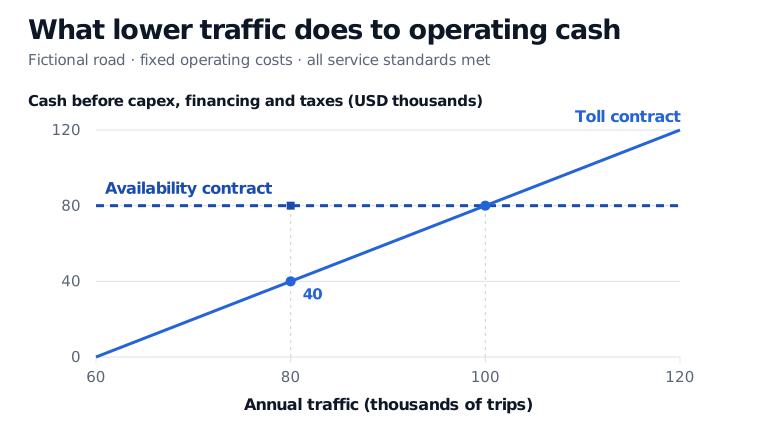
With the same operating costs, a drop in traffic cuts toll cash but leaves the stipulated availability payment intact when all service standards are met.
Construction risk and operating risk
A greenfield investment backs a new asset. Before it earns service revenue, capital goes into development and construction. A delay can increase build costs and push back the first payment, even if a long-term contract is already signed. A brownfield investment starts with an existing asset. An operating history gives the buyer traffic, outage and cost data to test, while ageing equipment, deferred maintenance and a short remaining concession can still make the cash flows fragile. An extension to an operating road can expose the same investment to both sets of risks. European Investment Bank, DIF Core Infrastructure Fund I, World Bank, Identifying Risks
Fund labels such as core, core plus, value-add and opportunistic describe an investment strategy. At one end, value may depend mainly on continued operation under a long contract or a regulatory framework. Further along the spectrum, it may depend on renewing contracts, delivering an expansion or selling output at uncertain market prices. The assumptions behind the label determine what to stress in the model. CION Grosvenor Infrastructure Fund, Targeted Risk-Reward Profiles
From asset cash to investor cash
In a discounted cash flow valuation, project the actual payment mechanism and deduct cash outlays such as major resurfacing and operating taxes. For a fixed-term concession, model cash flows through the date the rights expire and include an end payment or residual value only if the investor has a basis for receiving it. A road can keep serving drivers after its current operator’s right to collect tolls ends. World Bank, Direct Contractual Agreements
The investment decision concerns what the asset or claim is worth at the price paid. Financing determines how the purchase or build is funded and who receives the cash. An operator can borrow on its corporate balance sheet or use project finance, where lenders primarily rely on the project’s own cash flows for repayment. Equity investors receive what is available for distribution after debt obligations and other required outlays. The road’s USD 80,000 in the example is only the starting point for that calculation. World Bank, Finance Structures for PPP
Sources
- World Bank, Payment Mechanism
- Australian Energy Regulator, United Energy 2026–31 Final Decision, Attachment 1
- Transurban, What Drove Our FY26 Results
- European Investment Bank, DIF Core Infrastructure Fund I
- World Bank, Identifying Risks
- CION Grosvenor Infrastructure Fund, Targeted Risk-Reward Profiles
- World Bank, Finance Structures for PPP
- World Bank, Direct Contractual Agreements