A public-private partnership (PPP) is a long-term contract under which a public authority entrusts a private partner with delivering a public asset or service. The private partner takes on substantial management responsibility and risk, and its compensation depends on how it performs. A concession grants a private operator rights to provide a service or use an asset for a defined term, often with the right to charge users. Some jurisdictions also call government-paid contracts concessions. For an analyst, the contract determines which failures reduce cash flow, who absorbs the loss and when the right to collect revenue ends. World Bank, Defining Public-Private Partnership · PPP Contract Types and Terminology
What the authority buys
A standalone construction contract can require the builder to deliver a completed hospital. A hospital PPP can put design, construction and years of building maintenance under the same contract. The public authority can specify an output such as keeping operating rooms safe and ready during agreed hours. The private partner chooses how to maintain ventilation and bears the contractual cost of failing the standard. Linking long-term payment to room readiness gives the same party a reason to consider future maintenance when it designs the building. World Bank, PPP Contract Types and Terminology · Performance Requirements
From room readiness to the invoice
Suppose a fictional hospital PPP pays a base of USD 12 million for one operating year. A ventilation fault makes some rooms unusable during required hours. The authority verifies the failure and the operator misses its deadline to restore service. The contract stipulates a USD 2 million deduction for that incident. With no other adjustments, the authority pays:
If fewer patients arrive but the rooms remain ready and all other standards are met, the same contract still pays USD 12 million. The USD 10 million is what the operator receives before paying its own costs. World Bank, Payment Mechanism
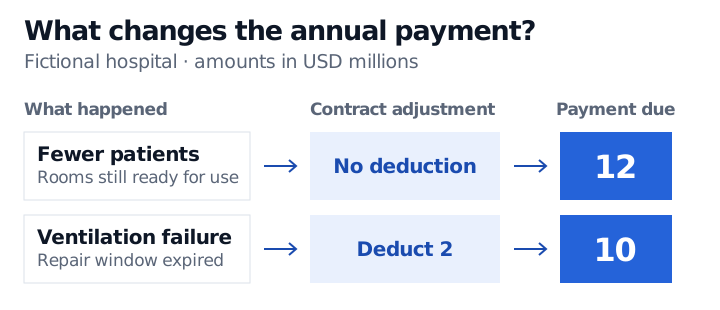
Room readiness is the contractual test in this example. Patient numbers do not enter the payment calculation.
Victoria's New Footscray Hospital illustrates how this can work in practice. The private consortium took on design, construction, financing and maintenance, while Western Health provides clinical care. The published project summary lists deductions from monthly service payments for specified failures, including areas that remain unavailable beyond the required repair period. It also includes a volume adjustment for patient meals. An availability PPP can therefore still contain individual charges that vary with use. Victorian Health Building Authority, New Footscray Hospital · Department of Treasury and Finance, project summary, sections 5.1–5.2
Who pays, who bears risk and when the rights expire
An availability payment comes from the authority and depends on the agreed condition or quality of the service. A usage-based payment rises or falls with the amount of service delivered. Drivers might pay a road concessionaire a toll per trip, or the authority might pay the operator per trip under a shadow toll. Who pays and what triggers the payment are separate questions. Guarantees, tariff rules and contractual exceptions can change who ultimately bears the risk of low usage. World Bank, Payment Mechanism
The clauses that matter change over time. Before opening, check the completion tests and which delays can postpone payment. During operations, check who verifies failures, how long the operator has to fix them and what the payment schedule deducts. At expiry, check the required condition of the asset at handback and who pays for any work needed to meet that standard. If the right to collect tolls ends at handback, an infrastructure investor ends those toll receipts in the forecast even if the road keeps operating. World Bank, Performance Requirements · Termination Provisions
Read the payment schedule, ownership and handback clauses, and applicable accounting rules separately. Legal title may stay with the authority even while the concessionaire has the right to operate and charge users. Government balance-sheet treatment depends on the applicable reporting framework and the contract, including factors such as who controls the asset or bears specified risks. A PPP governs service delivery, while project finance describes how lenders are repaid. The payment mechanism feeds the financing model because deductions change the receipts available to cover costs and debt. World Bank, PPP Contract Types and Terminology · Fiscal Accounting and Reporting for PPPs
Sources
- World Bank, Defining Public-Private Partnership
- World Bank, PPP Contract Types and Terminology
- World Bank, Performance Requirements
- World Bank, Payment Mechanism
- Victorian Health Building Authority, New Footscray Hospital
- Department of Treasury and Finance, New Footscray Hospital Project Summary
- World Bank, Termination Provisions
- World Bank, Fiscal Accounting and Reporting for PPPs