Project finance raises capital for a specific project whose future cash flows are the primary source of debt repayment. A special-purpose vehicle (SPV) typically holds the project’s assets and contracts, borrows from lenders and receives equity from the sponsors. For a lender underwriting an infrastructure investment, the practical question is whether cash from that project will arrive in time to pay each bill. In corporate financing, the company borrows on the strength of its wider business and balance sheet, even when it spends the proceeds on the same asset. A public–private partnership describes how a public authority contracts for a project or service. It can use either financing structure. World Bank PPP Resource Center, Finance Structures for PPP
From financial close to the first payment
A fictional solar plant’s SPV has USD 100 million in upfront project uses. At financial close, lenders commit 70 million of project debt and the sponsors commit 30 million of equity. Define project gearing here as debt divided by total committed debt and equity.
The 70 million is a funding source. The 100 million is what the financing must cover. A fuller sources-and-uses statement may also include construction interest, upfront financing fees and initial reserves among its uses. The gearing calculation gives the funding mix at close. To judge repayment, lenders model cash collections and outlays against the actual debt schedule. World Bank PPP Resource Center, Finance Structures for PPP
Suppose the operating plant has 12 million in cash available for debt service by a scheduled payment date, after relevant operating costs and taxes. Principal and interest due that day total 9 million. The debt service coverage ratio for the period is 12 ÷ 9, or about 1.33×. If a customer pays late and only 7 million is available by the same date, coverage falls to about 0.78×. In this simplified cash flow waterfall, debt gets paid first from the available cash, with no reserve draws, new funding or restrictions on distributing excess cash to equity. World Bank PPP Resource Center, Key Issues in Developing Project Financed Transactions
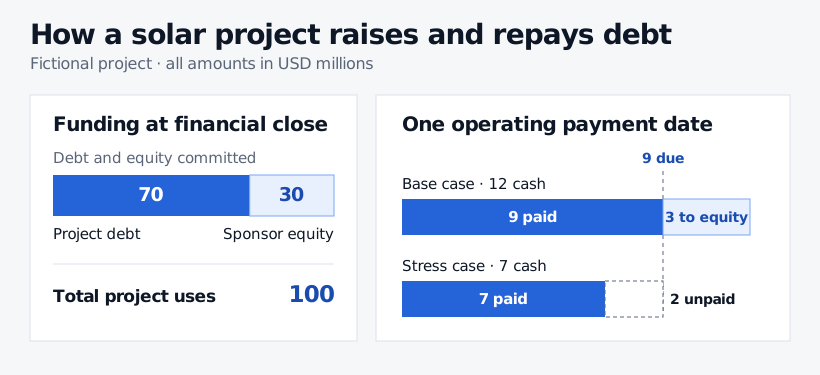
The funding mix is set at financial close. The ability to pay depends on the cash available when debt service falls due.
Who can lenders claim against?
The SPV ring-fences the project’s cash flows, assets and obligations from the sponsors’ other businesses. With debt that is non-recourse to the sponsors, lenders generally look to the project company and the agreed security, which may cover project assets, bank accounts or receivables. Limited recourse gives lenders specified access to sponsor support. For example, a sponsor could agree to fund construction overruns up to a cap until the plant passes its completion tests. A later payment shortfall would fall outside that undertaking. The loan and support agreements determine what creditors can claim and from whom. World Bank PPP Resource Center, Key Issues in Developing Project Financed Transactions
Ameresco’s 2025 annual report describes loans made directly to its energy project subsidiaries. It says these loans were generally non-recourse to Ameresco, with exceptions including completion guarantees and specified equity contribution obligations. The company still reported the loans on its consolidated balance sheet. Recourse describes the lender’s claims. Consolidation determines where the debt appears in financial reporting. Ameresco 2025 Form 10-K, Energy Asset Financing