Portable alpha combines synthetic benchmark exposure with a separate alpha-seeking strategy. See how financing, cash yield and collateral fit one capital budget.
Portable alpha
Portable alpha is a portfolio strategy that combines a chosen market exposure, obtained through derivatives, with a separately managed alpha-seeking investment. It separates the decision about which benchmark to hold from the decision about where to seek alpha. An equity mandate can therefore seek active returns from a strategy outside its equity index while retaining the intended market beta. CME Group explains this separation using stock-index futures and an underlying capital investment.
“Portable” describes the intended separation of exposures. It does not establish that a manager has skill, that the alpha investment is riskless, or that its returns will remain independent of the benchmark.
Two exposures do not create two pots of money
A futures contract or total return swap can supply benchmark exposure without buying the entire physical index. The investor must still provide collateral, finance the exposure and retain liquidity. The remaining capital can support an alpha-seeking sleeve, such as a long–short strategy designed for market neutrality.
Capital efficiency permits more exposure per invested dollar; it introduces leverage, rather than making the second exposure free. AQR’s discussion of capital efficiency, pp. 7–8, places portable alpha alongside other forms of delegated leverage. Its proposed benefit is access to an additional return source without reducing benchmark exposure.
The budget must identify which assets are available as collateral and which can be sold to meet cash calls. The same dollar cannot simultaneously be unavailable inside a locked fund and immediately available to the clearing broker.
Keep cash yield in the calculation exactly once
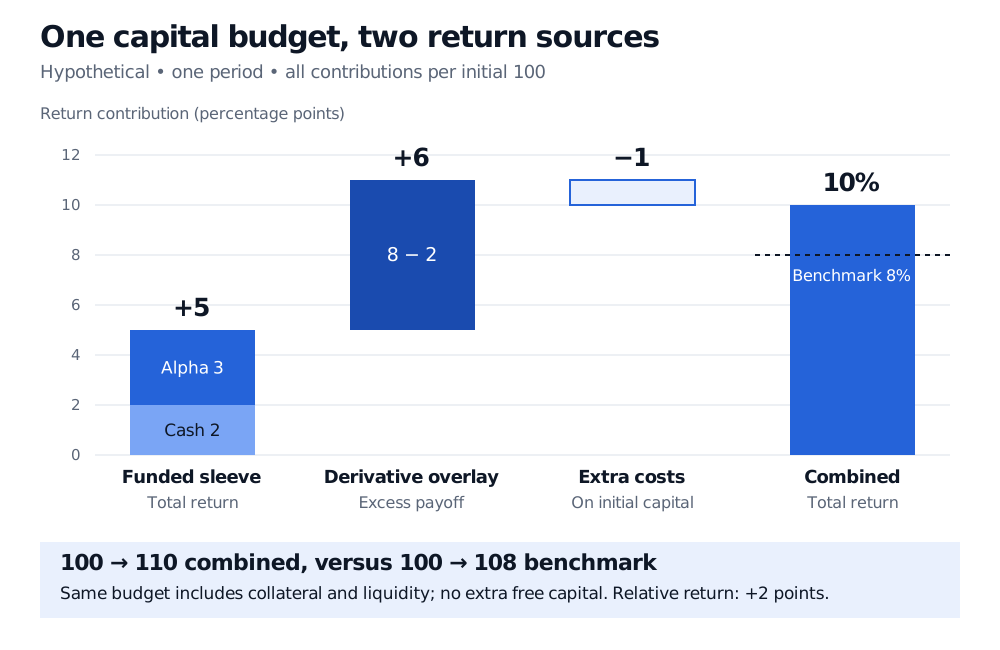
Consider an original hypothetical one-period portfolio with initial capital 100. The funded market-neutral sleeve, including its cash backing, earns a 5% total return: a 2% cash yield plus 3% alpha-sleeve excess return. Assume this funded arrangement can also support the collateral and liquidity required by the overlay within that same 100 budget.
The derivative overlay has benchmark notional 100. Stipulate a benchmark 8% total return and an overlay payoff equal to benchmark return less the 2% cash financing rate: 6 per initial 100, before extra costs. This excess-payoff convention is a simplifying contract assumption, not a universal futures-return identity. Extra trading, structuring and other costs, beyond that financing deduction, are 1% of initial capital.
Component
Gain or loss per initial 100
Funded sleeve: cash yield 2 plus alpha excess 3
+5
Overlay: benchmark total 8 less cash financing 2
+6
Extra costs
−1
Combined gain
+10
Writing RA for the funded sleeve’s total return, RB for benchmark total return, rc for cash yield and stipulated overlay financing, and c for extra costs gives
RP=RA+(RB−rc)−c=5%+(8%−2%)−1%=10%.
Ending wealth is 110, compared with 108 for the funded benchmark. The arithmetic benchmark-relative gain is 2 percentage points, equal here to the sleeve’s 3% excess return less 1% extra costs. That realised difference is not an estimate of persistent manager skill.
Adding the sleeve’s 5% total return to the benchmark’s funded 8% and subtracting only the extra 1% would count the cash return twice. BlackRock’s implementation discussion likewise distinguishes alpha funding, cash reserves and the cost of synthesising the index exposure.
Hypothetical one-period return on initial capital 100: funded sleeve contributes 5 percentage points, comprising cash yield 2 and alpha 3; derivative overlay contributes 6, equal to benchmark total 8 minus cash 2; extra costs subtract 1. Combined total return is 10%, ending wealth 110 versus benchmark 108, a 2-point relative gain.
Original one-period arithmetic illustration. All components use the same initial capital 100. Collateral and liquidity come from that budget; the overlay payoff is stipulated after the 2% cash financing rate, before the extra 1% costs.
This example aligns all returns over one period, ignores interim reinvestment and assumes sufficient eligible collateral and cash throughout. It also assumes no replication gap and no unexpected financing change. It does not allocate another free 100 to margin, prescribe a collateral percentage, or demonstrate that a real funded sleeve can meet every margin call.
Where the separation can fail
Beta leakage: the alpha sleeve may contain equity, credit or other systematic exposures. Adding an index overlay can then increase a risk already present. Market neutrality is an objective to test, including during stress.
Replication and funding:basis risk, contract rolls and financing spreads can make the overlay differ from the target benchmark. Bilateral swaps also create counterparty exposure even when collateralised.
Cash timing: a margin call can arrive before an alpha investment permits redemption. A positive terminal return cannot pay an earlier cash obligation. Forced liquidation can change the intended exposures.
Alpha loss and fees: the sleeve can underperform cash or lose principal. Overlay costs and fees can consume its excess return, while stress can make both exposures lose together.
Man Group’s implementation analysis, especially its sections on cash buffers, fees and rebalancing, explains why liquidity and portfolio rules affect outcomes. Its proposed buffer levels depend on its modelling; they are not inputs to this example. These provider materials describe mechanisms and implementation views, not evidence that a particular product will outperform.
For the underlying contracts, read Swaps (free sign-in required). For the mathematical benchmark-plus-active-portfolio decomposition and its long-only constraint caveat, see Mean–Variance Optimisation and Portfolio Theory (public preview; full lesson requires membership).