A finite sum of nonnegative integer powers. Read its degree, coefficients and units through a cost model, and separate model arithmetic from predictive accuracy.
Polynomial
A polynomial is a finite sum of terms whose variables have nonnegative integer powers. In one real variable, its general form is
p(x)=a0+a1x+a2x2+⋯+anxn.
The constants a0,…,an are coefficients; they can be negative, fractional or zero. The restriction concerns the powers of x, not the coefficients. For a nonzero polynomial, the degree is the largest exponent with a nonzero coefficient, after like terms have been combined. Thus 3x2−2x+7 has degree two, while 0x3+2x has degree one. A nonzero constant has degree zero; the zero polynomial has no degree under the usual elementary convention.
This makes polynomials useful building blocks for financial models: a constant can represent baseline cost, a first-power term proportional cost, and a squared term cost that accelerates with quantity.
Reading a cost curve
Suppose a hypothetical execution period incurs a baseline cost even if no shares are traded. Approximate its total cost by
C(q)=5+0.10q+0.001q2,q≥0,
where q is quantity in shares and C(q) is measured in USD. Quantity is treated as continuous for sensitivity calculations; a whole-share order must additionally have integer q.
The coefficients carry different units:
Term
Coefficient units
Contribution at 100 shares
Baseline 5
USD
USD 5
Proportional 0.10q
USD per share
USD 10
Quadratic 0.001q2
USD per share squared
USD 10
Every term therefore contributes dollars. The polynomial has degree two, with leading coefficient 0.001 USD per share squared. Substitution gives
C(100)=5+0.10(100)+0.001(100)2=25 USD.
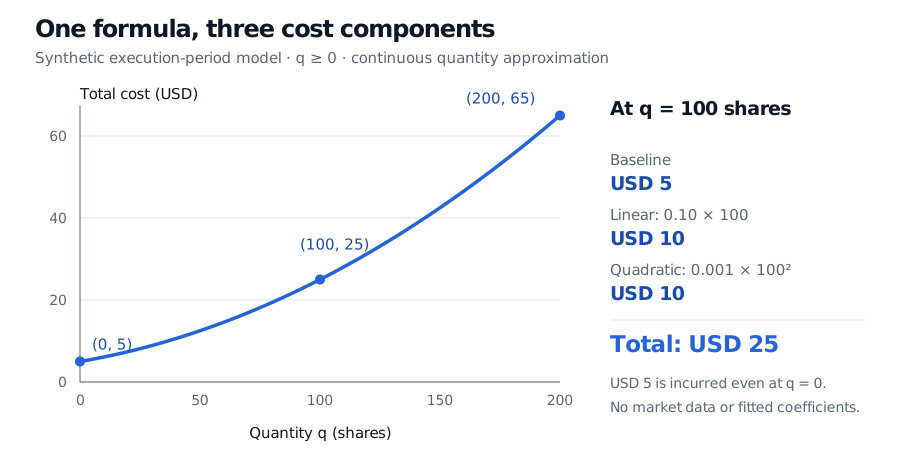
Synthetic polynomial cost curve: USD 5 at zero shares, USD 25 at 100 shares and USD 65 at 200 shares. The 100-share total contains USD 5 baseline cost, USD 10 linear cost and USD 10 quadratic cost.
Original hypothetical cost model. The baseline is incurred even when quantity is zero; the curve is a continuous approximation for nonnegative quantities, not observed trading costs.
The derivative gives the instantaneous marginal cost:
C′(q)=0.10+0.002q,C′(100)=0.30 USD per share.
That is different from average cost, C(100)/100=0.25 USD per share. It is also a local rate: the exact next-share increment is C(101)−C(100)=0.301 USD, slightly above the derivative's one-share approximation because marginal cost rises with quantity.
What the formula does—and does not—tell you
A polynomial with real coefficients defines a function at every real input. The economic domain can be narrower: negative quantity is outside this example's assumptions. The USD 5 value at zero is deliberate baseline expenditure. A fee charged only when an order executes would need a different model at zero.
Expressions such as 1/x=x−1, x=x1/2 and 2x are not polynomials in x: they use a negative power, a fractional power or a variable exponent. A polynomial expression is also different from a polynomial equation: setting p(x)=0 asks for its roots.
Finally, algebraic convenience supplies no evidence that a model predicts actual costs. The coefficients here are invented. If coefficients are estimated from data, fitting that sample well does not establish accuracy at new quantities, especially outside the fitted range. A Taylor polynomial has a further, distinct role: approximating a sufficiently smooth function around a chosen point, with accuracy governed by the remainder and distance from that point.