A separately managed account is a portfolio run for one client under a dedicated investment mandate. In a direct-account arrangement, the securities are held for that client in a separate account. A commingled fund combines capital from several investors in one portfolio. The investor holds a fund interest, such as shares or units, and the fund holds the portfolio assets. A risk report can assign the same bond exposure to either arrangement even though the investor holds a different instrument in each. Separate-account agreement filed on EDGAR, SEC glossary on pooled investment vehicles.
The account name alone leaves room for different legal arrangements. Hamilton Lane's 2026 annual report describes customized separate accounts that use either a client management agreement or a dedicated vehicle with the client as sole limited partner. The worked account below uses the direct arrangement. Hamilton Lane annual report, Customized Separate Accounts.
Follow the bond through both books
At one valuation time, a fictional client's separate account is worth USD 100 and has 30% in a particular bond. That is USD 30 of the bond on the account statement. In the pooled version, the client holds fund units worth USD 100 at net asset value (NAV). Total fund NAV is USD 500 and the fund holds USD 150 of the same bond. Assume identical units that participate proportionally in gains and losses, with no borrowing or derivatives.
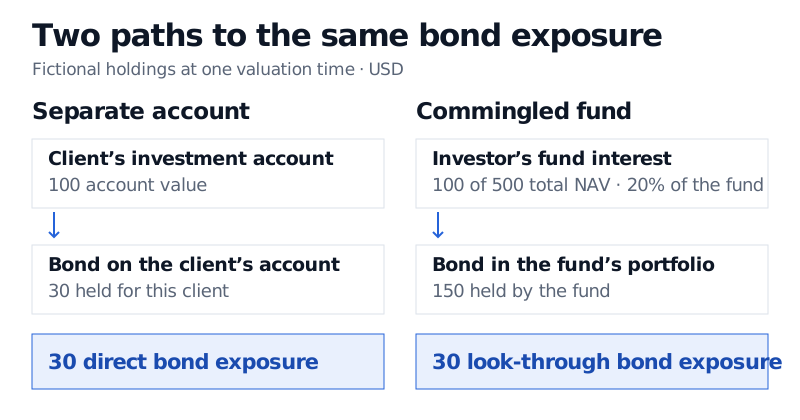
The account statement records the bond position. The fund investor's statement records units, which the risk report combines with the fund's holdings to calculate exposure.
The look-through amount measures how a change in the bond's price affects the value of the investor's units. Any right to influence the fund's trades comes from the fund's governing documents. If the fund also hedges that bond, include the hedge when measuring net exposure. If fund classes participate differently, use the actual allocation rules.
When the distinction matters
In a separate account, read the management and custody agreements for who can direct a sale or transfer and what happens when the mandate ends. A U.S. agreement form filed in 2009, for example, puts trading within written guidelines, has the client appoint the custodian, specifies how the advisory fee is calculated and requires the client to give asset instructions after termination. For U.S. advisers that use Form ADV Part 2A, the brochure also covers fees, custody and trading discretion. Filed agreement, §§ 2–5 and 14, SEC Form ADV Part 2A, Items 4–5 and 15–16.
For a pooled holding, read the documents for the share class you own. The April 2026 Vanguard Bond Index Funds U.S. mutual fund prospectus lists shareholder fees separately from fund operating expenses. Its redemption section distinguishes requesting a redemption from receiving payment and allows payment in securities in some circumstances. For cash planning, record the expected payment date and any charges separately from the bond exposure. Vanguard Bond Index Funds Investor Shares prospectus, Fees and Expenses and Additional Information Regarding Redemption of Shares.
Sources
- SEC Small Business Glossary, Pooled Investment Vehicle
- Form of Investment Management Agreement for Separate Account Clients, 2009 EDGAR exhibit
- Hamilton Lane Incorporated 2026 annual report, Customized Separate Accounts
- SEC Form ADV Part 2A brochure instructions, Items 4–5 and 15–16
- Vanguard Bond Index Funds Investor Shares prospectus, April 2026