A custodian safeguards and services client assets. Distinguish custody from investment decisions and beneficial ownership, then interpret a one-share reconciliation break without assuming a loss.
Custodian
A custodian is a bank or other financial institution that safeguards and administers assets for clients. For a quant portfolio, custody connects the strategy's recorded positions to the securities actually held and serviced: a model can report the right exposure while an unresolved settlement or recordkeeping error leaves the operating account different.
Holding assets is a different job from choosing them
Custody typically covers safekeeping, settlement support, records and reporting. Depending on the agreement, it can also include collecting income and processing corporate actions. The OCC's custody handbook describes these as contractual services whose scope varies by client.
Role
Core responsibility
Client or beneficial owner
Holds the economic interest in the assets; the legal structure determines the precise rights.
Investment manager
Chooses investments and issues instructions within its mandate.
Safeguards and services the resulting assets and maintains custody records.
These roles can sit within one financial group, but they remain different functions. Custody alone does not authorise discretionary investment management. Fabozzi and Fabozzi's sample investment management agreement makes the separation concrete: the manager has trading authority, while the client selects the custodian.
Execution agrees a trade; settlement completes the required transfers. Custody continues after settlement. The Market Participants lesson follows these distinct jobs through a trade (membership; public preview).
The registered name can differ from the economic owner
Custody does not necessarily put the client's name directly on the issuer's register. In the U.S. street-name arrangement described by the SEC and FINRA, an intermediary or nominee appears on the issuer's books, while the intermediary's records identify the investor as beneficial owner. Direct registration is a different arrangement, with the investor registered on the issuer's books.
A nominee name is therefore not, by itself, evidence that the custodian bought the securities for its own economic account. The custody chain and its records connect the registered holding to client entitlements. Nor should a fund investor be assumed to own each underlying security directly: the investor's claim may instead be units in the fund.
One missing share on a comparison record
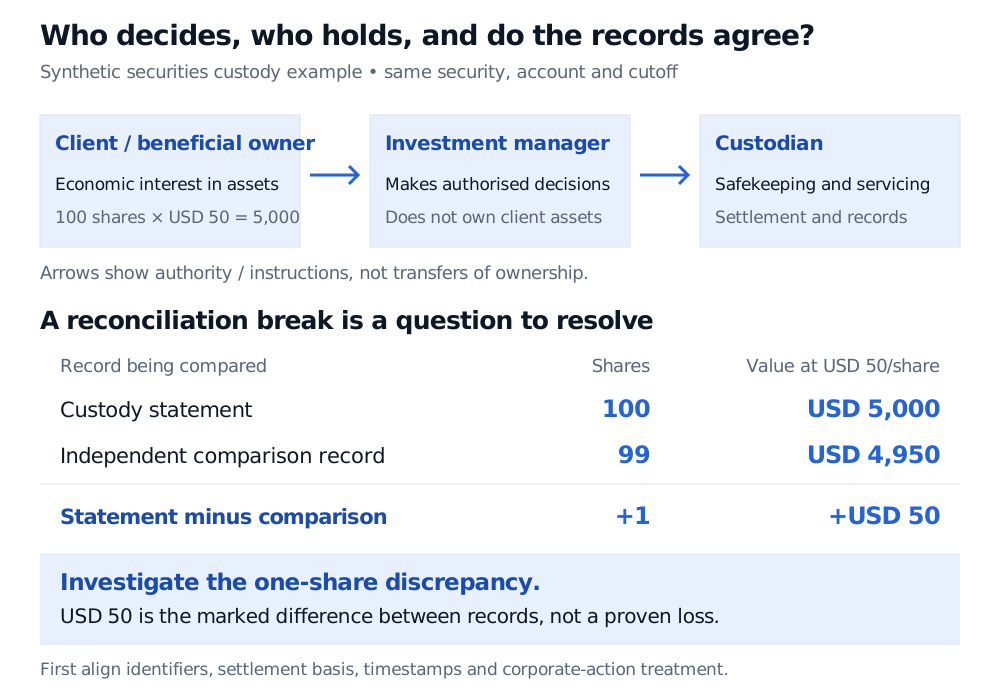
Consider a synthetic account whose custody statement reports 100 shares, each marked at USD 50, for a position value of USD 5,000. An independently maintained comparison record reports 99 shares. Align the security identifier, account, cutoff, settlement basis and corporate-action treatment before comparing them. Use the same USD 50 mark for both records; exclude fees and cash balances from this position-only comparison.
A client has the economic interest, a manager makes authorised decisions, and a custodian provides safekeeping and records. A 100-share statement marked at USD 50 values at USD 5,000; a 99-share comparison record values at USD 4,950. The one-share, USD 50 discrepancy requires investigation and is not a proven loss.
Original synthetic custody example. Both records use the same security, account, cutoff and USD 50 per-share mark. Arrows represent authority or instructions; the table compares records, not two separate holdings.
The comparison record values the position at 99×50=4,950 USD. Taking statement minus comparison gives one share, with a marked value difference of USD 50. This is a reconciliation break requiring investigation, not an automatically proven USD 50 loss. Neither record wins merely because it was called a statement or maintained independently.
Possible explanations include an omitted posting, an unsettled transfer, a timestamp mismatch or an incorrectly processed corporate action. Investigating the break means tracing the records to the underlying evidence and correcting the cause. Changing a price cannot repair a quantity discrepancy.
For firms within the relevant UK rules, FCA CASS 6.6 requires custody reconciliations and investigation of discrepancies; a difference is not resolved just by noticing it. In a quant workflow, the same discipline prevents an unexplained holding from being buried inside aggregate P&L. The positions-and-cash ledger lesson develops the accounting checks behind that discipline (membership; public preview).
Segregation reduces a particular risk
Separating client assets and records from a firm's own assets helps protect client entitlements. For example, FCA CASS 6.3 requires relevant client custody assets placed with third parties to be separately identifiable from the firm's and the third party's own assets, through account titles or equivalent protection.
The protection depends on the jurisdiction, account structure, custody chain and contractual terms. A global custodian may use local sub-custodians, adding operational and legal dependencies. Segregation does not guarantee immediate recovery after a failure or eliminate fraud, record errors or investment losses. Custody safeguards the holding process; it cannot guarantee the market value of what is held.
Sources
OCC: Custody Services — core services, operational risks and the global sub-custodian network; January 2002 handbook with the March 2025 amendment noted on its cover. Used for custody functions, not current settlement-cycle claims.
FCA Handbook: CASS 6.3 — particularly CASS 6.3.4A-1 on separate identification of assets held with third parties; UK rule text checked 25 October 2026.
FCA Handbook: CASS 6.6 — external custody reconciliations and discrepancy resolution, particularly CASS 6.6.33–34 and 6.6.48–50; checked 25 October 2026.
Frank J. Fabozzi and Francesco A. Fabozzi, Bond Markets, Analysis, and Strategies, 10th edition, MIT Press, 2021, Chapter 18, p. 434, and Appendix, The Investment Management Agreement — custody in the trade process and separation from investment-manager authority.