Use the product, quotient and power laws with the right domains, and distinguish adding log returns through time from combining assets in a portfolio.
Logarithm rules
Logarithm rules turn multiplication into addition, division into subtraction, and powers into multiplication. They explain why consecutive investment growth factors can be added after taking logarithms. They do not turn every financial calculation into an additive one.
For a real base b>0, b=1, positive arguments x,y>0, and any real exponent k:
Operation inside the logarithm
Equivalent expression
Rule
logb(xy)
logbx+logby
Product
logb(x/y)
logbx−logby
Quotient
logb(xk)
klogbx
Power
All logarithms in each identity use the same base. The laws also hold when 0<b<1. For the natural logarithm, simply replace logb with ln.
Why does the product rule work? Set u=logbx and v=logby. Then x=bu, y=bv, and xy=bu+v. Taking the logarithm returns u+v. The quotient and power laws follow from the corresponding exponent laws. To convert a logarithm's base, use change of logarithm base, rather than mixing bases within these identities.
What adds through time
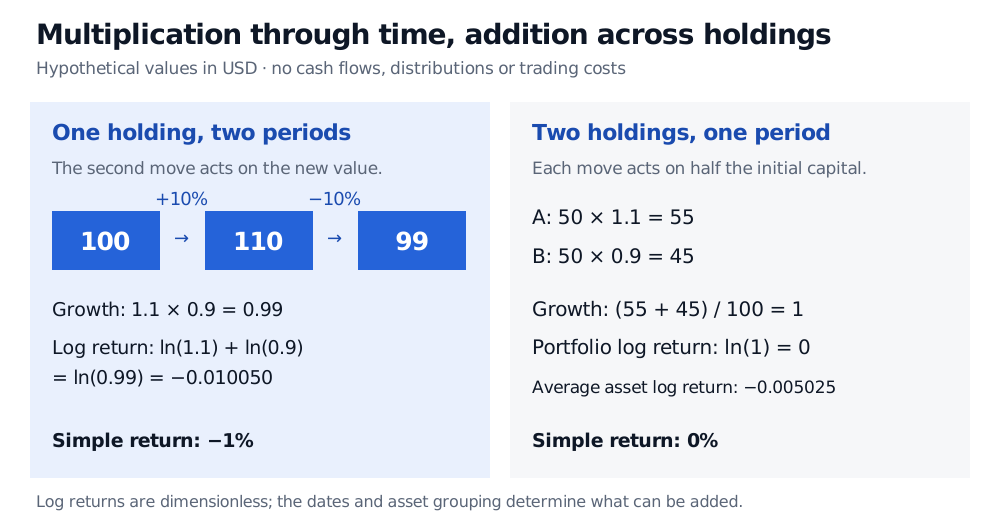
Consider a hypothetical holding worth USD 100. It gains 10% in the first period and loses 10% in the second, with no distributions, deposits, withdrawals or trading costs. Its successive values are USD 100, USD 110 and USD 99:
10099=1.1×0.9=0.99.
The product law gives the cumulative log return:
ln(1.1)+ln(0.9)=ln(0.99)≈−0.010050.
The exact identity holds before rounding. The simple return is 0.99−1=−1%; the cumulative log return is approximately −1.0050%. The two 10% moves do not cancel because the loss acts on a larger starting value.
More generally, consecutive positive prices telescope:
This is a pathwise algebra identity: it does not need independent returns or a probability model. Prices alone measure price returns; distributions require a consistently reinvested total-return series or explicit cash-flow treatment. Zero or negative values cannot be used as arguments of a real logarithm.
Hypothetical consecutive moves take USD 100 to USD 110 to USD 99, a log return of negative 0.010050. Simultaneous equal USD 50 holdings moving plus and minus 10% end at USD 55 and USD 45: portfolio log return zero, rather than the average asset log return negative 0.005025.
Original hypothetical cash-value ledger. Identical percentage moves produce different results when applied consecutively to one holding or simultaneously to separate holdings. All values are USD; no distributions, cash flows or costs.
For contrast, invest USD 50 in asset A and USD 50 in asset B over one shared period. A gains 10% and B loses 10%. The combined end value is 55+45=100, so the portfolio log return is zero. Averaging the asset log returns instead gives 21ln(1.1)+21ln(0.9)≈−0.005025.
For fixed holdings with initial value weights wi summing to one, positive asset gross returns Gi, and no cash flows or costs, the portfolio gross return is ∑iwiGi. Its log return is therefore
ln(i∑wiGi),
provided that sum is positive. It is generally not∑iwilnGi. Adding holdings' terminal values is a different operation from multiplying successive growth factors.
Keep the argument intact
There is no general rule that splits a sum inside a logarithm. For example,
ln(2+3)=ln5≈1.609438,ln2+ln3=ln6≈1.791759.
A sum can sometimes be factored before applying the product rule. For x,y>0,
ln(x+y)=ln[x(1+xy)]=lnx+ln(1+xy).
The remaining logarithm does not disappear.
Domain restrictions must also survive an expansion. Although ln(x2) exists for every real x=0, 2lnx exists only for x>0. The identity covering both signs is
ln(x2)=2ln∣x∣,x=0.
At x=−2, the left side is ln4≈1.386294; ln(−2) is undefined over the reals. Likewise, ln(x/y) may exist when both x and y are negative, while the proposed expansion lnx−lny does not. Check each argument after rewriting.
Finally, ln(xk) and (lnx)k are different expressions. The power law concerns a power inside the argument. It does not move a power applied to the logarithm itself.
For a longer route from these rules to continuously compounded rates, see Exponentials and Logarithms (public preview; full lesson requires membership).
Sources
Stewart, J. (2008). Single Variable Calculus: Early Transcendentals, 6th ed., §1.6, “Inverse Functions and Logarithms.”