Integration by substitution reverses the chain rule. Transform the integrand, differential and bounds, and track a synthetic cash stream through two dimensionless clocks.
Integration by substitution
Integration by substitution rewrites an integral in a new variable, transforming both the integrand and its differential. Often called u-substitution, it reverses the chain rule: a complicated expression becomes easier when its inner function is used as the integration variable.
The useful pattern is an inner function and its derivative. Replacing only the inner function leaves out the factor that converts small changes in one coordinate into small changes in the other. Feldman's UBC notes derive the rule directly from the chain rule.
Read the chain rule backwards
Suppose F′=f, g has a continuous derivative on the interval of interest, and f is continuous on the range of g. Then
dxdF(g(x))=f(g(x))g′(x).
Consequently, with u=g(x) and du=g′(x)dx,
∫f(g(x))g′(x)dx=F(g(x))+C.
In an indefinite integral, substitute back to the original variable in the final answer. The notation du=g′(x)dx records the chain-rule factor; it does not permit dropping factors that are inconvenient.
For example,
∫xex2dx=21∫eudu=21ex2+C,u=x2.
Here du=2xdx, so xdx=du/2. Differentiating the answer recovers xex2 and verifies the factor 1/2.
A cash-flow clock with changing speed
Consider a synthetic contractual cash stream, rather than a market forecast. Let t measure elapsed time, fix the scale τ=1 year and set K=USD 100. The stipulated receipt rate is
c(t)=τ2K(τt)exp[(τt)2].
The rate has units USD/year. Its exponential argument is dimensionless: writing the square of a time measured in years directly inside an exponential would hide a required scale.
How much cash arrives between t=0.2τ and t=0.8τ? First use the dimensionless clock x=t/τ, giving dt=τdx. Then change clocks again to u=x2:
The cash receipt rounds to USD 85.57. This is an undiscounted amount collected over the interval; present value would require a specified discount factor inside the original cash-flow integral. The positive function used here is a receipt-rate model, with no probability-density interpretation.
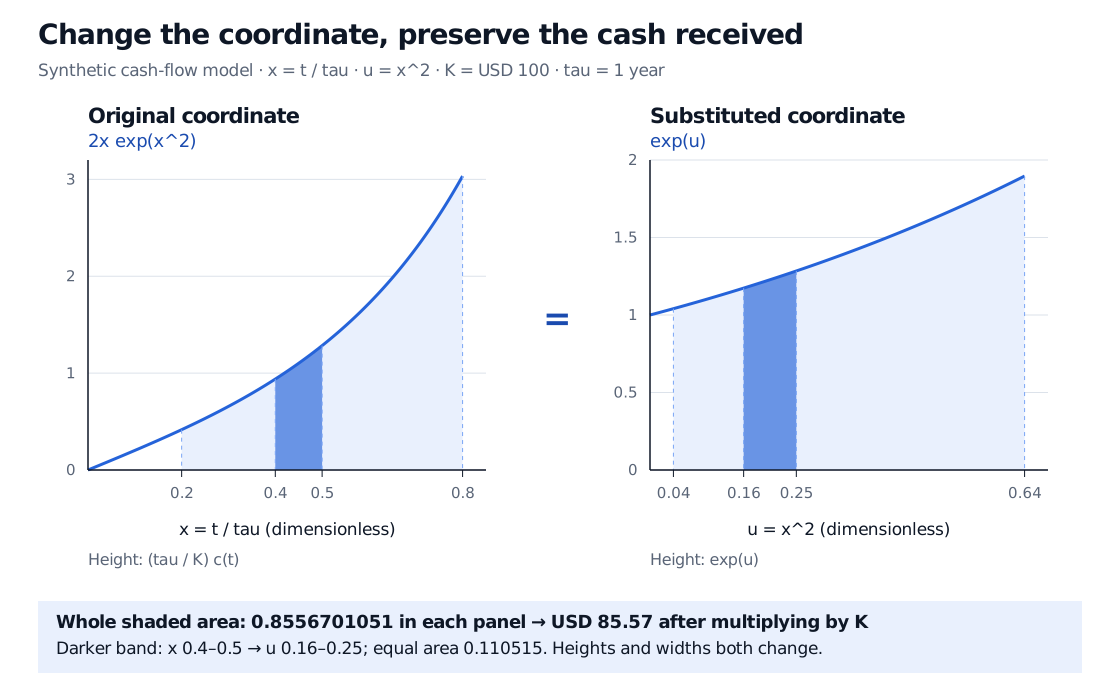
Two coordinate plots for the synthetic cash-flow model. The area under 2x exp(x squared) from x 0.2 to 0.8 equals the area under exp(u) from u 0.04 to 0.64: both are 0.8556701051, or USD 85.57 after multiplication by K equals USD 100. The darker band x 0.4 to 0.5 maps to u 0.16 to 0.25 and has area 0.110515 in both panels.
Original synthetic model. Both axes use dimensionless coordinates and normalised heights; multiplying either shaded area by K gives cash in USD. The darker bands show one corresponding subinterval.
The shapes are different because the new clock changes speed. Between x=0.4 and x=0.5, its increment is 0.25−0.16=0.09, while the original increment is 0.1. The exact relation is du=2xdx: the height factor 2x in the left panel becomes the width conversion in the right panel. Both darker bands accumulate 0.1105145457… before multiplying by K.
There are two consistent routes: change the bounds and evaluate in u, or find the antiderivative, substitute back to x, and evaluate at the original bounds. Mixing these routes gives the wrong interval. In the cash example, ∫0.20.8eudu would use the old numbers on the new clock. OpenStax's substitution section explains both the transformed integrand and transformed limits.
A decreasing substitution can reverse the bounds. Keep their order and the differential's sign together; do not sort the endpoints independently.
Nor does the chain-rule identity require g to be one-to-one. For instance, u=x2 on [−1,1] travels from 1 down to 0 and back to 1, and
∫−112xex2dx=∫11eudu=0.
The negative and positive contributions cancel. This does not justify replacing ∫−11ex2dx with a zero-length integral: the derivative factor 2x is absent. If a change of variables requires an inverse map, split a non-monotone domain into branches and transform each branch correctly. Signed chain-rule substitution and an unsigned area or probability transformation are different calculations.
Substitution is useful when it makes the remaining integral simpler. Choosing u=x2 in ∫ex2dx on x>0 produces ∫eu/(2u)du; it does not turn it into ∫eudu. A legal substitution need not provide an elementary antiderivative.
James Stewart, Single Variable Calculus: Early Transcendentals, 6th edition, §5.5, pp. 400–405 — substitution as the reverse chain rule and the definite-integral substitution theorem.