Insurance company financial statements show how an insurer earns revenue, what it estimates it owes on claims, and how its assets, liabilities and cash changed. For equity or credit analysis, separate the result from underwriting policies from the result on invested assets. Then check how much of the underwriting result came from revised estimates on old claims. Cash may arrive before the insurer earns the premium, and claims may take years to settle. Chubb, 2025 Form 10-K, Item 7 and consolidated financial statements
What each statement tells you
- The income statement measures activity over the period. In Chubb’s U.S. GAAP filing, written premiums reflect the business it wrote, while earned premiums reflect the portion recognised for coverage provided. Cash premiums are amounts actually collected. The filing shows net investment income and realised gains and losses on separate lines. Chubb, 2025 Form 10-K, statement of operations and Note 1(b)
- The balance sheet shows what the insurer holds and owes at the reporting date. In a property and casualty (P&C) filing like Chubb’s, look for investments, unearned premiums for unexpired coverage, and reserves for claims that have already occurred. Claim reserves include estimates for reported claims still unpaid and claims incurred but not yet reported. Chubb, 2025 Form 10-K, balance sheet and Notes 1(b), 1(k) and 8
- The cash flow statement tracks cash movements. Receiving a premium, paying a claim and selling an investment are cash events. An insurer can also record a higher claim expense when it revises a reserve before it pays anything more. Chubb’s cash flow statement starts from net income and adjusts for changes in balances such as unpaid losses and unearned premiums. Chubb, 2025 Form 10-K, statement of cash flows and Note 8
How 100 of earned premiums becomes 13 of pretax profit
A fictional P&C insurer reports 100 in earned premiums, 65 in incurred claims and claim-handling costs, and 30 in other underwriting expenses. All figures are in USD millions. There is no reinsurance. Net investment income is 8, and this example has no separate investment gains or losses, financing costs or other income or expenses.
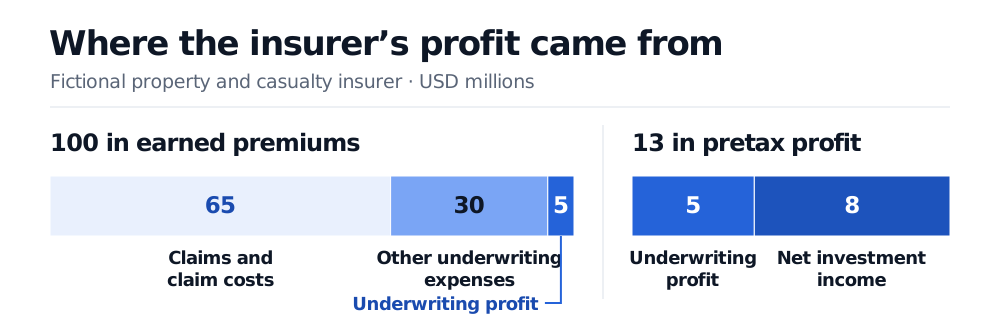
Net investment income contributes more to pretax profit than underwriting does in this example. Each bar shows the split of its own total.
With earned premiums as the denominator for both claims and expenses, the combined ratio is . Chubb also uses net premiums earned for each component of its P&C ratio. For comparisons, check which business lines and expenses are included, whether the figures are net of reinsurance, and whether the ratio excludes catastrophe losses or revisions to prior-year claims. Chubb, 2025 Form 10-K, Item 7, “P&C Combined Ratio” and “Non-GAAP Financial Measures,” and Note 5
Why incurred claims exceed payments
Suppose the insurer’s 65 of incurred claim costs consists of 61 for events this year and a 4 upward revision for earlier events. It pays 40 on claims during the year. With opening claim reserves of 50 and no other reserve movements, the balance sheet ends the year with claim reserves of . The upward revision is adverse prior-period development. It reduces this year’s underwriting profit because the insurer now expects old claims to cost more. The reserve note lets you separate that reassessment from the estimated cost of events that occurred this year. Chubb, 2025 Form 10-K, Note 8, “Unpaid losses and loss expenses”
Check the reporting basis before comparing insurers
IFRS 17 insurance revenue reflects insurance services provided during the period and excludes investment components of the contracts. The standard separates the insurance service result from insurance finance income or expenses, which can include the effect of discount-rate changes on insurance contract balances. Keep that finance line distinct from income on invested assets. Premiums collected, U.S. GAAP earned premiums and IFRS 17 insurance revenue measure different things. IFRS Foundation, IFRS 17, paragraphs 80–87 and 110
U.S. statutory reporting serves state insurance supervision and focuses on the insurer’s ability to meet policyholder obligations. Its asset recognition and surplus measures can differ from those used in a U.S. GAAP group filing. Use the statutory statements of the relevant insurer when assessing its regulatory surplus, and match the reporting entity and accounting basis before comparing figures. NAIC, Statutory Accounting Principles · Chubb, 2025 Form 10-K, Note 22