Reinsurance is cover an insurer, called the cedent, buys from a reinsurer for losses on the business it has insured. A quota-share treaty passes a fixed percentage of covered losses and corresponding premiums to the reinsurer. An excess-of-loss treaty reimburses losses above a threshold, up to a limit. Quota share reduces the insurer’s exposure across covered loss sizes. Excess of loss concentrates the recovery in a specified range of losses. NAIC Receiver’s Handbook, Chapter 7, §3 · Everest Reinsurance Holdings, 2025 Form 10-K, Item 1
One covered loss of 90
Compare two fictional, standalone treaties, each applied separately to one covered occurrence. Amounts are in USD millions. Assume full collectability, full participation by the reinsurer in the excess layer and no other treaty provisions that affect the payout. The figures show losses and recoveries before reinsurance premiums and commissions.
- 40% quota share. The reinsurer takes . The insurer retains .
- 30 xs 50 excess of loss. Read this as “30 in excess of 50.” The attachment is 50 and the limit is 30, so the layer covers the portion of the loss above 50 through 80. Of the 40 above attachment, 30 is recoverable. The insurer keeps the first 50 and the 10 above the top of the layer, for 60 in retained loss.
For covered loss , attachment and limit , full participation in this simple layer gives recovery . The retained loss is . In a disclosed example, Everest’s Canadian branch provided Everest Canada with up to CAD 150 million of cover above CAD 25 million per catastrophe occurrence for the 2025 treaty year. Everest Reinsurance Holdings, 2025 Form 10-K, Note 16
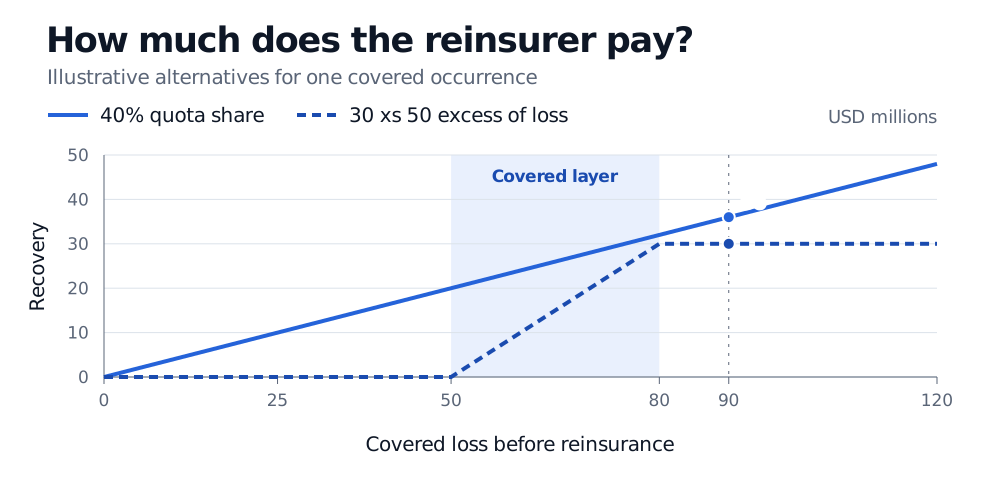
Each additional dollar of loss adds 40 cents of quota-share recovery. The excess-of-loss recovery rises dollar for dollar within the shaded layer and stays flat once the limit is exhausted.
Count occurrences before applying the layer
Two covered claims of 45 produce a recovery of 30 if the treaty treats them as one occurrence of 90. If they are separate occurrences, each falls below the attachment and total recovery is zero. Check whether the treaty applies the threshold per risk, per occurrence or to aggregate losses for a period. An aggregate recovery cap can also limit payments across multiple occurrences. If the contract permits reinstatement, used limit can be restored for future losses, sometimes for an additional premium. NAIC Receiver’s Handbook, Chapter 7, §3 · RLI, 2025 Form 10-K, Item 1, “Reinsurance”
To estimate expected recovery, apply the treaty terms within each modelled loss scenario and average the results. That expected recovery is one input to pricing the cover. Section 5.2 and Exercise 3 of the SelfMadeQuant lesson work through the expected payout above a retention for cover with no cap. Expected Shortfall and Other Tail Risk Measures (membership, public preview)
Separate the recovery from the economics
Comparing the treaties means weighing the recoveries across loss scenarios against the cost of the cover. Under quota share, the insurer cedes the agreed portion of covered premiums and may receive a ceding commission to help cover acquisition costs. Excess-of-loss cover has its own negotiated premium basis. In insurance company financial statements, read ceded losses alongside ceded premiums to see both sides of the trade. Everest Reinsurance Holdings, 2025 Form 10-K, Item 1
The insurer still owes its policyholders and faces counterparty credit risk on the amounts due from the reinsurer. The loss split measures contractual recovery. Any regulatory capital benefit depends on the applicable rules and how they recognise the arrangement. RLI, 2025 Form 10-K, Item 1, “Reinsurance” · NAIC, Reinsurance