Insurance embedded value (EV) estimates what an insurer’s covered business is worth to shareholders as of a reporting date. It combines adjusted net worth with the present value of future shareholder earnings from policies already on the books, after allowing for risk under the stated methodology. Life insurers disclose it because premiums, benefits and expenses on a policy can run for decades. Analysts use EV to estimate the value already in the book and the movement in EV to see how much value new sales added during the period. CFO Forum EEV Principles 2–3, 8 and 12
What goes into the total?
- Free surplus is the value of assets allocated to the covered business above what is needed to back policy liabilities and meet required capital.
- Required capital is the part of the covered business’s net assets that shareholders must leave in the business to support the policies. It belongs in the value of the book even though its distribution is restricted. The valuation accounts for the cost of holding it.
- Value of in-force business (VIF) is the discounted value of future shareholder profits on covered policies in force at the valuation date. The projection reflects items such as future premiums and investment income, less policy benefits, expenses and taxes. Where the filing shows a net VIF, check which adjustments it already includes. European Insurance CFO Forum Market Consistent Embedded Value Principles 3–9, Copyright © Stichting CFO Forum Foundation 2008
Suppose a fictional life insurer reports 15 million of free surplus, 25 million of required capital and 30 million of VIF after all adjustments under its reporting method. The first two amounts make up adjusted net worth of 40 million. All three are on the same valuation date and in the same currency.
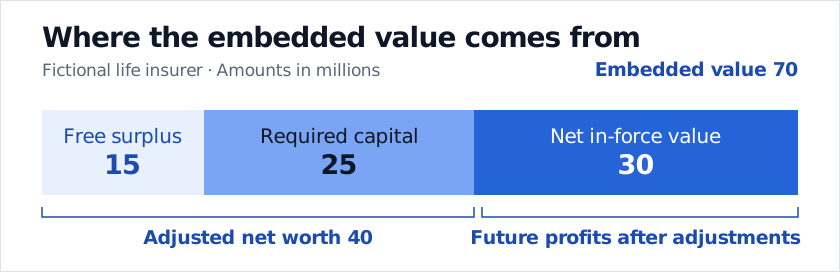
The first two amounts come from assets held at the valuation date. The final amount comes from projected profits on the existing policies.
You can follow the same reconciliation in Prudential plc’s year-end 2025 Traditional Embedded Value (TEV) disclosure. All figures are in millions of US dollars. Its insurance operations reported free surplus of 6,352 and required capital of 7,761. The report deducts capital costs of 1,021 from gross in-force value of 23,094. Adding the resulting 22,073 to net worth gives embedded value of 36,186 for those operations, excluding goodwill attributable to equity holders. Prudential plc FY2025 results, TEV Note 2(a)
Where the policy book ends
A premium expected next year on a policy in force today can belong to VIF, subject to the methodology’s renewal and contract boundary rules. A policy the insurer expects to sell next year falls outside today’s embedded value. The value of new business in a year’s results measures the value created by policies sold during that reporting period and may include qualifying increases to existing contracts. It appears in the movement from opening to closing embedded value as those sales join the in-force book. Adding it to closing EV would count that contribution again. CFO Forum MCEV Principle 10, Prudential plc FY2025 results, TEV Note 2
How to compare reported figures
Start with the methodology note. The CFO Forum’s European Embedded Value (EEV) guidance uses a margin in the discount rate for remaining risk and presents the cost of holding required capital against that capital. Insurers can present the components differently, as Prudential does. The CFO Forum’s Market Consistent Embedded Value (MCEV) principles calibrate risk to market prices where those prices can be observed reliably. To calculate MCEV’s in-force component, the insurer reduces the present value of projected profits by the time value of options and guarantees, the frictional costs of required capital and the cost of residual risks that cannot be hedged. Both approaches depend on assumptions about mortality, lapses and expenses. A guaranteed minimum return can become costly in low-yield scenarios, so a single projection at average yields can miss the cost. CFO Forum EEV Principles 5–7 and 9–10, CFO Forum MCEV Principles 6–9 and 11
In a valuation table, EV can also stand for enterprise value, which values operations across capital providers. Embedded value is a shareholder measure for a defined book. Market capitalisation is the traded equity value of the whole listed company and can reflect future sales, other businesses and different expectations about the existing book. A price-to-embedded-value comparison therefore starts by matching the reporting date and checking which operations and ownership interests the denominator covers. Accounting fair value under IFRS 13 has a separate objective. It estimates the market-participant exit price for an asset or liability. CFO Forum MCEV Principles 2–3, IFRS Foundation, IFRS 13