An institutional asset owner is an organisation that holds an investment pool, either for its own purposes or on behalf of beneficiaries. Pension funds, insurers, sovereign wealth funds and university endowments are common examples. The owner’s governing body sets the investment objectives and oversees the strategy for the whole pool. A manager can beat the benchmark for its part of the portfolio while the owner’s overall position deteriorates because other assets fell or the value of its obligations rose.
Who sets the strategy and who makes the trades?
A pension trustee can approve the strategic asset allocation and delegate stock selection to an external equity manager. The investment mandate can specify the manager’s benchmark, permitted investments, risk limits and reporting. The trustee still reviews whether that assignment fits the whole plan’s needs. The same distinction applies when the manager is an in-house team. In Australian superannuation, APRA’s SPS 530 assigns approval of investment strategy and oversight of investment objectives to the board of a registrable superannuation entity licensee. APRA, SPS 530, The role of the Board and Monitoring investments
The SelfMadeQuant lesson Fund Management and Retirement Investing in Australia maps the roles of trustees, managers, consultants, administrators and custodians. The preview is public and the full lesson requires membership.
What the trustee sees in a funding report
Suppose a fictional defined benefit pension plan has assets of 110 and benefit obligations with a present value of 100, both measured for the same plan, in the same currency, on the same date and on a consistent valuation basis. Its simplified funding ratio is . The 10-unit surplus is a snapshot on that basis. A regulatory funding assessment would require the measures prescribed under the applicable rules. Pension funded status, AASB 119, paragraphs 57 and 113
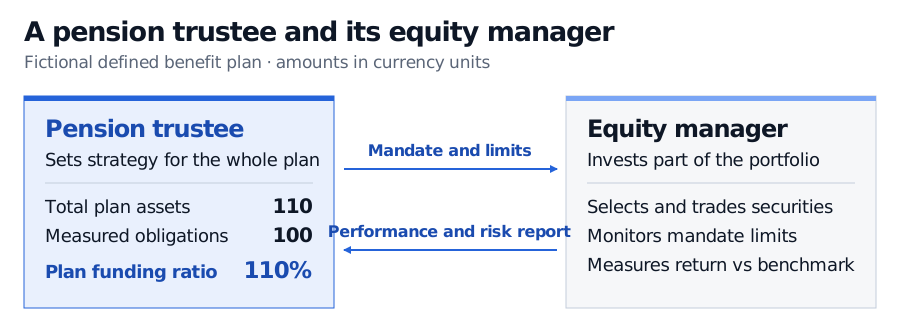
The mandate goes to the manager. Performance and risk reports come back to the trustee, who monitors funding for the whole plan.
A trustee also needs to know when benefits are due and which assets can be turned into cash in time. In asset-liability management, the investment team can stress the assets and benefit obligations together. For example, falling yields can raise the present value of promised payments. The effect on funding also depends on how the plan’s assets respond.
The pool’s purpose shapes the portfolio
| Asset owner | What its investments need to support |
|---|---|
| Defined benefit pension fund | Promised retirement benefits. The timing of benefit payments and the sensitivity of their value to rates affect the fund’s cash needs and exposure to interest rates. AASB 119, Amount, timing and uncertainty of future cash flows |
| Insurer | Claims and policy benefits. A life insurer with long-dated guarantees can assess how rate changes affect assets and obligations together, alongside its capital requirements. APRA, LPS 114, Real interest rates stress |
| Sovereign wealth fund | The public purpose set by its mandate. Norway’s Government Pension Fund Global supports long-term government saving and can face withdrawals linked to the fiscal budget. The Ministry of Finance sets its mandate and Norges Bank manages the investments. Norges Bank Investment Management, Annual Report 2025, Note 1 |
| University endowment | Spending for the university today and support for future generations. Yale’s policy smooths annual distributions while aiming to preserve long-term purchasing power. Yale University, Policy 2202, Endowment Spending Policy |
Sources
- Australian Prudential Regulation Authority. SPS 530 Investment Governance.
- Australian Accounting Standards Board. AASB 119 Employee Benefits, defined benefit plans.
- Australian Prudential Regulation Authority. LPS 114 Capital Adequacy: Asset Risk Charge.
- Norges Bank Investment Management. Annual Report 2025.
- Yale University. Policy 2202, Endowment Spending and Distributions.