Inflation targeting is a monetary policy framework in which a central bank publicly specifies an objective for the rate of inflation and uses policy to keep inflation near that objective over time. For a rates analyst, the target is a reference point for interpreting economic news and changes in the expected path of the policy rate. The official framework specifies which price index and time window matter. RBA, Australia’s Inflation Target
A return to 2% can leave prices higher
Suppose a fictional central bank targets 2% annual inflation and its price index rises from 100 to 103 over one year. Annual inflation is
Inflation is 1 percentage point above target. If inflation is exactly 2% the following year, the index rises from 103 to . The comparison path that grew at 2% in both years reaches . The rate is back at target even though the index is still above that comparison path. A price-level target would instead specify a path for the index itself.
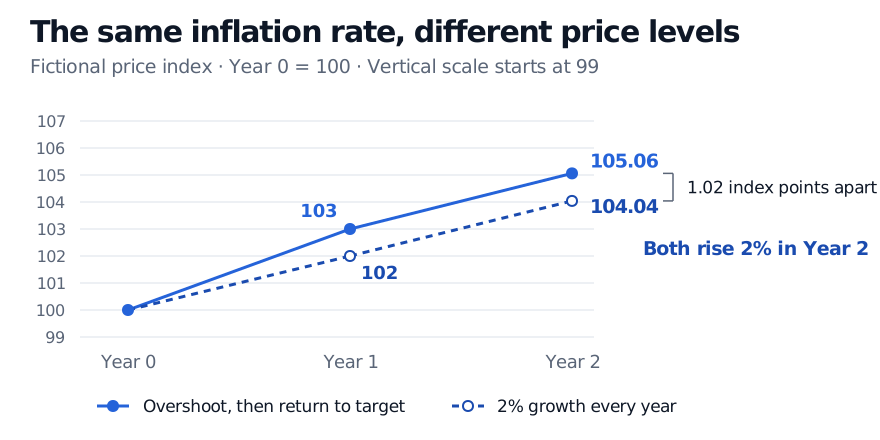
Both paths reach 2% inflation in Year 2. The price-level gap created by the first-year overshoot persists when both indices grow at the same rate.
The same miss can mean different things
A one-off disruption to fuel supply can raise the price of fuel once and keep it high. Its direct effect on annual inflation fades once both months in the year-over-year comparison include the higher price. Since policy affects spending and prices with a lag, a rate change made in response to that release could take effect after the direct inflation impact has faded. If cost increases instead spread to more prices and longer-term inflation expectations move up, wage and price decisions can sustain the pressure after the initial shock. RBA, Understanding Supply Shocks
Policymakers assess whether new data change the projected path back to target, given the assumed path of interest rates and the risks around that projection. A Taylor rule gives a benchmark policy rate from a specified formula using inputs such as the inflation gap and a measure of spare capacity. The inflation target is an objective, and a published projection describes an outlook conditional on its assumptions. A single inflation gap leaves both the size and timing of a policy move open. RBA, Forward Looking and Data Dependent, Federal Reserve, Monetary Policy Report, Box 4
Credibility matters for currencies and bonds as well. In an emerging economy where import prices respond strongly to exchange rates, a depreciation can raise inflation and unsettle longer-term expectations. A capital outflow can also weaken the currency while raising local sovereign borrowing costs through higher risk premia. A weaker currency and higher yields can therefore occur together even without an increase in the policy rate. BIS, Monetary policy frameworks in emerging market economies
Read the framework in force on the date
Australia’s agreement of 10 July 2025 sets a 2–3% range for annual consumer price inflation. The Reserve Bank of Australia (RBA) aims for inflation to return to the 2.5% midpoint over a timeframe that depends on conditions, including any trade-off with full employment. The agreement treats outcomes within the range as consistent with price stability. Statement on the Conduct of Monetary Policy, RBA, Australia’s Inflation Target
The US Federal Reserve’s 2020 framework said that after a persistent undershoot it would likely aim for moderately above-target inflation for a time. Its August 2025 revision removed that makeup approach while keeping the longer-run 2% objective for annual inflation in the personal consumption expenditures price index. The Federal Open Market Committee reaffirmed the revised statement in January 2026. Powell, August 2025 framework review, Federal Reserve, 2025 strategy statement, January 2026 reaffirmation
For a historical analysis, pair the framework in force at each decision with the releases and projections available at that time. Where data are revised, using today’s figures can introduce look-ahead bias. Section 3 of the SelfMadeQuant real-time macro forecasting project (membership required) shows how to reconstruct historical inputs, including CPI, for an industrial-production forecast.
Sources
- RBA and the Treasurer, Statement on the Conduct of Monetary Policy, 10 July 2025
- RBA, Australia’s Inflation Target
- RBA, Monetary Policy: Forward Looking and Data Dependent in the Face of Uncertainty
- RBA, Understanding Supply Shocks and Their Implications for Monetary Policy
- Federal Reserve, Monetary Policy Report, Box 4, July 2026
- Federal Reserve, 2025 Statement on Longer-Run Goals and Monetary Policy Strategy
- Federal Reserve, Reaffirmation of the Strategy Statement, January 2026
- Jerome Powell, Monetary Policy and the Fed’s Framework Review, August 2025
- BIS, Monetary policy frameworks in emerging market economies, 2019