An index provider is an organisation that supplies a financial index, such as a stock index, for use as a market measure, a benchmark or a reference for investment products. The provider’s methodology determines the exposure a fund is asked to track. A change in which stocks qualify, how they are weighted or when changes take effect can alter that exposure and prompt trades in an index fund. S&P Dow Jones Indices’ Index Mathematics Methodology
Who sets the rules, and who uses them?
- The benchmark administrator oversees how the index is determined. Its methodology specifies eligible securities, weights, rebalancing dates and the treatment of events such as splits or constituent replacements. Governance covers how the rules are reviewed and changed. S&P Dow Jones Indices (S&P DJI), for example, uses index committees and consults stakeholders on potential material methodology changes. S&P DJI’s index governance
- A calculation agent applies the methodology to inputs such as closing prices and share counts. The provider or a data distributor can then deliver levels, constituent data or corporate-action files. A product licence can grant permission to reference the index and use its brand on agreed terms. Data subscriptions and display licences can serve other uses, such as benchmarking or publishing live levels. A fund acquires any securities it needs separately. S&P DJI’s data and licensing services
- The product sponsor and fund manager bring the fund to market and implement its tracking strategy. The manager decides how to replicate the exposure within the mandate. A fund that holds a sample of the basket can diverge from the benchmark. Fees and trading costs can also reduce the fund’s return. SEC Investor.gov’s index-fund guide
Licensing and custom calculations are sources of revenue for S&P DJI. For certain custom indices, S&P DJI acts as administrator and calculation agent while its client owns the index and licenses the associated rights. S&P DJI’s methodology and licensing disclosure, S&P DJI’s custom index services
“Benchmark administrator” can also be a regulatory designation. Under the UK Benchmarks Regulation, for example, a regularly determined public index can fall within scope when an investment fund uses it to track returns. The FCA explains that UK entities carrying out in-scope benchmark administration in the UK need authorisation or registration. FCA’s UK Benchmarks Regulation guidance
What the published return measures
A fictional two-stock price-return index starts with weights of 60% in A and 40% in B. Over one period A gains 10% and B loses 5%, measured as simple price returns in the same currency. Keep the constituent quantities and divisor fixed, with no rebalancing, corporate actions, dividends or costs. Each stock’s return contributes in proportion to its beginning weight:
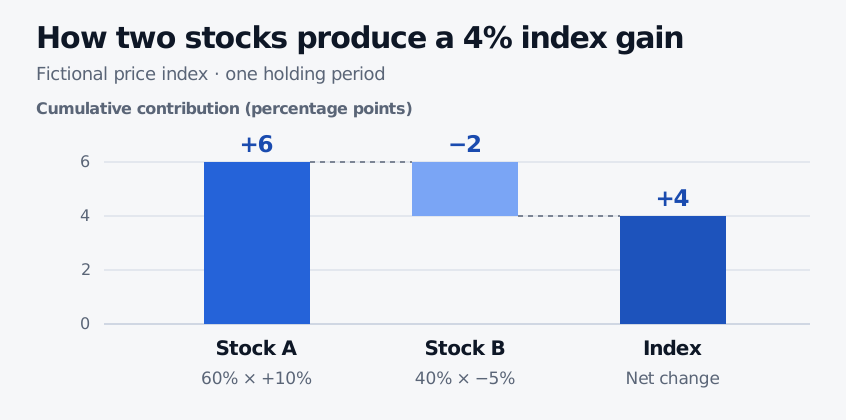
Stock B offsets two percentage points of Stock A’s contribution. The connecting lines show the arithmetic of the decomposition.
For a real index, the methodology tells you which adjustments to apply before computing the return. A provider can change the divisor when a stock is replaced so that the switch itself leaves the level continuous at the same prices. A total-return version also credits dividends under its reinvestment rules. When measuring how closely a fund tracks, match the exact series, currency and closing times before interpreting any return gap. S&P DJI’s divisor and total-return calculations
The SelfMadeQuant lesson Equities, Indices and Corporate Actions works through how a divisor change keeps a price-weighted index continuous after a stock split. The preview is public and the full lesson requires membership.
Sources
- S&P Dow Jones Indices, Index Mathematics Methodology, September 2026, pp. 6–8, 21–22 and 79.
- S&P Dow Jones Indices, Index Governance, Data & Index Licensing and Custom Index Solutions.
- Financial Conduct Authority, UK Benchmarks Regulation, “Benchmarks and indices defined” and “Benchmark administrators.”
- SEC Investor.gov, Index Funds, fund costs, sampling and tracking.