Convert equity beta to unlevered beta and back using market leverage and a model for the interest tax shield.
Hamada equation and unlevered beta
The Hamada equation converts a company's equity market beta into the beta of the same assets financed entirely by equity, and back again. This unlevered beta captures the assets' exposure to market movements before the effect of borrowing. Holding the business fixed, an analyst can apply a different financing mix to estimate the equity beta for a CAPM cost of equity.
Let D and E be the market values of interest-bearing debt and common equity, and T the marginal corporate tax rate. In the standard case, debt and the interest tax shield have negligible market beta, and the shield is worth TD. With only debt and common equity as financing claims, the two directions are
βE=βU[1+(1−T)ED],βU=1+(1−T)D/EβE.
Why the tax adjustment appears
Write the levered firm's value as the unlevered value VU plus the present value S of the interest tax shield. In this model, the shield is the only financing effect on total value, so VU+S=E+D. Both sides represent the same aggregate cash flows. The beta of either side is the market-value-weighted average of its components' betas because covariance with the same market return is linear. Multiplying through by the common total value gives
VUβU+SβS=EβE+DβD.
If debt and the shield have zero beta, the market exposure in dollars, VUβU, sits entirely with equity holders. With a permanent fixed amount of riskless debt, a constant tax rate and fully usable deductions, the tax savings are a perpetuity discounted at the debt rate, worth TD. This gives VU=E+(1−T)D, so the ratio VU/E is precisely the multiplier in the Hamada equation. If the firm also holds substantial non-operating assets, its unlevered beta reflects those assets as well. Hamada (1972), Section II, equations (4)–(5) · Modigliani and Miller (1963), equation (3) and notes 5 and 9
Same dollar exposure, smaller equity base
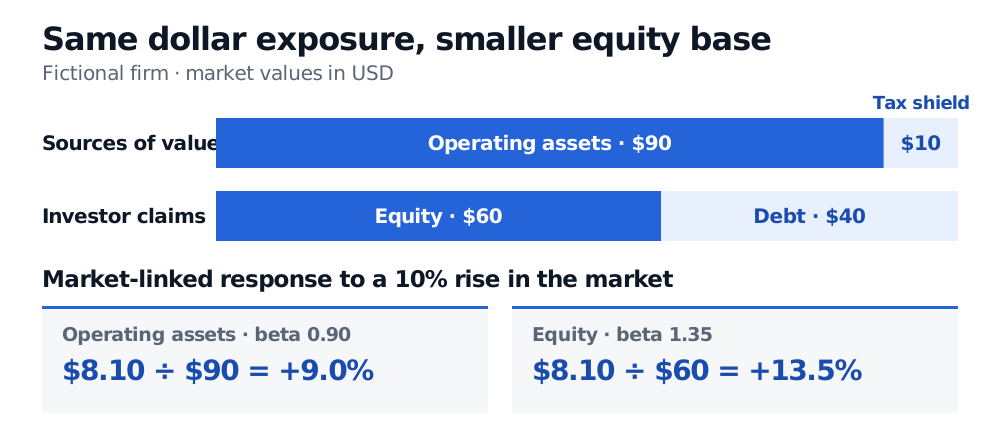
Suppose a fictional firm has USD 60 in market equity, USD 40 in market debt, an unlevered beta of 0.90 and a 25% marginal tax rate. The shield is worth USD 10, so the unlevered business is worth USD 90. For a hypothetical 10% rise in the market, the beta-implied component of the operating return is 9.0%, or USD 8.10. With zero market exposure in the shield and the debt, the same USD 8.10 is 13.5% of the equity base. The equity beta is therefore 13.5%/10%=1.35. Dividing by the leverage multiplier of 1.50 recovers 0.90.
In a fictional firm, USD 90 of operating assets plus a USD 10 tax shield equal USD 60 of equity plus USD 40 of debt. For a 10% rise in the market, the market-linked gain is USD 8.10, or 9.0% of operating assets and 13.5% of equity.
Both bars sum to USD 100. Operations and equity have the same dollar exposure in this example, with betas of 0.90 and 1.35 respectively.
Match the beta to the financing assumptions
Use D/E in the multiplier. The firm's D/(D+E) is 40%, which converts to D/E=0.40/(1−0.40)=2/3. If you unlever a historical equity beta, match the debt and equity inputs to the financing regime that generated the returns. After a recapitalisation, a beta estimated mostly before the change can misrepresent today's leverage. Use the financing mix assumed in the valuation when relevering. The bottom-up beta workflow applies these steps to a set of comparable businesses. Hamada (1972), Section II · Damodaran, Estimating Risk Parameters, “Degree of Financial Leverage”
If debt itself has market exposure, part of the firm's dollar exposure belongs to debtholders. If deductions become harder to use in downturns or the firm resets borrowing as asset values move, the shield's value and market beta can change. For the same two-claim setup with the shield as the only financing effect, rearrange the value-weighted relation using betas measured against the same market benchmark and horizon.
βE=E(E+D−S)βU+SβS−DβD.
Step 3 of the SelfMadeQuant lesson derives how CAPM uses the resulting equity beta to price market exposure. The page offers a public preview and the full lesson requires membership. Derivation — CAPM from Portfolio Theory