A green bond dedicates its proceeds to financing or refinancing eligible environmental projects. A sustainability-linked bond (SLB) has a financial or structural term, such as its coupon rate, that can change based on performance against a predefined sustainability target. SLB proceeds generally fund the issuer’s broader activities. A single issue can combine both features, in which case the analyst checks both the allocation of proceeds and the terms that change the cash flows. ICMA Principles Guidance Handbook, overview
Where did the money go?
A utility could issue a green bond to fund eligible grid upgrades. Under ICMA’s voluntary Green Bond Principles, it sets project eligibility criteria, tracks an amount equal to the net proceeds and reports on allocation and expected environmental impact. The allocation report tells investors which projects the financing supported. The bond terms establish who owes the payments and what backs them. For a standard unsecured green use-of-proceeds bond, investors have recourse to the issuer and bear its credit risk. ICMA Green Bond Principles, core components and Appendix I
The EU’s European Green Bond (EuGB) designation is a separate legal label that issuers can choose to use if they meet the requirements of Regulation (EU) 2023/2631. The regulation has generally applied since 21 December 2024. Regulation (EU) 2023/2631, Articles 3 and 72
When does the coupon change?
The same utility could issue an SLB with emissions intensity as its key performance indicator (KPI) and a specific threshold on a specified date as its sustainability performance target (SPT). Investors can assess the target against historical performance and check which operations and emissions the measure covers. Independent verification tests performance against the stated target. The bond terms define the effect of a miss and what happens if the issuer cannot measure or verify the KPI as scheduled. ICMA Sustainability-Linked Bond Principles, sections 1–5
Suppose the fictional utility issues a USD 100 million SLB paying 4.00% annually. Its target is at most 0.40 tonnes of CO₂e from direct generation emissions per MWh generated for the year ending 31 December 2030. A verified result of 0.42 misses the target and triggers a coupon increase of 25 basis points. The terms set 30 June 2031 as the deadline for the verified report. Interest at 4.25% begins accruing on 1 July 2031 and the utility pays the first adjusted coupon on 1 July 2032. Assume the full principal stays outstanding for that one-year accrual period and the issuer pays as promised.
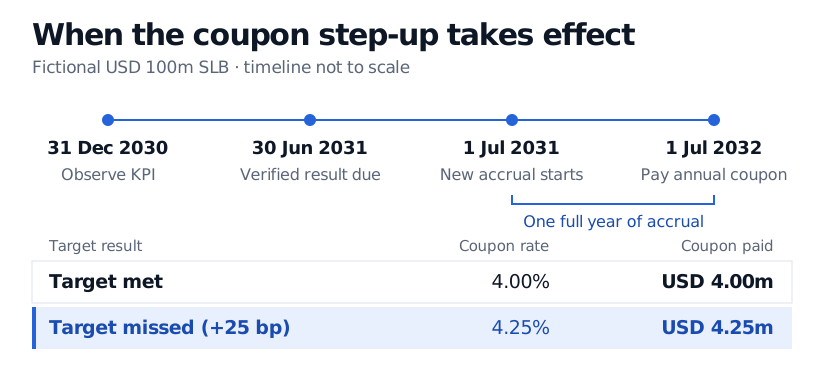
The missed target adds USD 250,000 to the coupon paid after one full year at the higher rate.
For a partial accrual period, use the contract’s day count convention. For a callable bond, check the first call date and whether the redemption price includes compensation for the step-up. A call before the coupon reset can end future interest accrual before the higher rate takes effect. When valuing the feature before observation, discount the extra cash flows in the scenarios where the contract makes them payable, allowing for the timing of any call or default. ICMA Sustainability-Linked Bond Principles, Appendix I and ICMA Principles Guidance Handbook, Q4.4.2