A fund administrator is a service provider that handles agreed operating tasks for an investment fund. When the mandate includes fund accounting, the administrator maintains the books, reconciles balances and calculates the net asset value (NAV). A missed expense or an incorrect share count can change the NAV used to price investor orders even if every security price is correct. Some agreements also cover financial reporting and regulatory filings. Guggenheim funds and BNY administration agreement, Schedule I
What goes into the NAV close
The custodian safeguards the fund’s securities and keeps custody records. The fund accountant compares those records with the positions and cash in the fund’s books and investigates differences. An unsettled trade, for example, can appear in the fund’s trade-date books before the securities arrive in custody. The accountant applies prices from the sources specified in the valuation policy and records income and expenses incurred through the valuation point, including fees still to be paid. Guggenheim funds and BNY administration agreement, Schedule I
The unit count comes from a separate record. The transfer agent typically maintains the investor register and records unit issues and redemptions. The fund accountant checks that the unit count used for NAV agrees with the register for the same valuation point under the fund’s accounting and dealing rules. A provider group can take on several roles under separate agreements. Filed transfer agency agreement, Schedule 1, Guggenheim funds and BNY administration agreement, § 1 and Schedule I
Suppose a fictional single-class fund closes with assets worth USD 103, accrued liabilities of USD 3 and ten equal units outstanding. Its NAV per unit before any dealing adjustments is
If the expense accrual were missed, the books would overstate NAV by USD 0.30 per unit, even though the cash balance matched the custodian’s statement.
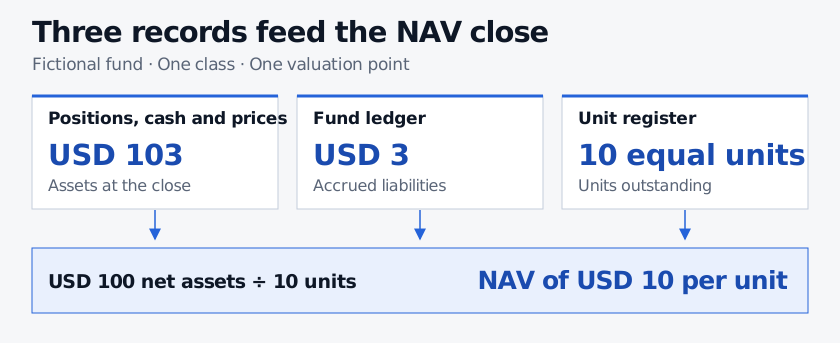
The closing NAV draws on three sets of records. Even when holdings and prices are right, a missing expense or an out-of-date unit count changes the result.
Who decides the price when a quote is unreliable?
The administrator can flag a suspect mark and escalate it under the valuation policy. For a U.S. registered management investment company, the board determines fair value in good faith when a market quotation is unavailable or unreliable. It can instead designate the fund’s investment adviser, or officers of an internally managed fund, to make those determinations under board oversight. The portfolio manager selects investments. The rule requires a valuation designee to separate fair-value determinations from portfolio management so that the portfolio manager cannot decide or effectively control those marks. In the filed BNY agreement, BNY uses prices from approved services or the adviser and calculates NAV under the fund’s policy. 17 CFR § 270.2a-5(b), (c) and (e), Guggenheim funds and BNY administration agreement, Schedule I
In an EU UCITS, the management company retains its responsibilities when it delegates functions. The depositary safeguards assets, monitors cash flows and checks that unit values are calculated in accordance with the applicable rules. The statutory auditor audits the accounting information in the annual report. UCITS Directive, Articles 13, 22 and 73