Fisher–Weil duration measures how sensitive a bond's price is to a small parallel shift in continuously compounded spot rates. It discounts each fixed payment at the zero-coupon rate for its own maturity. A portfolio manager can use it to estimate the effect of a level move even when the starting yield curve slopes or bends.
From payment weights to a price slope
Let be a fixed payment due in years and its continuously compounded spot rate, quoted as an annual decimal. A parallel bump adds the same amount to every . The price at the same valuation date is
Differentiating brings down a factor of for each payment. Dividing the negative price slope by the initial price gives
For positive cash flows, this is the average payment time weighted by each payment's share of present value. Its units are years. For a small parallel bump, the proportional price change is approximately . The derivative depends on the compounding convention used to define the bump. Maddah, The Term Structure of Interest Rates, pp. 11–12
One bond, two ways the curve can move
A hypothetical bond pays 5 in one year and 105 in two years, per 100 face. Its one- and two-year spot rates are 3% and 4%, respectively. The two present values are and , giving a price of 101.779444. Using unrounded values, the time-weighted sum divided by price gives 1.952326 years.
If both rates rise by 25 basis points, then and duration estimates a price decline of 0.4881%. Repricing the two payments at 3.25% and 4.25% gives a 0.4869% decline. If the one-year rate instead rises to 3.25% while the two-year rate falls to 3.75%, the price rises 0.4655%. In the twist, the lower two-year rate raises the value of the final payment by more than the higher one-year rate reduces the value of the coupon.
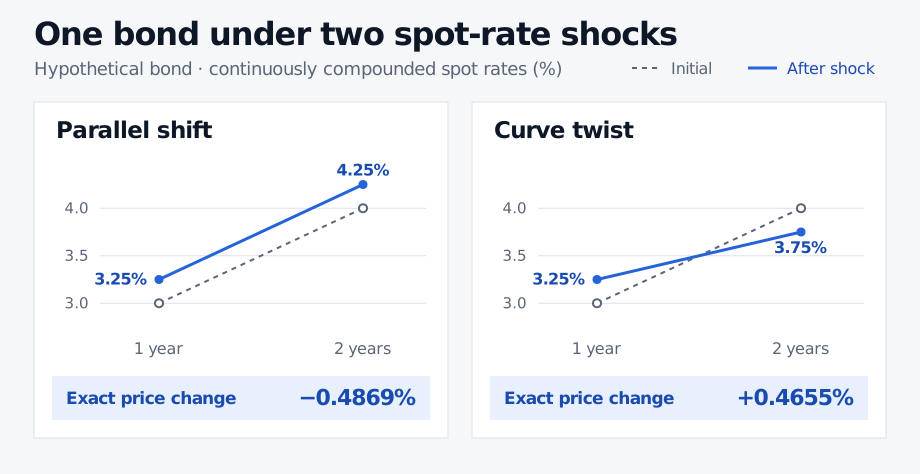
The parallel shock preserves the gap between the two spot rates. The twist narrows it and raises the value of the larger, later payment.
What changes when you use one yield?
Macaulay duration weights the same payment times using a single yield to maturity. The example bond's continuously compounded yield of about 3.9757% reproduces the total price but assigns slightly less present value to the first payment, giving a Macaulay duration of 1.952789 years. The two duration measures coincide on a flat spot curve with matching compounding. Modified duration measures the local proportional price response to the bond's own yield under its quote convention. Fisher–Weil duration bumps the spot curve directly.
What duration matching protects
If assets and liabilities have equal present values and equal Fisher–Weil durations, their price slopes match. The surplus is then locally insensitive to a parallel move in the chosen spot curve. Larger moves can expose differences in convexity, while even small twists can expose different cash-flow concentrations. Key-rate duration separates those concentrations by bumping individual parts of the curve. The Fixed Income lesson shows how to construct the bumps and use them in a hedge. The preview is public and the full lesson requires membership. Key Rate Exposures, Bucket Shifts, and Immunization