Euler’s formula turns an imaginary exponential into a point on the unit circle. Connect radians, rotations and conjugate symmetry to characteristic functions used in Fourier option pricing.
Euler's formula
Euler’s formula connects the complex exponential to the sine and cosine functions:
eiθ=cosθ+isinθ,θ∈R.
Here i is the imaginary unit, with i2=−1, and the angle is measured in radians. The right side is a complex number whose real coordinate is cosθ and imaginary coordinate is sinθ. The formula describes rotation, and supplies the oscillating building blocks used in Fourier methods. MIT’s complex-number notes develop this geometric interpretation.
A point that turns without growing
As θ increases from zero, eiθ moves counterclockwise from 1 around the unit circle. Its complex modulus is
∣eiθ∣=cos2θ+sin2θ=1.
A quarter-turn, half-turn and complete turn give
eiπ/2=i,eiπ=−1,e2πi=1.
The half-turn produces Euler’s identity, eiπ+1=0: a special case of the formula, rather than a different rule. Angles differing by an integer multiple of 2π give the same point. Thus an exponential does not identify a unique angle.
Multiplication adds angles:
eiαeiβ=ei(α+β).
For example, multiplying eiπ/3 by eiπ/6 combines a 60-degree rotation with a 30-degree rotation, producing i. Degrees help describe the turns verbally; the exponents use their radian equivalents. Entering 90 into a function expecting radians does not request a quarter-turn.
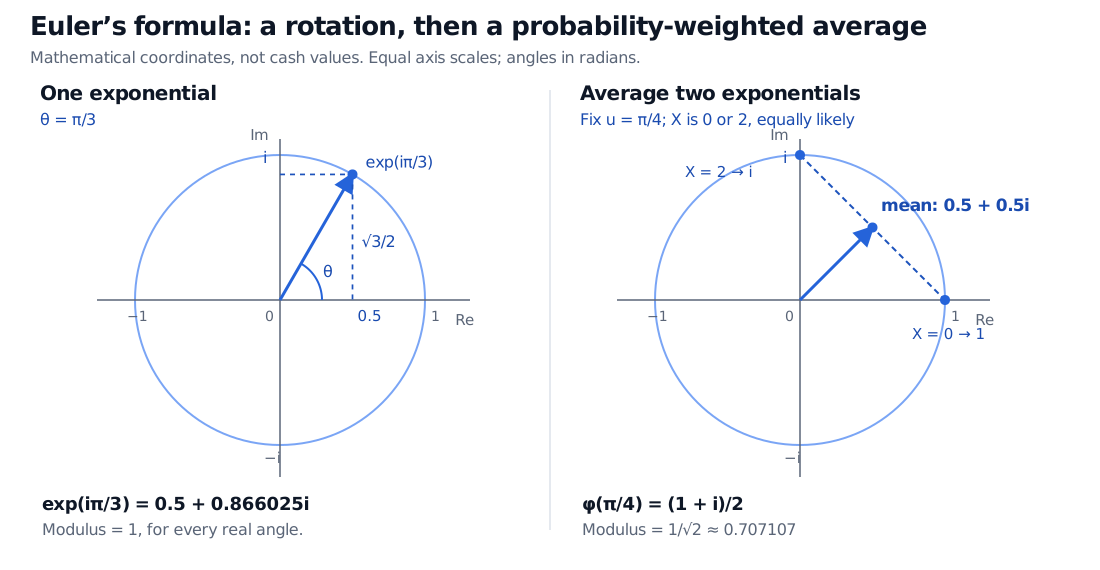
Two equal-scale complex planes. The point exp(i pi/3) has coordinates 0.5 and 0.866025 and modulus 1. At frequency pi/4, equally likely X values 0 and 2 produce 1 and i, whose mean is 0.5 plus 0.5i with modulus 0.707107. Coordinates are dimensionless.
Original mathematical illustration. Left: a single rotation stays on the unit circle. Right: averaging two rotated points can move the result inside it. The coordinates are neither prices nor probabilities.
The unit-modulus statement requires a purely imaginary exponent. For real a and b,
ea+ib=ea(cosb+isinb),∣ea+ib∣=ea.
The real part of the exponent controls scale; the imaginary part controls rotation.
Why the exponential and the circle agree
One construction defines the complex exponential by its everywhere absolutely convergent power series. Substituting iθ, then separating even and odd powers using i2=−1, gives
Absolute convergence justifies regrouping the terms. These are the sine and cosine Taylor series in radians. Strang’s Introduction to Linear Algebra, 5th edition, §9.1, uses this connection to explain products and powers of complex numbers.
Why a quant encounters it
Suppose a model describes a dimensionless random outcome X. At a real frequency u, its characteristic function is
φX(u)=E[eiuX]=E[cos(uX)]+iE[sin(uX)].
The product uX supplies the angle. If X carries units, u must have reciprocal units so that this angle is dimensionless. The characteristic function averages points on the unit circle; consequently ∣φX(u)∣≤1. It exists for every real u because the sine and cosine components are bounded. Sheffield’s probability lecture introduces this expectation directly.
Before feeding a model into a Fourier option pricer, a quant can test its phase convention with an intentionally artificial distribution: take X=2 with certainty and u=π/4. There is only one point to average:
φX(π/4)=ei(π/4)2=eiπ/2=i.
Now change the model: let X equal 0 or 2, each with probability 1/2. At the same frequency,
This is the midpoint shown in the figure. A characteristic function need not have modulus one even though each exponential being averaged does. Nor does modulus one at a particular frequency prove that X is certain: for this same two-outcome model, φX(π)=1 because both phases complete whole turns.
In quantitative finance, X often represents a log return under a specified model and probability measure. A Fourier transform method can turn a suitable risk-neutral characteristic function into option values. The complex value i above is an intermediate mathematical quantity, not an imaginary cash price or a probability. Pricing additionally requires the payoff, discounting and an appropriate inversion method; Euler’s formula alone does not price an option. Carr and Madan (1999) provide the classic FFT pricing construction.
Reversing the angle
Since cosine is even and sine is odd,
e−iθ=cosθ−isinθ=eiθ.
This is a complex conjugate: reflection across the real axis. For real-valued X, it implies φX(−u)=φX(u). The negative frequencies mirror the positive frequencies. With the needed integrability assumptions, Fourier inversion can exploit that symmetry to recover real quantities from complex calculations. Transform sign conventions vary, so check which sign an implementation uses.
A numerical library may return a tiny real residue, around 6×10⁻¹⁷, when evaluating eiπ/2. That is floating-point approximation of an exact zero, not a failure of the identity. Finally, Euler’s formula is distinct from the Euler discretisation method used to approximate differential equations: the identity here is exact.
Gilbert Strang, Introduction to Linear Algebra, 5th edition, §9.1, pp. 434–435, and §9.3, p. 445: complex exponentials, polar multiplication and Fourier roots of unity.