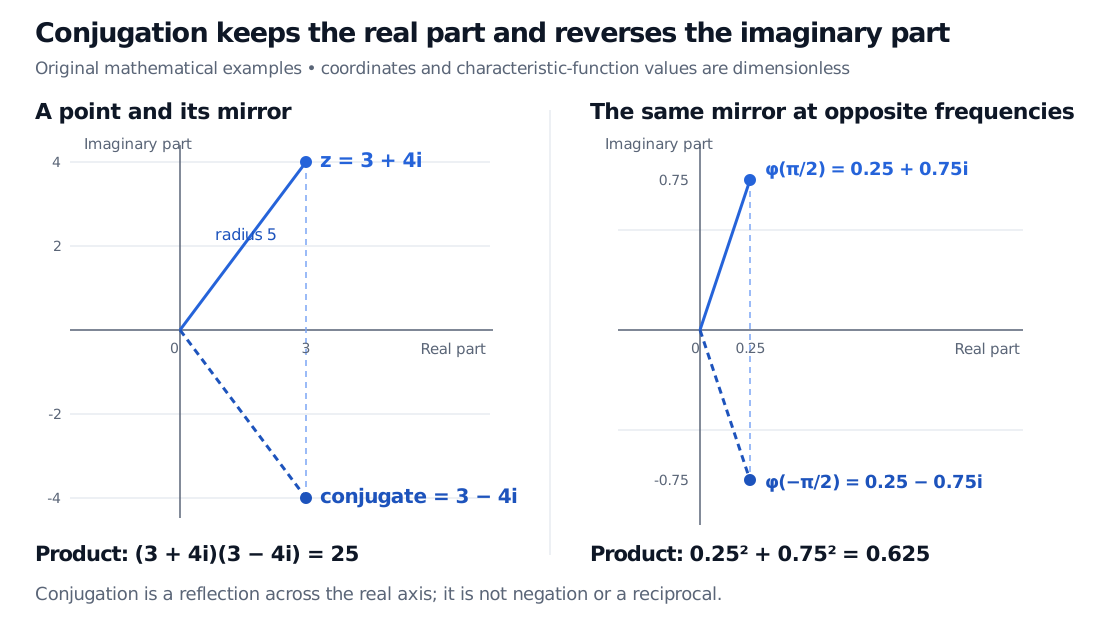
Complex conjugation reflects across the real axis, produces modulus squared in a product, and explains the symmetry of opposite Fourier frequencies.
Complex conjugate
The complex conjugate of a complex numberz=a+bi is zˉ=a−bi, where a,b are real and i2=−1. Keep the real part; reverse the sign of the imaginary part. On a complex-plane diagram, this reflects the point across the real axis.
In quantitative finance, conjugation helps turn complex-valued Fourier calculations into real-valued quantities. The imaginary components encode oscillations in a calculation; a quoted cash price still has real currency units.
A reflection that preserves distance
For z=3+4i, the conjugate is 3−4i. Both points have distance 5 from the origin, but one lies above the real axis and the other below it. Their product is
zzˉ=(3+4i)(3−4i)=9−16i2=25.
Generally,
(a+bi)(a−bi)=a2+b2=∣z∣2.
The result is the square of the complex modulus, not the modulus itself: here the product is 25 and the modulus is 5. Multiplying z by itself gives a different result, z2=−7+24i.
Conjugation is also different from negation: −z=−3−4i reverses both coordinates. Nor is it generally the reciprocal. For a nonzero z,
z1=∣z∣2zˉ,3+4i1=253−4i=0.12−0.16i.
Only on the unit circle, where ∣z∣=1, does the conjugate equal the reciprocal. At zero the conjugate exists, but the reciprocal does not. A real number has no imaginary component to reverse, so it equals its own conjugate. Conjugating twice always returns the original number.
Left: 3 plus 4i and 3 minus 4i mirror across the real axis, each with radius 5; their product is 25. Right: characteristic-function values 0.25 plus 0.75i and 0.25 minus 0.75i at frequencies pi over 2 and minus pi over 2 mirror in the same way; their product is 0.625.
Original dimensionless examples. The second panel uses a synthetic event indicator with probabilities 0.25 and 0.75; frequency angles are in radians.
Why negative frequencies are a mirror
Suppose an analyst models an event indicator X: it is 0 with probability 0.25 and 1 with probability 0.75. This is a deliberately simple risk model, rather than a set of market-implied pricing probabilities.
Its characteristic function records the probability-weighted complex oscillation at each real frequency u:
φX(u)=E[eiuX]=0.25+0.75eiu.
Using Euler's formula, eiu=cosu+isinu. At u=π/2, the two possible values of the exponential are 1 and i. Thus
φX(π/2)=0.25+0.75i,φX(−π/2)=0.25−0.75i.
Changing frequency reverses the imaginary part. This holds for every real-valued random variable, without requiring a density or finite mean. For real u,
φX(−u)=E[e−iuX]=E[eiuX]=E[eiuX]=φX(u).
The expectations exist because the exponential has modulus one. Conjugation passes through expectation by taking the expectations of the real and imaginary components separately. This identity says that the real component of the characteristic function is even in frequency and the imaginary component is odd. It does not say that the distribution of X is symmetric, or that the characteristic function is real.
For the example, the product of the opposite-frequency values is
φX(π/2)φX(−π/2)=∣φX(π/2)∣2=0.252+0.752=0.625.
That number is a squared transform magnitude, not an event probability or an option price. The characteristic function is dimensionless here; 0.75i is not an imaginary cash payment.
Recovering real quantities from complex arithmetic
A conjugate pair adds to twice its real component:
z+zˉ=2Re(z).
In the event example, the two frequency values sum to 0.5, with their imaginary components cancelling. More generally, conjugate symmetry lets Fourier inversion pair opposite frequencies when reconstructing real densities or real pricing functions. The real-valued output comes from the structure of the full calculation; discarding imaginary components at arbitrary intermediate steps can change it.
The symmetry above assumes real frequencies. Fourier option-pricing methods may also evaluate characteristic functions at shifted complex arguments for damping, which requires separate integrability conditions. The elementary real-frequency identity does not by itself justify those shifts, inversion, or a pricing model.
The Fourier Transform Pricing lesson develops the conjugate-pair argument inside inversion and then applies transforms to option valuation. Its public page is a preview; the complete lesson requires membership.
Sources
Lloyd N. Trefethen and David Bau III, Numerical Linear Algebra, SIAM, 1997, Lecture 2, “Adjoint,” p. 11: scalar conjugation and its role in the complex adjoint.