Measure the size of a complex number, connect its modulus to the conjugate identity, and interpret a synthetic Fourier coefficient without losing track of phase or scaling.
Complex modulus
The complex modulus is the magnitude of a complex number: its distance from zero in the complex plane. For z=a+bi, where a,b are real and i2=−1,
∣z∣=a2+b2.
The result is a nonnegative real number, with ∣z∣=0 exactly when z=0. For a real input it reduces to ordinary absolute value. In quantitative work, it lets us measure the size of a complex transform coefficient while keeping that question separate from its phase.
A length, not a sum of coordinates
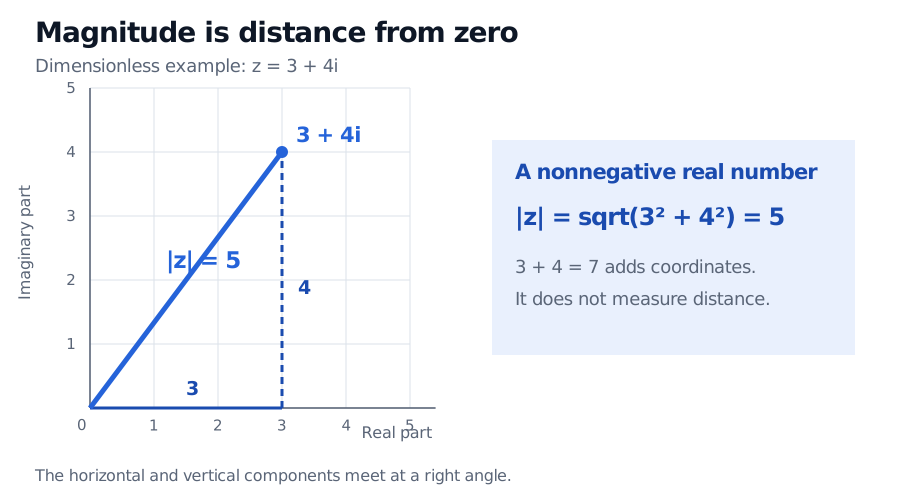
Plot z=3+4i at the point (3,4). The real and imaginary components form perpendicular sides of a right triangle, so
∣3+4i∣=32+42=5.
Adding the components gives 3+4=7, which does not measure the diagonal distance. The same geometry gives ∣z−w∣ as the distance between two complex numbers z and w.
Complex-plane diagram with real component 3 and imaginary component 4 meeting at a right angle. The diagonal from zero to 3 plus 4i has modulus 5, rather than coordinate sum 7.
Original dimensionless example. Modulus measures the diagonal length; the real and imaginary components remain distinct coordinates.
Modulus discards direction. The numbers 3+4i, 3−4i and −3−4i all have modulus 5, despite occupying different points. Knowing magnitude alone cannot reconstruct a complex number.
Why the conjugate appears in the formula
The complex conjugate of z=a+bi is z=a−bi. Multiplying them cancels the imaginary terms:
zz=(a+bi)(a−bi)=a2+b2=∣z∣2.
Thus ∣z∣=zz, taking the nonnegative real square root. For the example, (3+4i)(3−4i)=25, so the modulus is 5. The product is the squared modulus. Squaring the original number instead gives (3+4i)2=−7+24i, which is a different operation.
Two useful rules follow from this length interpretation and identity:
∣zw∣=∣z∣∣w∣,∣z+w∣≤∣z∣+∣w∣.
The second is the triangle inequality. Magnitudes multiply, but generally do not add: z+(−z)=0 even when each term has magnitude 5.
For a real angle θ, eiθ=cosθ+isinθ has modulus 1 because cos2θ+sin2θ=1. Multiplying by it rotates a complex number without changing its magnitude.
Reading an amplitude from a complex coefficient
Suppose an analyst constructs a fictional periodic component of P&L, purely to illustrate frequency analysis. Its complex coefficient is A=(3+4i)USD. Let t be elapsed time in days and ω=2π radians per day, so the period is one day. Define the real signal by
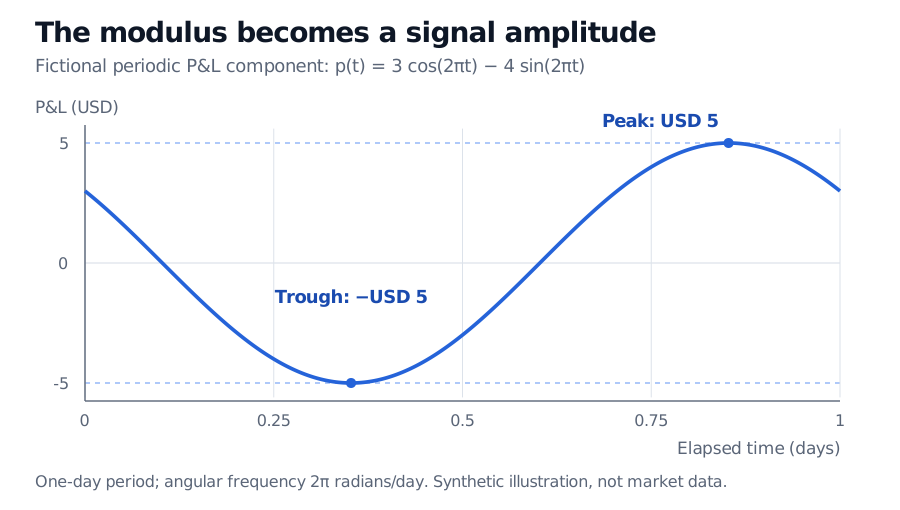
p(t)=Re(Aeiωt)=(3cos(ωt)−4sin(ωt))USD.
The two components combine into a single oscillation:
p(t)=5cos(ωt+θ)USD,θ=atan2(4,3)≈0.9273 radians.
Its amplitude is ∣A∣=5USD. The phase determines the timing of the peaks, while the modulus determines their distance from the zero baseline. At t=0 the signal is USD 3, not USD 5; amplitude is a maximum excursion, not the current value.
Synthetic one-day periodic P&L component 3 cosine minus 4 sine, in USD. The signal starts at USD 3 and oscillates between a trough of negative USD 5 and a peak of USD 5; its complex coefficient has modulus USD 5.
Original synthetic signal, with angular frequency 2π radians per day. The modulus determines amplitude; this illustration contains no observed market data or estimated trading relationship.
Check the Fourier convention before interpreting a coefficient. Here we used p(t)=Re(Aeiωt). If the same signal is written as the two-sided Fourier pair
p(t)=c1eiωt+c−1e−iωt,c1=2A,c−1=2A,
each coefficient has modulus USD 2.50; together they produce the USD 5 amplitude. A transform library's scaling also matters. A magnitude spectrum is therefore not automatically a list of peak amplitudes without knowing the representation.
This is one role of modulus in Fourier analysis. It does not turn a coefficient into a probability, option price or expected profit. A characteristic function is a different, dimensionless probability transform; the USD-valued coefficient above is not one. Replacing complex coefficients by their moduli also removes phase information and can change the reconstructed signal.
For the option-pricing application, Fourier Transform Pricing develops characteristic functions, inversion and explicit transform conventions. The public page is a preview; the complete lesson requires membership.
Walter A. Strauss, Partial Differential Equations: An Introduction, 2nd edition, §5.2, pp. 115–117: complex Fourier-series representation and coefficients.
Christiaan Tiberius, TU Delft MUDE, “Complex Fourier Series”: magnitude/phase representation and the relation between real sinusoidal amplitudes and two-sided complex coefficients. The P&L signal and figures here are original synthetic examples.