Ten shares and a USD 10 cash target
You hold ten shares in a fictional company at USD 10 each. Its investment plan is already funded, so any dividend in this example comes from surplus cash. Compare the two policies at the same instant. There is no new information, no change in the investment plan, no tax, and no cost or price impact when you trade.
- The company pays USD 1 per share. A share priced at USD 10 with the dividend attached trades at USD 9 ex-dividend in this setup. You get USD 10 from the company and keep ten shares worth USD 90.
- The company keeps the cash. The shares still trade at USD 10. You sell one to another investor for USD 10 and keep nine shares worth USD 90.
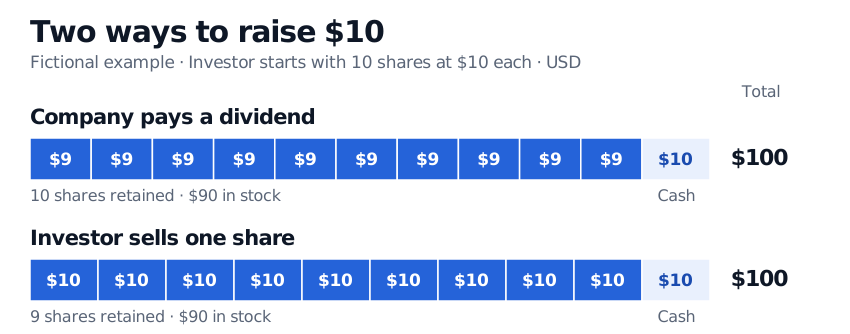
The comparison matches cash and stock value at that instant. A dividend leaves your ownership percentage intact here because the company issues no shares. A sale transfers the sold share’s claim on future payouts to the buyer. Future proceeds from the remaining shares depend on what happens to the retained cash and how much of the company you still own. If you receive more cash than you want, you can also use the excess dividend to buy shares at the market price.
What pays for a larger dividend?
The example uses surplus cash. In the original proof, if a higher dividend creates a shortfall and the firm still makes the same investments, it sells new shares at fair value with no issuance costs. Write for total cash dividends, for the investment outlay, and for the cash available before paying either. When outside equity is needed, the amount raised is
What market prices can tell you
- Taxes and trading costs affect the shareholder’s cash. A dividend and a realised gain on a share sale can have different tax treatment. Spreads or fees can also reduce the cash from a sale or make it costly to reinvest a dividend. Miller and Modigliani, 1961, §V
- An announcement can change expectations. Investors may read a surprise dividend change as a signal about future profits. A price move at announcement can reflect that reassessment. Miller and Modigliani, 1961, §IV, “The informational content of dividends”
- The observed ex-date move is a separate measurement. The USD 1 price change in the example isolates the loss of the dividend entitlement. Actual trading prices also reflect other changes in value between observations and how the stock trades. Bali and Hite show how discrete price ticks can contribute to a gap between the observed drop and the cash dividend. Bali and Hite, 1998, §1
Sources
- Miller, M. H., and Modigliani, F. (1961). Dividend Policy, Growth, and the Valuation of Shares. The Journal of Business, 34(4), 411–433.
- Bali, R., and Hite, G. L. (1998). Ex Dividend Day Stock Price Behavior: Discreteness or Tax-Induced Clienteles?. Journal of Financial Economics, 47(2), 127–159.