Dividend signaling occurs when investors use a dividend decision to update their beliefs about information management has and the market lacks, such as how well the business is earning. Dividend clientele effects arise when investors with different payout preferences favour different stocks. A change in dividend policy can prompt both a revision in earnings beliefs and a shift in who wants to own the stock. A price move by itself cannot tell you which happened.
The payout changed. What was the surprise?
A fictional company raises its regular cash dividend from USD 0.50 to USD 0.60 per common share. There are 100 million eligible shares in both periods. The dividend is 20% higher than the prior payment, and the declared payout rises from USD 50 million to USD 60 million, an increase of USD 10 million for this payment.
The announcement surprise compares the new dividend with the expectation immediately before the release. If investors expected USD 0.65, the surprise was minus USD 0.05 per share despite the increase. If they already expected USD 0.60, the amount supplied no surprise. In an event study, use an expectation observable before the announcement, such as a timestamped consensus for the same payment, and document any proxy used in its place. Miller and Rock, Dividend Policy under Asymmetric Information, section I.D
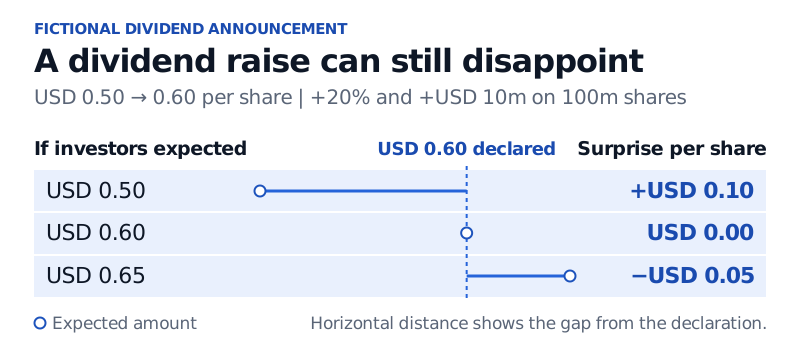
The company declares the same amount in all three cases. Only the pre-announcement expectation changes.
What could explain the reaction?
Information about the business. In Miller and Rock’s model, managers know more than investors about current earnings. An unexpectedly high payout can be informative because a weak firm would have to give up more valuable investment to mimic it. Investors can then revise their view of earning power. The link to future growth is conditional. In Benartzi, Michaely and Thaler’s sample, the size of a dividend increase did not predict future earnings. A firm can also distribute more cash because it has fewer uses for it, so the decision alone leaves the reason for the raise open. Miller and Rock, section II.C · Benartzi, Michaely and Thaler, Do Changes in Dividends Signal the Future or the Past?
Demand from different investors. A shareholder who funds spending from regular distributions may value the larger cash payment. Another may prefer to choose when to raise cash by selling shares. Demand can shift even if both investors agree about the firm’s prospects. Graham and Kumar found differences in dividend-stock holdings across investor groups and buying after announcements consistent with attention in their retail brokerage sample. Changes in who trades or holds the stock are evidence to examine. They do not establish a permanent valuation premium. The dividend irrelevance and homemade dividends benchmark shows how investors can choose their own cash payout when trading is frictionless and the firm's investment policy is fixed. Graham and Kumar, Do Dividend Clienteles Exist?, sections III.C and IV · Miller and Modigliani, Dividend Policy, Growth, and the Valuation of Shares, section V
Other news in the same release. If the company also reports an earnings beat or cuts its guidance, an abnormal return around the release measures the move relative to a return benchmark across all that news. A shorter window helps with releases separated in time. A dividend and earnings announced together still share the same window. Analyse dividend-only announcements separately where available, or model the earnings and dividend surprises jointly. Kane, Lee and Marcus found that the response to either announcement depended on the other in their sample. Keep the announcement timestamp distinct from the ex-dividend date, when a new buyer stops receiving the declared payment. Kane, Lee and Marcus, Earnings and Dividend Announcements
The SelfMadeQuant Event-Study Project works through the same attribution problem from the earnings side, where a dividend inside the event window makes the earnings effect hard to isolate. The full lesson requires membership.
Sources
- Miller and Rock (1985). Dividend Policy under Asymmetric Information.
- Benartzi, Michaely and Thaler (1997). Do Changes in Dividends Signal the Future or the Past?.
- Graham and Kumar (2006). Do Dividend Clienteles Exist? Evidence on Dividend Preferences of Retail Investors.
- Miller and Modigliani (1961). Dividend Policy, Growth, and the Valuation of Shares.
- Kane, Lee and Marcus (1984). Earnings and Dividend Announcements: Is There a Corroboration Effect?.