Separate cash dividends, franking credits, grossed-up income and tax offsets in a fictional Australian dividend-imputation ledger, with investor eligibility limits.
Dividend imputation
Dividend imputation is a tax system that lets an eligible shareholder credit company income tax against tax on the distributed profit. In Australia's system, a franked dividend carries a franking credit. For a quant, the essential distinction is between cash received, income assessed for tax and a credit usable by a particular investor. Treating all three as spendable dividend cash overstates a strategy's funding.
The mechanism connects two layers of taxation. The company pays tax; the shareholder includes the attached credit in assessable income and receives a corresponding tax offset, subject to eligibility. The offset reduces tax payable rather than reducing assessable income. This is the general Australian gross-up and tax-offset rule in section 207-20. Other countries' imputation systems have their own rules.
One profit, two ledgers
Consider a fictional Australian company allocating AUD 100 of pre-tax profit to a shareholder. Assume company tax is 30%, all remaining profit is distributed, the dividend is fully franked at that rate and the shareholder is an Australian resident individual fully eligible for the attached credit. Ignore payment delays and interest for this arithmetic.
The company pays AUD 30 tax and distributes AUD 70 cash, accompanied by AUD 30 of franking credit. The investor's tax calculation begins with AUD 100 of grossed-up income. The credit is evidence of tax attributed to the distribution; it is not another AUD 30 cash payment by the company.
Now stipulate that this entire AUD 100 increment is taxed at a constant 45% personal marginal rate, excluding Medicare levy and every other levy, deduction, offset and interaction. This is a teaching assumption, not a calculation from a current personal tax bracket schedule.
Entry
AUD
What it represents
Cash dividend
70
Money paid to the investor
Attached franking credit
30
Tax credit, conditional on eligibility
Grossed-up assessable income
100
Cash dividend plus credit
Personal tax before the credit
45
45% of the grossed-up income
Franking tax offset
30
Credit applied against tax
Additional personal tax
15
45 minus 30
Cash retained after that tax
55
70 minus 15
The company tax and additional personal tax total AUD 45. Subtracting AUD 45 directly from the AUD 70 dividend would count company tax twice. Conversely, treating the AUD 30 credit as an immediate cash receipt would invent money available to trade.
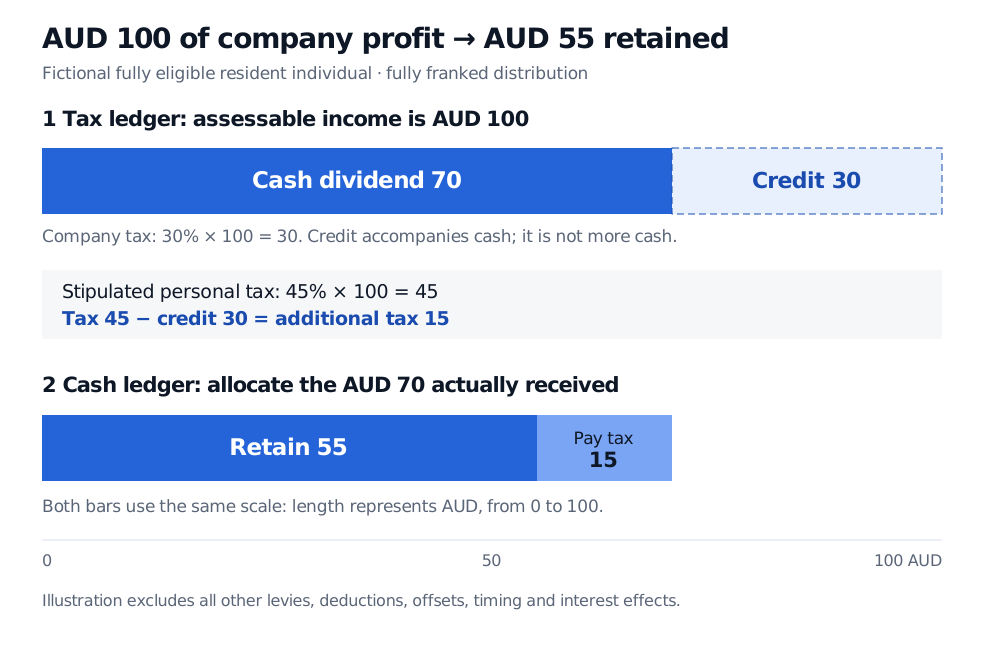
Fictional Australian example in AUD: grossed-up income 100 comprises cash dividend 70 and franking credit 30. Personal tax 45 less credit 30 leaves additional tax 15; cash 70 less that tax leaves 55.
Original fictional ledger: a fully eligible resident individual, fully franked dividend, 30% company tax and stipulated 45% marginal personal tax excluding all other levies and interactions. The upper bar measures assessable income; the lower bar allocates actual dividend cash.
The 30% company rate is not universal. Australia's government business guidance distinguishes the full 30% rate from the 25% rate for eligible base rate entities. A real distribution's statement supplies its cash amount and attached credit; these should not be inferred from a blanket company-rate assumption.
Gross-up is a conversion, not a return
For a fully franked cash dividend D, using an applicable imputation rate c under the simplified assumptions above,
C=D1−cc,G=D+C=1−cD.
Here C is the attached credit and G is grossed-up income. With full entitlement to the offset and a constant marginal personal rate m over this income increment,
Tadditional=mG−C,D−Tadditional=G(1−m).
In the example, C=70(0.30/0.70)=30 and Tadditional=0.45(100)−30=15. These equations model the incremental tax effect under stated assumptions; an actual tax assessment combines income and applicable rules more broadly.
A negative additional-tax amount may lead to a refund for a recipient entitled to refundable excess credits. It is not a promise that every investor receives the unused credit in cash. The current refundable-offset rules contain recipient-specific exceptions. The Parliamentary Budget Office's explanation of refundability describes the resident-individual mechanism; entity status and the applicable law still matter.
Likewise, grossing up a dividend yield creates a tax-inclusive income measure under a convention. It does not make it an after-tax yield or a total return: price changes, costs, investor taxation and the timing of payments remain separate.
The credit belongs to an eligible investor
Entitlement to the cash dividend does not establish entitlement to its tax credit. Australia's rules include residency and qualified-person requirements. At-risk holding periods, arrangements passing the benefit of a dividend to someone else, and integrity rules can affect the offset. The ATO's individual dividend instructions for 2024–25 explain holding-period and related-payment conditions and the small-shareholder exception; those instructions are specific to that tax year. The current Act's sections 207-70, 207-75 and 207-145, checked against its 1 October 2026 compilation, establish residency and integrity restrictions on the general rule.
A non-resident portfolio cannot simply reuse the resident individual's credit treatment. Nor does hedging a position while collecting its dividend establish a riskless credit-capture profit. Qualification and any offset or refund must be determined for the investor and arrangement being modelled.
For a backtest, keep the issuer's cash distribution, franking amount, investor eligibility, tax recognition and settlement timing as separate fields. Inspect whether a benchmark already includes franking credits before adding them. A tax-inclusive index and a cash-dividend total-return index answer different questions; neither automatically equals an investor's net cash return.
The Corporate Actions and Survivorship lesson develops the underlying dividend-receivable ledger and checks for counting distributions twice. Its public preview is available; the full lesson requires membership. Adding investor-specific taxation extends that accounting rather than replacing it.