The discount window is the Federal Reserve’s standing facility for lending to eligible depository institutions against pledged collateral. A bank facing unexpected withdrawals can borrow from its Federal Reserve Bank to make payments without immediately selling assets. For a bank’s funding liquidity risk analysis, the key quantity is how much the Reserve Bank will lend against collateral the bank can pledge in time. Federal Reserve Board, Discount Window
How much cash can the bank raise?
Suppose a bank needs USD 95 million today and has already pledged eligible collateral with a market value of USD 100 million. Assume the pledge is available for this advance and the Reserve Bank applies a hypothetical 10% haircut to that market value.
The pledge supports at most USD 90 million in this example. That leaves USD 5 million to raise through other funding or additional eligible collateral. The haircut sets the collateral-based limit. Drawing on that capacity also depends on programme eligibility and the Reserve Bank’s approval. The programme’s interest rate determines what the loan costs.
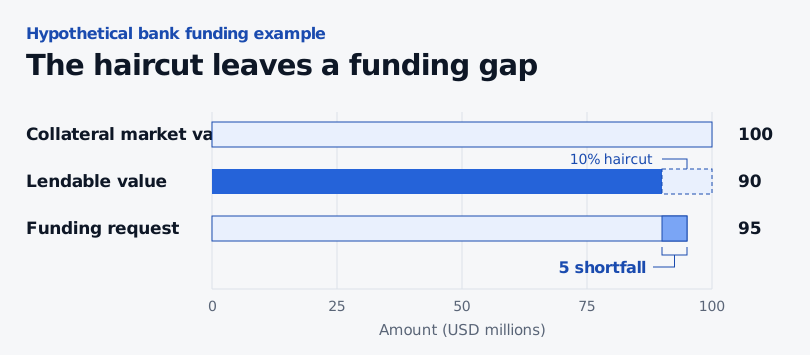
Figure 1. The request falls below the collateral’s market value but exceeds its lendable value. All amounts are hypothetical.
The Reserve Bank assigns its own values to qualifying securities and loans. The Fed’s collateral tables quote margins as the percentage of the estimated value the Reserve Bank credits. A 90% margin corresponds to the 10% haircut in this example. The applicable margin varies by asset. For securities it depends on factors such as asset type, credit rating and duration. Federal Reserve Banks, Collateral Valuation
The bank must have executed the lending agreements and pledged collateral that gives the Reserve Bank a first-priority perfected security interest. Pledging ahead of time can avoid a delay between submitting collateral and being able to borrow against it. Federal Reserve Banks, Pledging Loans, Discount Window Setup
Who can borrow?
| Programme | Eligibility and purpose |
|---|---|
| Primary credit | The main programme, for depository institutions the Reserve Bank judges to be in generally sound financial condition. Institutions can borrow overnight or request a term of up to 90 days under the Reserve Banks’ current terms. |
| Secondary credit | For institutions that do not qualify for primary credit, subject to Reserve Bank approval. It is usually very short term, carries a higher rate than primary credit and can support a return to market funding or an orderly resolution. |
| Seasonal credit | For smaller institutions with demonstrated recurring seasonal funding needs, such as a bank whose lending rises during the agricultural season. Advances carry a floating rate based on selected short-term market rates. |
U.S. branches and agencies of foreign banks can also access the window when eligible. The Reserve Bank assesses eligibility separately from the value of the collateral. Federal Reserve Board, Discount Window, Federal Reserve Banks, Primary and Secondary Credit Programs, Seasonal Credit Program
Where it fits in overnight funding
The discount rate in this context is the rate the Reserve Bank charges on window credit, often referring specifically to the primary credit rate. The Fed’s key policy rate is expressed as the Federal Open Market Committee’s target range for the federal funds rate, an overnight unsecured market rate. In a routine repo, the borrower sells securities and agrees to buy them back. A typical window advance is a loan secured by a pledge, and eligible collateral can include loans. The New York Fed’s standing repo operations are a separate route to secured funding for eligible trading counterparties. Federal Reserve Board, Discount Window, New York Fed, Monetary Policy Implementation
A bank can hesitate to use the window if it expects others to interpret borrowing as a sign of financial weakness. This stigma helps explain why some banks have paid more for private overnight funding. The Fed reports outstanding window credit in aggregate each week and releases borrower-level details about two years later. Assessing distress at a particular bank requires institution-level evidence. Armantier, Cipriani and Sarkar, Discount Window Stigma After the Global Financial Crisis, Federal Reserve Board, Discount Window disclosure
The SelfMadeQuant lesson Margin and Collateral works through the same haircut calculation for a repo. The full lesson requires membership.
Sources
- Federal Reserve Board, Discount Window. Facility purpose, credit programmes, collateral and disclosure.
- Federal Reserve Banks, Primary and Secondary Credit Programs and Seasonal Credit Program. Programme eligibility and terms.
- Federal Reserve Banks, Discount Window Setup, Pledging Loans and Collateral Valuation. Agreements, collateral pledging and lendable values.
- Federal Reserve Bank of New York, Monetary Policy Implementation. Federal funds rate target range and standing repo operations.
- Olivier Armantier, Marco Cipriani and Asani Sarkar, Discount Window Stigma After the Global Financial Crisis. New York Fed Staff Report 1137, revised March 2026.