A cookie-jar reserve is an intentionally inflated or unsupported accounting reserve held so that it can be drawn down to lift reported earnings later. A big-bath charge deliberately concentrates excessive or premature charges in an already weak reporting period, making subsequent results look better against a lower baseline. The two can overlap. An inflated restructuring charge can both deepen the initial loss and create a reserve that later flatters profit. For an earnings forecast, the question is how much of the apparent recovery came from the business and how much came from the accounting. SEC, The “Numbers Game”, 1998
How an expense becomes a later earnings boost
A fictional manufacturer earns USD 100 million before the entries in each of two quarters. In Q1, it deliberately books USD 30 million more than the evidence supports for a warranty provision. In Q2, it releases USD 20 million of that excess to boost earnings. The supported warranty estimate stays the same, and the example isolates the excess entries. All profit figures are pretax.
- Q1. The extra expense increases the provision liability by 30 and reduces reported profit to 70.
- Q2. The release reduces the liability and credits expense by 20, raising reported profit to 120. The liability still exceeds the supported amount by 10.
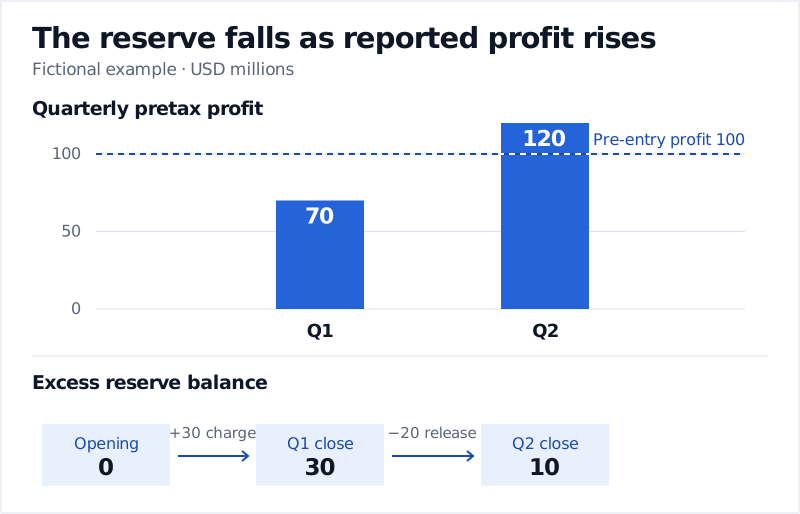
The Q2 release returns part of the Q1 charge to earnings. The profit rebound appears on the income statement while the unreleased excess stays on the balance sheet.
On the income statement, reported profit rises by 50 between quarters, even though profit before the entries is flat. Across both quarters, reported profit totals 190 versus 200 before the entries. The missing 10 is the part of the original over-accrual still sitting in the liability. Neither entry moves cash.
What changed before the release?
IAS 37 requires a provision to reflect the best estimate of the amount needed to settle a present obligation. An estimate can legitimately fall. Suppose the Q1 estimate was well supported and, after those statements were authorised, a repair supplier agreed to a lower price for outstanding warranty work. The new price could justify a Q2 reduction. Under IAS 8, changes in estimates take effect prospectively, while material prior-period errors generally require retrospective correction. Ask whether the original estimate used the reliable information that was available at the time, and when the evidence for the reduction emerged. AASB 137, §§14, 36–43 and 59–62 · AASB 108, §§34–38, 41–48
A large restructuring charge can also be justified. Under IAS 37, a detailed formal plan can create a constructive obligation once implementation starts or the plan's main features are communicated in a way that gives those affected a valid expectation it will happen. The provision is limited to costs that the restructuring itself requires and that are separate from ongoing operations. Retraining staff who will stay with the company is a future operating cost. AASB 137, §§70–83
In its 2001 consent order, the SEC found that Sunbeam padded its year-end 1996 restructuring charge with improper reserves and other entries and later drew improper reserves into 1997 income. Sunbeam consented without admitting or denying the findings, while admitting jurisdiction. SEC, Sunbeam Corporation, Release No. 33-7976
Read the reserve roll-forward
Start with the opening and closing balances in the notes. Separate new charges, amounts used to settle the obligation, and reversals of unused amounts. Spending against a provision generally settles a liability already recorded, while a reversal can lift current profit. Check the explanation against changes in the underlying obligation and trace actual payments in the cash flow statement where they are identifiable. For a large charge followed by a release, the reason for the change matters more than the sequence alone. AASB 137, §§59–62 and 84–85 · SEC staff guidance on restructuring disclosures, Topic 5.P
Check whether the charge was added back to adjusted profit and whether any subsequent reversal was removed on the same basis. Keep documented releases separate when testing earnings quality, and retain the original filing alongside any amendment so revised numbers enter a historical signal only once available. In the SelfMadeQuant project report, “Incidents and drills” shows how a filing monitor handles non-reliance notices and links amendments to original filings. Financial filing change and deterioration monitor, membership required
Sources
- IFRS Foundation, IAS 37 Provisions, Contingent Liabilities and Contingent Assets and AASB 137, January 2026 compilation, §§14, 36–43, 59–62 and 70–85.
- IFRS Foundation, IAS 8 and AASB 108, §§34–38 and 41–48.
- SEC, Arthur Levitt, The “Numbers Game”, 1998.
- SEC, Sunbeam Corporation, Release No. 33-7976, 2001.
- SEC, Codification of Staff Accounting Bulletins, Topic 5.P.