Causal trees estimate intervention effects in feature-defined groups. Honest splitting separates subgroup discovery from effect estimation, without replacing causal identification.
Causal trees and honest splitting
A causal tree is a decision tree designed to divide pre-treatment feature space into groups with different average effects of a specified intervention. Honest splitting and estimation separate choosing those groups from measuring their effects. For a quant testing a new execution rule, this can reveal where the rule helps and where it harms, without measuring each discovered subgroup on the same lucky observations that made it look interesting.
An effect in a leaf
A terminal group, or leaf, is a region ℓ defined by feature rules. With potential outcomes Y(1) under the new rule and Y(0) under the existing rule, its target is
τℓ=E[Y(1)−Y(0)∣X∈ℓ].
This is a leaf-average treatment effect, a piecewise-constant approximation to the conditional average treatment effect. It does not recover the missing counterfactual for an individual order.
Ordinary outcome CART searches for accurate outcome predictions. A causal tree targets effect estimation. A feature that predicts high execution costs under both rules need not identify a group that benefits more from switching. Athey and Imbens' honest causal-tree criterion rewards effect heterogeneity while accounting for estimation variance; a split can also help by reducing outcome variability within the treatment arms. See their treatment-effect construction.
Freeze the rules before measuring
Structure sample: choose the feature splits and tune or prune the tree using this sample.
Freeze the partition: keep the resulting rules fixed.
Independent estimation sample: route fresh observations through those rules and estimate each leaf's effect. Do not revise the partition after seeing these estimates.
In a completely randomised binary-treatment experiment, with both arms represented in the leaf, the usual estimate is
τℓ=Y1,ℓest−Y0,ℓest.
The superscript identifies the estimation sample. The official honest.causalTree implementation accepts separate structure and estimation datasets and re-estimates the leaves. An “honest” splitting criterion by itself does not establish that the supplied datasets are independent.
Two leaves, one misleadingly small average
Consider a fictional randomised execution experiment. The outcome is an execution-quality score in basis points, defined so that higher is better. Assume an independently selected, frozen tree has leaves A and B. The following are stipulated summaries from a separate estimation sample, not results from fitting a tree here:
Leaf
New-rule mean
Existing-rule mean
Estimated effect
A
6 bp
4 bp
+2 bp
B
3 bp
4 bp
−1 bp
If each leaf represents half the target population, the weighted average treatment effect estimate is
τ=0.5(6−4)+0.5(3−4)=0.5 bp.
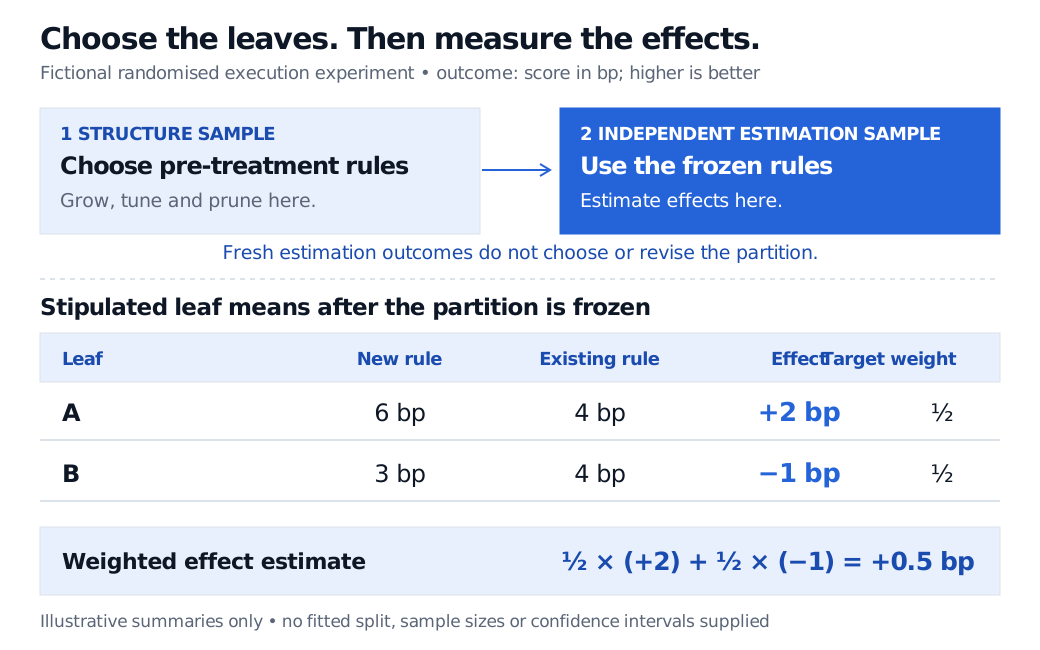
A structure sample selects and freezes pre-treatment rules. A separate estimation sample gives leaf A treated mean 6 and control mean 4, an effect of plus 2 basis points; leaf B gives 3 and 4, an effect of minus 1. Equal target weights give plus 0.5 basis points.
Original stipulated estimation summaries. Separate samples protect measurement from partition selection; no fitted split, sample sizes or uncertainty estimates are supplied.
The small positive average conceals a negative estimate in B. These signs alone do not establish statistically reliable benefits or harms: the table supplies neither arm counts nor within-arm variation. The half weights describe the target population, not the treatment-assignment probability. This is an intervention-effect question; it does not automatically produce an alpha or return forecast.
What honesty cannot supply
Honesty addresses selection-induced estimation bias, with the cost of fewer observations for each task. Inference still needs an appropriate sampling design and enough information in each arm. Treating every leaf's confidence interval as a simultaneous guarantee for all reported claims requires additional care. See Athey and Imbens' inference discussion.
Causal identification is separate. In observational execution data, urgency could affect both rule choice and execution quality. Unconfoundedness given the full pre-treatment features does not imply that treated and control orders are comparable inside a coarse leaf. Raw leaf mean differences may still need covariate adjustment or propensity weighting. There must also be overlap, a well-defined intervention and no unaccounted interference between orders. The GRF causal-effects reference describes the identification and adjustment requirements for the related forest setting. Sample separation cannot repair an unobserved confounder or create a missing comparison arm.
A causal forest extends the tree idea through an ensemble. Its extra machinery is distinct from the readable single partition developed here. For the underlying split-and-prune mechanics, Decision Trees: Splitting Criteria and Pruning offers a public preview; the full lesson requires membership.
Sources
Athey and Imbens (2016), Recursive partitioning for heterogeneous causal effects, PNAS 113(27), 7353–7360. Primary paper: The Problem; Honest Inference for Treatment Effects; Inference; Observational Studies with Unconfoundedness.
causalTree authors, honest.causalTree source: separate estimation-data inputs and final leaf re-estimation; accessed 1 November 2026.
GRF authors, The GRF Algorithm: Causal Forests and Orthogonalization; related ensemble context, accessed 1 November 2026.