Understand conditional support for causal comparisons: structural zeros, weak practical overlap, inverse weights and how trimming changes the population being studied.
Causal overlap and positivity
Causal positivity requires each action being compared to have a nonzero probability within the relevant covariate profiles of the target population. Overlap describes the resulting shared support between action groups; practical overlap also concerns whether that support is substantial enough for useful estimation. In quant research, an execution policy can remove an action from entire market states, leaving historical data unable to identify its effect there without further assumptions.
The condition is conditional
Let A∈{0,1} denote two well-defined execution actions and X the pretreatment covariates used to address confounding. The propensity score is the conditional probability
e(x)=P(A=1∣X=x).
For the population average effect of action 1 versus action 0, positivity requires
0<e(X)<1almost surely in the target population.
For discrete covariates, this means every profile with positive target-population probability. For continuous covariates, the almost-sure formulation concerns their distribution, rather than requiring repeated observations at every exact numerical value. Other target effects can require support only in a narrower population. This is the identification condition described by Hernán and Robins, §3.3.
An overall mixture of actions is insufficient. A desk could use action 1 on every urgent order and action 0 on every patient order. Both actions appear in the full ledger, but neither urgency group contains an alternative action to compare.
For the probability notation, Probability Fundamentals develops conditioning and its denominator. Its public page introduces the lesson; reading the full lesson requires a free signed-in account.
Rare comparisons carry large weights
Suppose a fictional desk compares crossing the spread immediately (A=1) with posting a specified limit order (A=0). Fix order eligibility, the limit-order cancellation rule and the outcome horizon before analysing results. An outcome could be signed execution cost against the decision midprice, with a stated treatment of unfilled shares.
For illustration, assume the assignment probabilities are known. An order assigned action 1 receives an unstabilised inverse-probability weight of 1/e(x); an order assigned action 0 receives 1/[1−e(x)].
Pretreatment profile in the fictional policy
Probability of action 1
Weight for an action-1 order
Immediate execution is rare
0.05
20
Actions are equally likely
0.50
2
Immediate execution is forbidden
0
Undefined; action-1 outcomes are absent
The first two entries are 1/0.05=20 and 1/0.50=2. One rare-action observation can therefore contribute much more heavily to a weighted calculation. The weight is dimensionless; it is neither an execution cost nor a forecast of profitability.
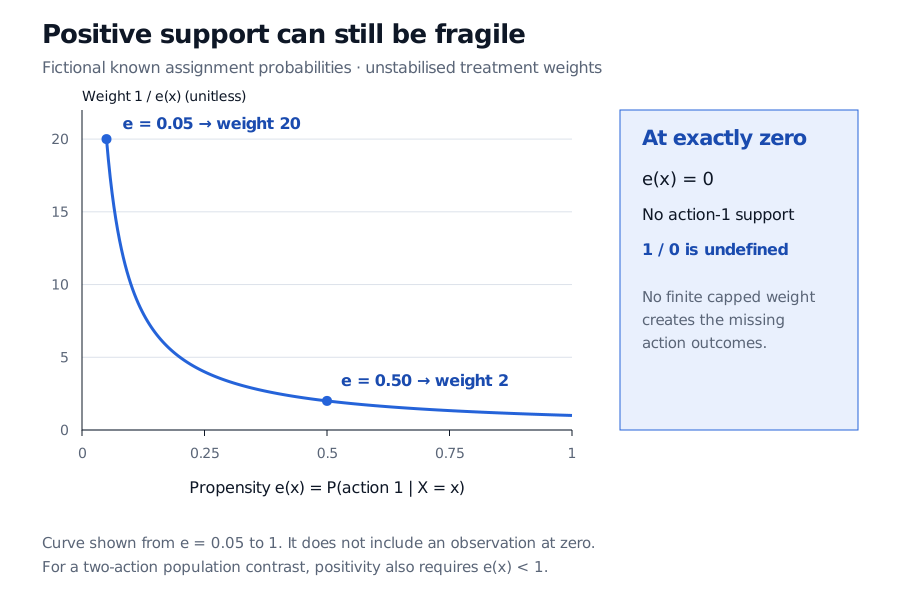
A known-propensity curve gives an unstabilised treatment weight of 20 at probability 0.05 and 2 at 0.50. A separate panel marks probability zero as absent action-1 support and an undefined reciprocal.
Original fictional assignment illustration. The positive-probability curve and the zero-support panel distinguish a large valid weight from a missing comparison.
At a true zero, there is no observed action-1 order from that profile to reweight. The expression 1/0 is undefined, not a large finite weight. Giving it a cap cannot manufacture the missing outcome. The endpoint e(x)=1 produces the analogous problem for action 0.
These are assignment probabilities. In an observational ledger they usually need estimation; a fitted model returning probabilities strictly between zero and one does not demonstrate that the underlying policy supplies both actions. Cole and Hernán discuss weight construction, model specification and diagnostics.
A policy prohibition differs from an empty sample cell
A structural violation occurs when the data-generating policy makes an action impossible in a relevant profile. For example, suppose immediate execution is prohibited whenever a particular client instruction is present. Collecting more orders under that same rule will not create immediate executions for those instructions.
A finite-sample shortage can occur even when both actions have positive population probability. If immediate execution is allowed but uncommon for a profile, a small sample may contain none. Practical overlap can also be weak when both groups are observed but only a few observations carry most of the weight. These distinctions and the effect of restriction are developed in Westreich and Cole's Positivity in Practice.
Inspect action counts across substantively important pretreatment profiles, propensity distributions by action, and the resulting weights. A histogram of one fitted score can conceal sparse combinations of urgency, liquidity and client restrictions. Coarsening those variables can conceal the policy rule too; removing a needed confounder simply to improve a plot can compromise the causal analysis.
Changing the population changes the question
Restricting analysis to profiles where both actions are supported can produce a defensible comparison, but it changes the target population. Trimming observations is not merely cleaning the original population estimate. A result for orders eligible for either action does not automatically answer what would happen across all orders, including prohibited states.
Capping extreme weights is a different operation: it keeps observations but alters their contributions, potentially trading bias against variance. Neither clipping scores nor capping weights restores missing support. Any extrapolation into unsupported profiles relies on additional modelling assumptions.
Finally, overlap alone does not identify an effect. In the usual adjustment approach to causal inference, one also needs consistency between observed and specified actions, and conditional exchangeability: no remaining confounding of action and potential outcome after conditioning on the chosen covariates. In the desk example, unrecorded urgency could influence both the action and cost. Balanced weights cannot establish that it is absent. Hernán and Robins, §3.1 separate these assumptions.