The buy side invests capital for a portfolio, fund or asset owner. The sell side helps issuers raise capital and helps investors trade, for example by underwriting new securities, routing orders or quoting prices. An asset manager can sell shares and still be on the buy side. A dealer can buy those shares and still be on the sell side. For a quant, the distinction tells you whose investment objective drives the order and who bears the resulting position risk. SEC advisory-account bulletin · SEC overview of broker-dealers
Follow the mandate, then the trade
A pension fund or asset manager chooses positions within an investment mandate. For example, when an index fund adds a stock after an index change, the fund takes the exposure and its trading desk tries to complete the order at a cost consistent with the fund’s tracking objective. Nasdaq’s study of buy-side trading costs
A broker-dealer can serve that order in different capacities. An agency broker can route it to a venue for execution against another party. A dealer acting as principal trades for its own account and is the fund’s counterparty on that fill. The same financial group can also house buy-side and sell-side businesses. Goldman Sachs’s 2025 filing, for example, describes underwriting and trading in Global Banking & Markets and portfolio management in Asset & Wealth Management. Classify the activity at the desk level and read capacity at the trade level. SEC overview of broker-dealers · Goldman Sachs 2025 Form 10-K
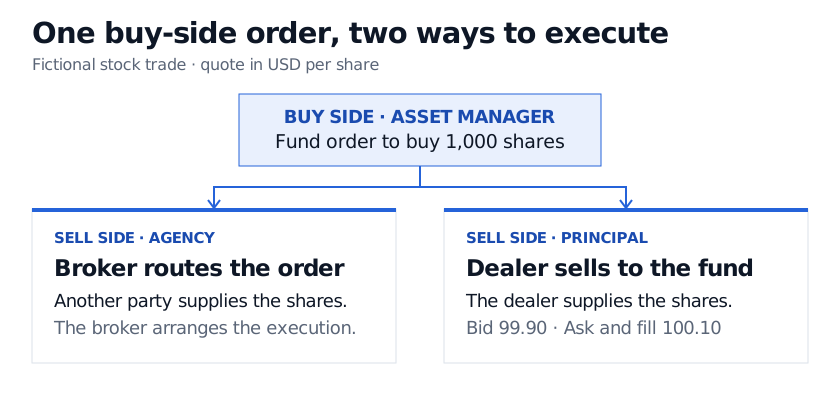
Two alternative routes for the same fund order. The quote and fill belong to the principal route.
What the dealer quote tells the fund
Suppose the asset manager accepts the dealer’s USD 100.10 ask for all 1,000 shares when the dealer’s bid is USD 99.90. The fund pays USD 100,100 before any separate fees. The full quoted bid-ask spread is USD 0.20 per share, or USD 200 at this quantity.
Only the purchase took place. Against the contemporaneous quote midpoint of USD 100.00, the fund paid USD 0.10 more per share, or USD 100 for immediate execution on this benchmark.
The midpoint is a reference price and may be unavailable for execution. A commission would be a separate charge. To calculate the dealer’s realised profit on the sale, you would need its inventory cost or offsetting trades, along with applicable expenses. The displayed bid only tells you what the dealer was quoting to buy at that moment. Nasdaq on spread costs and commissions · Nasdaq’s analysis of market-making and markouts
The SelfMadeQuant Market Participants lesson follows the trade through clearing, settlement and custody. The preview is public and the full lesson requires membership.