A block trade is a large transaction in a security or derivative, often arranged through negotiation to find enough counterparties for institutional size. For a quant, the practical issue is whether the whole position can be transferred at an acceptable cost: a good price for a small displayed quantity may tell you little about the cost of a much larger order.
“Block” has no universal share-count or notional threshold. Its precise meaning depends on the asset, venue and applicable rules. Size alone also does not identify the execution mechanism: a large exchange execution and a privately arranged block are different observations. This article focuses on negotiated institutional blocks, traditionally associated with the upstairs market.
Finding the other side before trading
An upstairs broker searches for investors willing to absorb a large order, rather than relying solely on interest already resting in an order book. The intermediary may assemble several counterparties. It may act as an agent finding a match, or commit its own capital to take a position. Those arrangements allocate completion and inventory risk differently. Keim and Madhavan’s original study describes this search mechanism and distinguishes upstairs origin from the size of the eventual trade.
The opportunity is access to liquidity that was not offered on screen. The cost is that finding it can take time and reveal trading intentions. Negotiation can therefore reduce the need to consume displayed depth without eliminating information leakage or market impact. Keim and Madhavan found evidence consistent with leakage in their historical sample of 1985–1992 equity trades; that result is not a forecast of today’s block execution costs.
One price, two very different quantities
Consider a fictional stock buy for 100,000 shares, with prices in USD per share. Record an arrival midpoint of 50.00. A broker obtains an executable negotiated price of 50.05 for all 100,000 shares, and the buyer accepts. Assume complete execution, with fees and taxes excluded.
At arrival, a displayed ask price is 50.10 for only 1,000 shares. These observations answer different questions:
| Observation | Price, USD/share | Quantity covered |
|---|---|---|
| Negotiated execution | 50.05 | Entire 100,000-share order |
| Visible ask at arrival | 50.10 | Only 1,000 displayed shares |
The block’s notional is
Its buy-side execution concession against the arrival midpoint is
Expressed as basis points of the arrival notional, rather than the cash paid:
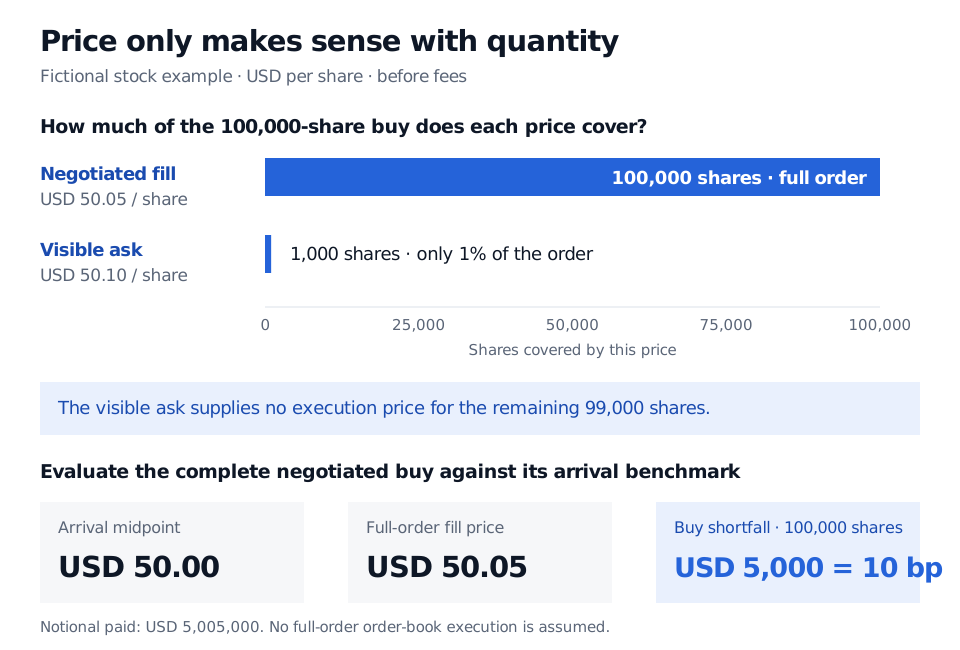
Original fictional stock example. Bar lengths show shares covered by each price. The visible ask is not a quote for the entire order; the negotiated full fill is stipulated.
The fill is five cents below the visible ask and five cents above the arrival midpoint. Both statements are true. Neither establishes how much the broker saved relative to an alternative complete execution. The visible ask covers just 1% of the order; the remaining 99,000 shares have no supplied order-book execution price. Multiplying the ask by the full order would invent liquidity that the snapshot does not show.
The USD 5,000 is a benchmark-relative cost, not an estimate of price movement caused by the buyer. It can reflect the spread, negotiation terms, market movement and other effects. The implementation-shortfall framework also accounts for fees and unfilled intended shares; here the order is fully completed and the calculation uses arrival as its reference.
What the block label leaves unresolved
A block is not necessarily a discount. State the side and the reference price. A buyer paying above a reference incurs a positive concession; a seller receiving below it does too. Price improvement relative to a small displayed quote is a different comparison from cost relative to an arrival or decision benchmark.
A block is not synonymous with a dark pool. A dark pool describes non-displayed matching; an upstairs arrangement describes how counterparties are found. A large print alone does not reveal either process. Execution location, pre-trade visibility and reporting treatment need their own evidence.
An exchange’s formal block facility has specific conditions. As checked on 31 October 2026, CME Group’s block-trade documentation describes privately negotiated eligible futures and options transactions outside its public auction market. It identifies Rule 526 and product-specific minimum quantities that can also vary by transaction type and execution time. Those conditions do not supply a universal definition for equity blocks, and the stock example above claims no regulatory eligibility.
To assess a proposed block, retain the quantity, side, benchmark and timestamp alongside the price. Then compare feasible alternatives for the same intended position, including completion risk and charges. Without that common scope, “better than the screen” can be an incomplete execution claim.
For the full ledger, the Implementation Shortfall lesson extends the calculation to delay, partial completion and fees. Its public preview is open; the full lesson requires membership.
Sources
- Donald B. Keim and Ananth Madhavan, The Upstairs Market for Large-Block Transactions: Analysis and Measurement of Price Effects (1996), Review of Financial Studies 9(1), pp. 1–36. Introduction and Section 1.2 explain counterparty search and distinguish trade size from upstairs origin. This is historical mechanism evidence, not current exchange-rule guidance.
- CME Group, Block Trades, checked 31 October 2026. Current overview, Rule 526 reference and threshold-table structure support the venue-specific futures and options discussion.