Count unordered selections with n choose k, see why 336 ordered lists collapse to 56 baskets, and separate a default-pattern count from its probability.
Binomial coefficient
The binomial coefficient, written (kn) and read “n choose k,” is the number of ways to choose k distinct objects from n distinct objects without repetition and without regard to order. Each chosen set is a combination. The set is a selection; the coefficient is the number of such selections.
For integers 0≤k≤n,
(kn)=k!(n−k)!n!.
Here n! is a factorial, with 0!=1. The result is a count, not a probability. That distinction matters when a risk analyst enumerates possible default sets or a portfolio researcher counts candidate baskets.
Why eight names give 56 baskets, not 336
Suppose an analyst has eight distinct issuers, labelled A through H, and wants to enumerate every three-name basket. Each issuer may appear at most once. The task is to choose membership; weights, trading costs and suitability are outside this counting question.
If we first build an ordered list, there are eight choices for the first name, seven for the second and six for the third:
8×7×6=336.
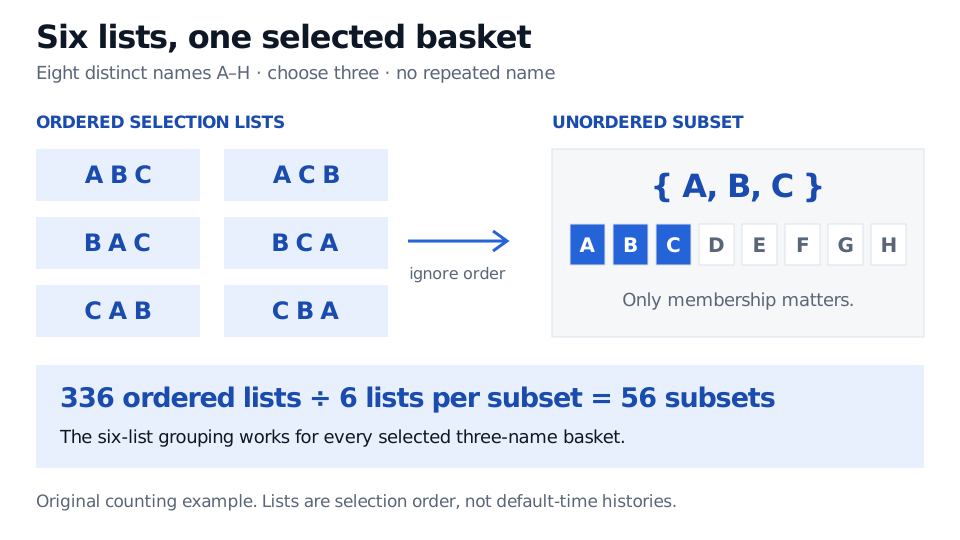
That is a permutation count. But the lists ABC, ACB, BAC, BCA, CAB and CBA all specify the same basket {A,B,C}. Every three-name basket appears 3!=6 times in the ordered count. Dividing removes that duplication:
(38)=3×2×18×7×6=56.
Six ordered lists of A, B and C identify one unordered subset. Across eight distinct names, 336 ordered three-name lists divided by six lists per subset give 56 baskets.
Original counting example: eight distinct names, three chosen without repetition. Selection-list order is discarded; this is not a model of default-time order.
The choice of count comes from the question. A basket containing A, B and C is unchanged by how you list it. An assignment of those names to three distinct roles, or a ranking of which defaults first, second and third, retains order and needs a different outcome description. Allowing an issuer to be selected repeatedly also changes the problem. The ordinary subset formula does not count that situation.
Adding probabilities requires a model
Now keep all eight issuers in a synthetic credit basket and ask a different question: what is the probability that exactly three default within one year? Assume each issuer has default probability p=0.02 over that same year, their default indicators are mutually independent, and each name is classified only as defaulted or not defaulted. These are illustrative assumptions, not estimates for real issuers.
One specific event—A, B and C default, while D through H survive—has probability
0.023×0.985=0.0000072313663744.
The powers describe three defaults and five survivals. Independence lets us multiply the eight probabilities; a common p makes every exact three-default set have the same probability. The 56 events are disjoint because each specifies the complete default/survival status of all eight names. Adding them gives
This is the count factor in the binomial distribution: generally, P(N=k)=(kn)pk(1−p)n−k under independent binary outcomes with common probability p.
The count survives changes in the probability model; the probability calculation may not. There are still 56 distinct three-name subsets to enumerate if default probabilities differ, but their probabilities need not match. If defaults are dependent, even the product used for one particular set need not be valid. A common economic shock can make independence an unsuitable assumption.
Nor should we divide 56 by the 28=256 binary default/survival patterns here. Those patterns are not equally likely at p=0.02. That ratio would give the probability of exactly three defaults in the independent model with p=1/2. Counting the possible sets alone supplies neither their likelihoods nor a credit-loss forecast: losses also require exposures and recovery assumptions.
Why it is called a coefficient
The same number appears when expanding a two-term power:
(a+b)n=k=0∑n(kn)akbn−k.
To make a term with k copies of a, choose which k of the n factors supply a; the rest supply b. There are exactly (kn) such choices. For example, the coefficient of a3b5 in (a+b)8 is 56. Taking a=p and b=1−p explains why binomial probabilities sum to one.
Useful checks before trusting a count
Choosing no objects has one outcome, the empty set; choosing every object also has one outcome. Thus (0n)=(nn)=1, including n=0. For a nonnegative integer n, it is conventional to set (kn)=0 for integer k<0 or k>n, since such subsets do not exist; do not substitute negative factorials into the formula.
Two identities provide useful checks:
(kn)=(n−kn),(kn)=(k−1n−1)+(kn−1)(1≤k≤n−1).
The first says that choosing three of eight is equivalent to specifying the five left out. For the second, separate baskets according to whether one designated issuer is included. Including H leaves two names to choose from seven; excluding H leaves three. Hence (38)=(27)+(37)=21+35=56.
For large inputs, use an exact combinatorial routine such as Python's math.comb(n, k) rather than forming huge floating-point factorials. Before calculating anything, settle the essential questions: are the objects distinct, can they repeat, and does their order matter?
The Counting and Combinatorics lesson develops these distinctions further and extends them to partitions into several labelled groups. Its public page is a preview; the full lesson requires membership.
Sources
Sheldon Ross, A First Course in Probability, 10th edition (2019), §1.4, “Combinations,” and §4.6, “The Bernoulli and Binomial Random Variables.”