Use algebra to translate trading cash flows into a break-even equation, preserve units and solutions, and distinguish an exact root from a feasible whole-share trade.
Algebra
Algebra is the use of symbols and rules to represent quantities, simplify expressions and solve relationships between unknowns. In finance, it turns a statement such as “the price gain must cover the trading costs” into a calculation whose assumptions and units can be checked.
The distinction between an expression and an equation matters. The expression 2.90q−12 gives a number once a share quantity q is supplied. The equation 2.90q−12=0 asks which quantity makes that expression zero. Simplifying an expression preserves its value; solving an equation seeks all allowed values that make the equality true.
From a trade description to a threshold
Suppose a hypothetical round trip buys shares at USD 50 per share and sells them at USD 53. A completed trade incurs total transaction costs of USD 0.10 per share plus a fixed USD 12. Prices and the fee schedule are assumed independent of size; there are no other cash flows. The sale price is a scenario input, not a forecast or a guaranteed opportunity.
For a positive quantity q, net profit is sale proceeds minus purchase cost minus fees:
The parentheses are consequential: subtracting the fee expression changes the signs of both its terms. Collecting like terms combines the three quantities proportional to q. The fixed fee remains separate.
2.90q−122.90qq=0,=12=2.9012=29120≈4.138add 12 to both sides,divide both sides by 2.90.
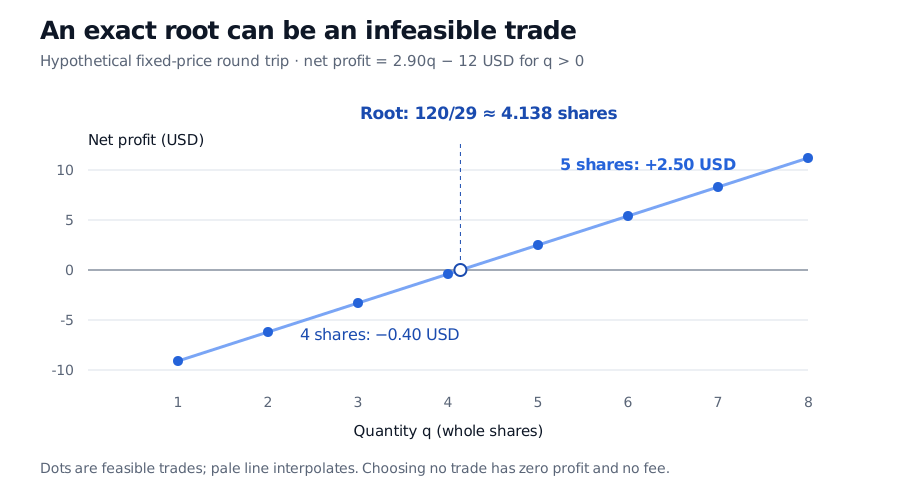
The equation has a valid real solution, but that may not be an available trade. If only whole shares are allowed, the decision is the inequalityΠ(q)≥0 over positive integers. Four shares lose USD 0.40; five earn USD 2.50. Thus five shares is the smallest trade with non-negative profit, not an exact zero-profit trade. Substitution into the original cash ledger confirms this: USD 265 of sale proceeds minus USD 250 of purchase cost minus USD 12.50 of fees leaves USD 2.50.
Hypothetical trade profit in USD versus whole shares. Four shares lose USD 0.40, five earn USD 2.50, and the interpolated line crosses zero at 120/29 shares, approximately 4.138.
Original fixed-price scenario. Dots show feasible whole-share trades; the line shows the continuous extension. Choosing no trade incurs no fee and has zero profit.
The paid-trade formula applies for q>0. Extending it mechanically to q=0 gives minus USD 12, which describes paying the fixed fee without trading. That is different from choosing not to trade. The domain comes from the economic arrangement as well as the formula.
Rearrange the relationship, keep the units
Write the same problem with entry price S0, exit price S1, variable cost c per share and fixed cost F:
Π(q)=(S1−S0−c)q−F.
Prices and c have units of USD per share. Multiplying their difference by shares produces USD; only then can the USD fixed fee be subtracted. Adding q directly to F, or treating the fee of USD 0.10 per share as a 10% fee, would describe a different and dimensionally inconsistent calculation.
Let m=S1−S0−c denote net gain per share before the fixed fee. With F>0 and m>0,
qbreak-even=mF.
The quotient has units of shares. If m=0, division is undefined and every paid trade loses F. If m<0, each extra share increases the loss, so there is no positive break-even quantity. A negative algebraic root is outside the stated trading domain. In actual execution, prices or costs may change with size; then the original linear relationship must be revised before using its threshold.
Which operations preserve the answers?
Adding or subtracting the same defined quantity on both sides preserves an equation's solution set. Multiplying or dividing both sides by the same nonzero quantity also preserves it. Unknown quantities need a case check: dividing x(x−2)=0 by x discards the valid solution x=0, leaving only x=2.
Other transformations may produce candidates that need checking. Squaring x=1 gives x2=1, whose extra solution x=−1 does not satisfy the original equation. For inequalities, multiplying or dividing by a negative number reverses the inequality sign. Always check the final values in the original relationship and its allowed domain.
These habits scale from one trade to linear algebra, where many positions and constraints are handled together. For a fuller foundation in percentages, equations and functions, see Arithmetic, Algebra, Equations and Functions (public preview; full lesson with membership).
James Stewart, Single Variable Calculus: Early Transcendentals, 6th ed. (Brooks/Cole, 2008), Appendix A, “Numbers, Inequalities, and Absolute Values,” pp. A2–A5: allowed denominators, real-number domains and inequality rules.