Solve a linear equation through a share-quantity break-even model, check units and admissible quantities, and distinguish unique, absent and unrestricted solutions.
Linear equation
A linear equation is an equality that can be written as a sum of constant coefficients times unknowns, plus a constant, equal to zero. After simplification, the unknowns appear only to the first power, without products between unknowns. In one unknown, its usual form is
aq+b=0.
Here q is the unknown; a and b are known coefficients. For a=0, subtracting b and dividing both sides by a gives the unique real solution q=−b/a. The coefficient must be nonzero before that division is valid.
Finding a break-even quantity
Suppose a hypothetical position earns a benefit of USD 3 per share, incurs a variable cost of USD 0.50 per share, and bears a USD 20 fixed cost. These amounts are model assumptions, not observed market prices. Let q count shares. The fixed cost is charged throughout this model, including at q=0; modelling the choice not to enter the trade would require a separate cost rule.
Net profit in USD is Π(q)=3q−(0.5q+20). Break-even requires
3q−(0.5q+20)2.5q−202.5qq=0,=0,=20,=8.
The coefficient 2.5 has units USD per share, whereas the constant −20 has units USD. Thus 20/2.5 has units shares. Substituting into the original equation checks both the arithmetic and the meaning: benefit is USD 24, variable cost is USD 4, and fixed cost is USD 20. Net profit is zero.
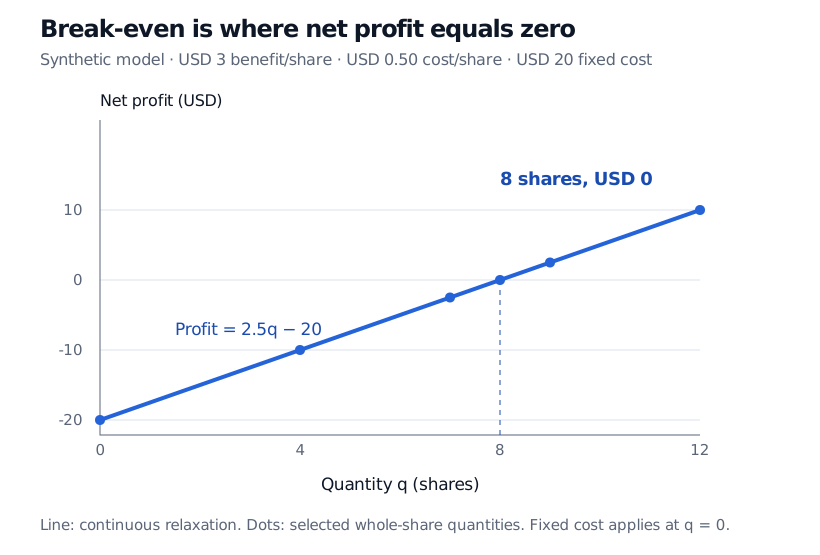
Synthetic net profit equals USD -20 at zero shares, USD -10 at four shares, USD 0 at eight shares and USD 10 at twelve shares. The straight line crosses zero at eight shares.
The line shows a continuous relaxation of the synthetic model; dots mark selected whole-share quantities. Each additional share adds USD 2.50 to net profit under the stated constant coefficients.
The economic constraint still matters. For non-negative whole shares, q belongs to {0,1,2,…}, and eight is an admissible exact break-even quantity. At seven shares profit is USD −2.50; at nine it is USD 2.50. If trades must instead be in lots of ten shares, the algebraic solution remains eight but no allowed quantity gives exactly zero profit. Increasing slippage or a size-dependent benefit can also make this constant-coefficient model inappropriate.
What happens when the coefficient vanishes?
For real q, the complete classification of aq+b=0 is:
Coefficients
Solution set
Reason
a=0
One solution, q=−b/a
Division by a is valid
a=0, b=0
Every real q
The equality reduces to 0=0
a=0, b=0
No solution
A nonzero constant cannot equal zero
The last two are degenerate cases of the form, rather than first-degree equations. With a restricted domain, intersect these solution sets with that domain. Economically, zero net benefit per share cannot offset a positive fixed cost, however many shares are traded.
More unknowns, the same requirement
A linear equation in several unknowns has the form
a1x1+⋯+anxn=c,
with fixed coefficients. For example, 2x+3y=5 is linear and describes a straight line of real solutions: both (1,1) and (4,−1) satisfy it. The equations x2+y=5 and xy=5 are nonlinear in the pair (x,y). Linearity is judged after simplification and with respect to the declared unknowns: px=5 is linear in x when p is known, but is not linear jointly in unknown p and x.
A constant term is allowed in a linear equation. By contrast, the function q↦aq+b is strictly a linear transformation only when b=0; otherwise it is affine. Requiring several linear equations to hold simultaneously leads to a system of linear equations.
For a longer introduction to rearranging equations, units and admissible trade sizes, see Arithmetic, Algebra, Equations and Functions (public preview; full lesson requires membership).