An inequality compares two quantities by order: less than (), greater than (), less than or equal to (), or greater than or equal to (). Solving an inequality means finding all allowed inputs that make the comparison true. In finance, this turns a statement such as “net profit must be positive” into a rule for admissible trade sizes.
The distinction at equality matters:
| Statement | Mathematical form | Is the boundary included? |
|---|---|---|
| Profit is positive | No: strict inequality | |
| Profit is nonnegative | Yes: weak inequality | |
| Weight is at most 60% | Yes | |
| Weight is below 60% | No |
For a real variable, describes the interval , whereas describes . A number-line drawing uses an open endpoint for the first and a filled endpoint for the second. Infinity is unboundedness, not an attainable endpoint. OpenStax explains these endpoint conventions.
From a fee to a trade-size rule
Suppose a hypothetical executed trade earns USD 1.50 per share before a USD 20 fixed fee. Assume that per-share margin stays constant with quantity; price uncertainty, market impact and other charges are omitted. Let count shares, restricted to positive integers for trades that incur the fee. Net profit in USD is
The units agree: USD per share times shares gives USD, from which we subtract a USD fee. For nonnegative profit,
The linear equation locates the boundary. The inequality selects a side of it. Intersecting that side with the allowed quantities gives . At 13 shares the result is −USD 0.50; at 14 it is +USD 1.00. There is no whole-share trade with exactly zero profit in this model.
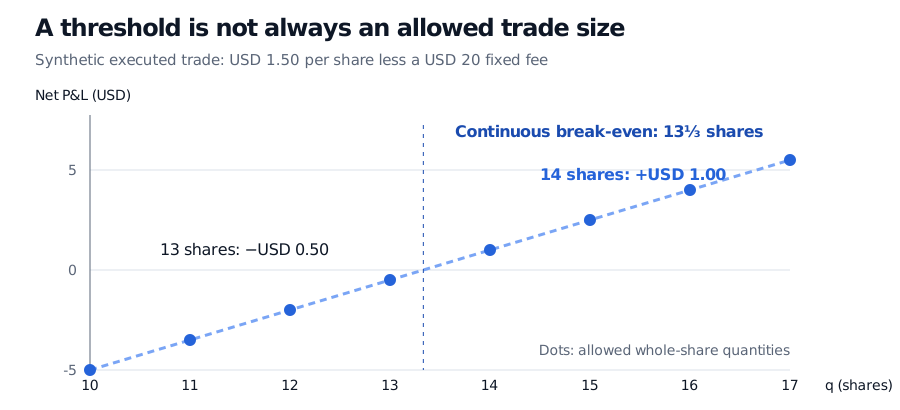
Original synthetic fee model. The dashed line locates the continuous boundary; dots mark whole-share trade sizes. The chart shows the region from 10 to 17 shares, not the full positive-integer domain.
Requiring strictly positive profit gives . It happens to produce the same first whole-share trade, 14, because the boundary is not an integer. Strict and weak inequalities remain different: starts at 11 whole shares, while starts at 10.
Choosing no trade has zero P&L. It is a separate choice outside this fee-bearing formula: substituting zero into that formula would charge a fee for a trade that was never executed. Thus 14 is the smallest profitable executed trade, while doing nothing is also available if the requirement merely permits zero P&L. The calculation identifies a threshold under assumed economics; it does not establish that taking the trade is desirable.
Rearrange without changing the answer
Adding or subtracting the same quantity on both sides preserves order. Multiplying or dividing by a positive number also preserves it. Multiplying or dividing by a negative number reverses it:
Geometrically, multiplication by a negative number reflects the number line. For example, becomes . Equality, if allowed, stays allowed when the direction reverses.
An unknown sign requires cases. For real and , solving gives
The last case follows from ; division by zero is unavailable. If the original variable has a restricted domain, keep that restriction in every case. Do not divide by a variable whose sign is unknown as though it were positive.
Inequalities often act as constraints. Their joint solutions form a feasible set: every condition, including integer quantities and units, must hold together. Finding that set is different from choosing its best member.
For further work with units, fee expressions and break-even equations, see Arithmetic, Algebra, Equations and Functions. Its public preview introduces the lesson; full access requires membership.
Sources
- James Stewart, Single Variable Calculus: Early Transcendentals, 6th edition (2008), Appendix A, “Numbers, Inequalities, and Absolute Values,” especially pp. A4–A5: order rules and solution sets.
- OpenStax, Elementary Algebra 2e, §2.7, “Solve Linear Inequalities”: endpoint conventions and order-preserving or order-reversing operations.